
What's New in Rust's "Giddy Up!" Update
June 2019 put players on horseback for the first time, complete with stamina, feeding and a 3 hour despawn timer. Alongside it came a rebuilt main menu, an in-game item store, the Unity 2019.1 upgrade and a serious nerf to oil rig loot farming.
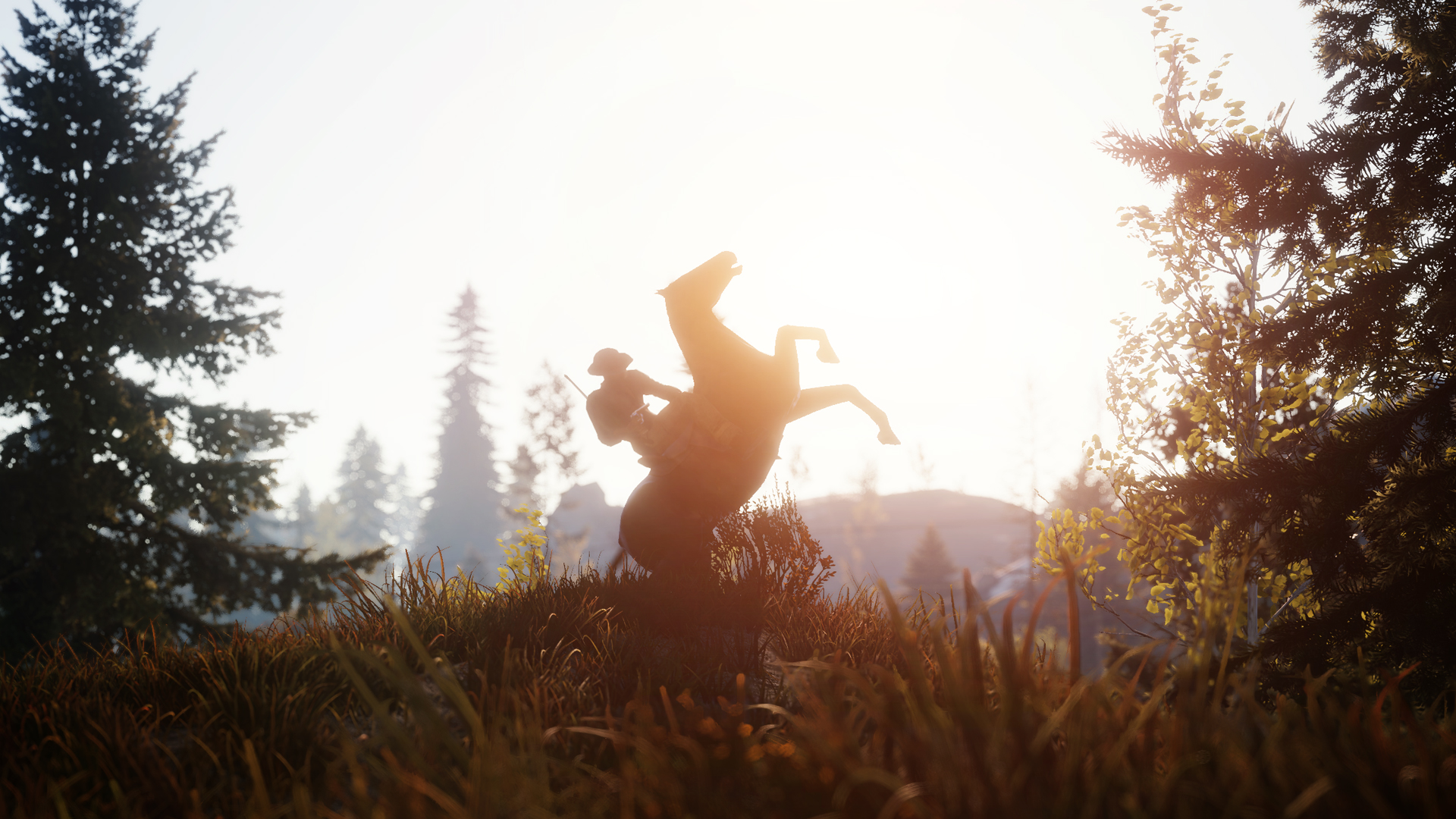
Giddy Up! arrived in June 2019 and gave Rust one of its most recognisable features: rideable horses. It was explicitly a first pass - no taming, no hitching, no armour - but alongside it came a complete main menu overhaul, the Unity 2019.1 upgrade, an oil rig loot nerf, and a long list of optimizations touching everything from weapon particle effects to the server browser.
Horseback riding
Horseback riding went in as version 1.0, and Helk was upfront that it worked in a fairly rudimentary way. Horses with saddles spawn in the world in place of the traditional horses. Walk up to one and press E to mount, steer with ASDW, Space to dismount, and Shift to sprint.
The interesting system is stamina. A yellow stamina bar appears above your health bar while mounted, showing how long the horse can sprint. Run it dry and you drop to a trot while it recovers - and stopping entirely speeds that recovery up considerably. A secondary bar shows the maximum stamina your horse can recover to, and that's raised by feeding it. Throw food on the ground or walk it up to fruits and vegetables and it'll eat, which also regenerates its health. If a horse is hurt, you can read its health by looking at the saddle.
A few practical rules worth knowing:
- Horses die very quickly if kept indoors
- They despawn after being unattended for 3 hours, similar to rowboats
- They use much less stamina and sprint faster on roads
- Stamina recovers faster when their food level is kept high
- Each 4k server should have roughly 40 horses
Hitching posts, so you could keep a horse permanently, were flagged as needed but held back until the performance implications of horses at scale were understood. Alex Rehberg got a specific credit for the sound work.
The new main menu
Garry set out to change a few things on the menu and ended up revamping all of it. New recruit Paddy produced a set of background videos chosen randomly at startup. The options screen was split into categories and better localized. And a new in-game item store appeared, listing items in your local currency and checking out through the Steam overlay.
The server browser got attention too, and for a properly technical reason. It had been built the easy way - fetch every server, build a panel for each, and scroll it - which had already forced a 256-server display cap. That meant creating and maintaining 256 objects to show about 15, all of them lingering in the background, which Unity handles poorly. The fix was a virtual scroller: only the visible items exist, and as items scroll out of view they're deactivated and stored for reuse. It's invisible to the player, it's what Windows list views have always done, and it removed the 255-server display limit as a bonus. The browser also gained wipe times and the ability to sort by them, plus an indicator for which servers your friends are on.
Unity 2019.1 and garbage collection
The update pulled the trigger on Unity 2019.1.4f1, which andre described as surprisingly one of the most stable releases in years. A windowed-mode problem was fixed by Unity in time, and a handful of smaller UI problems arose - which may well be what pushed Garry into rebuilding the main menu in the first place. The upgrade opened up a range of optimizations and visual improvements, most needing manual work and rolling out over subsequent updates.
One immediate arrival was the new incremental garbage collector, which in theory eliminates GC stutter entirely unless an emergency collection is triggered. In practice it mostly worked but would occasionally stall for no obvious reason. Because Rust has its own custom GC logic, the game wasn't entirely dependent on it - the honest summary was that things were better than before, but not solved.
Related: skin unloading had been disabled the previous month because it could corrupt skin materials under certain conditions. After several fixes and an optimization pass making the unloading GC-free, it was re-enabled by default for anyone with less than 10GB of RAM, with the intent to enable it for everyone once proven - necessary groundwork for many more months of skins.
Network and light optimizations
Servers were struggling with entities constantly sending network updates because they or their parent kept moving - especially when parented to a globally broadcasting entity like the cargo ship. Scientists, dropped items and corpses were fixed so they no longer broadcast globally even while on the cargo ship, which should ease the load on servers that used to buckle whenever it showed up.
Separately, Light LOD handling had inefficiencies in pooling and fading. That work is now amortized across multiple frames, so the number of lights no longer affects single-frame performance - it's fixed and predictable instead.
Weapon visuals and VFX
Petur described Rust's weapon visuals as "pretty much a mess" - texture sizes all over the place and materials that had degraded as the shaders evolved. Every single weapon was polished, which means better-looking guns and some saved memory.
The particle effects were in similar shape and almost always far too heavy, so nearly all of them were rebuilt from scratch, with a few exceptions like the rocket and grenade launcher still to come. The new effects are cheaper on both RAM and GPU. Attachment and shell ejection points were repositioned so they stop clipping through parts of the gun, and muzzle effects now visually match the actual barrel and any attachments fitted.
Oil rig nerfs and puzzle resets
Helk's assessment of the oil rig was that it dropped "way too much loot". Loot from both types of scientists was cut by a significant margin - with the acknowledgement that it was still too much, and this was step one.
The bigger nerf was structural. Monuments used to reset on a 30-60 minute timer that, if it detected players, would wait 30 seconds and check again. On the oil rig that was disastrous: a team could take up to 30 minutes to clear it and find it respawning as they boated away, letting them drop their loot and immediately run it again. Now the timer pauses when players are detected, meaning a monument genuinely needs 30 minutes with nobody present before it respawns.
Movement and the water
Anyone who's been stopped dead by a five-inch curb at Harbor or Launch Site got relief here: step detection was added to the movement code, automatically bumping players over small geometry rather than relying on Unity's physics. Small, but it makes moving around monuments noticeably smoother.
Diogo also previewed coastal waves, nearly finished but held back to the following week for stability. The change introduces waves that move in the direction of the terrain, gives artists finer control over open-sea wave shapes, and rebuilds wave crest foam from scratch. The design intent is that coastal waves can be treacherous, but surviving the shore earns you far more forgiving conditions out at sea.
The rest of the changelist
Beyond the headline items, the patch was heavy on smaller improvements - lowered research costs across the board, flashlights casting additional light in first person beyond just the cone, the water jug spawning with less water, faster UI loading, optimized fonts, chat UI, input button updates and occlusion texture memory, improved CJK font rendering, and new invisible_collider, prevent_movment_volume and gas station prefabs for mapmakers. On the fixes side: a projectile line-of-sight exploit abusing player bounds forgiveness, a server-side fall-through-floor exploit, scope and viewmodel jitter when riding vehicles or the cargo ship, players clipping through the oil rig dock, and terrain drawing white at distance on shader levels 101 to 199.
Fittingly, the month's item store leaned into the theme - the Cowboy Hat, Cowboy Shirt and Cowboy Pants all landed alongside the horses. If you want to see how the Giddy Up-era cosmetics have held their value since, they're tracked in our skin tracker.