
What's New in Rust's "Devblog 198" Update
Rust's first post-Early-Access patch brought the Chainsaw, the SPAS-12 shotgun, Dragon's Breath shells, a big scientist AI overhaul, upkeep grief protection, much cheaper repairs, and a first look at the CH47 Chinook.
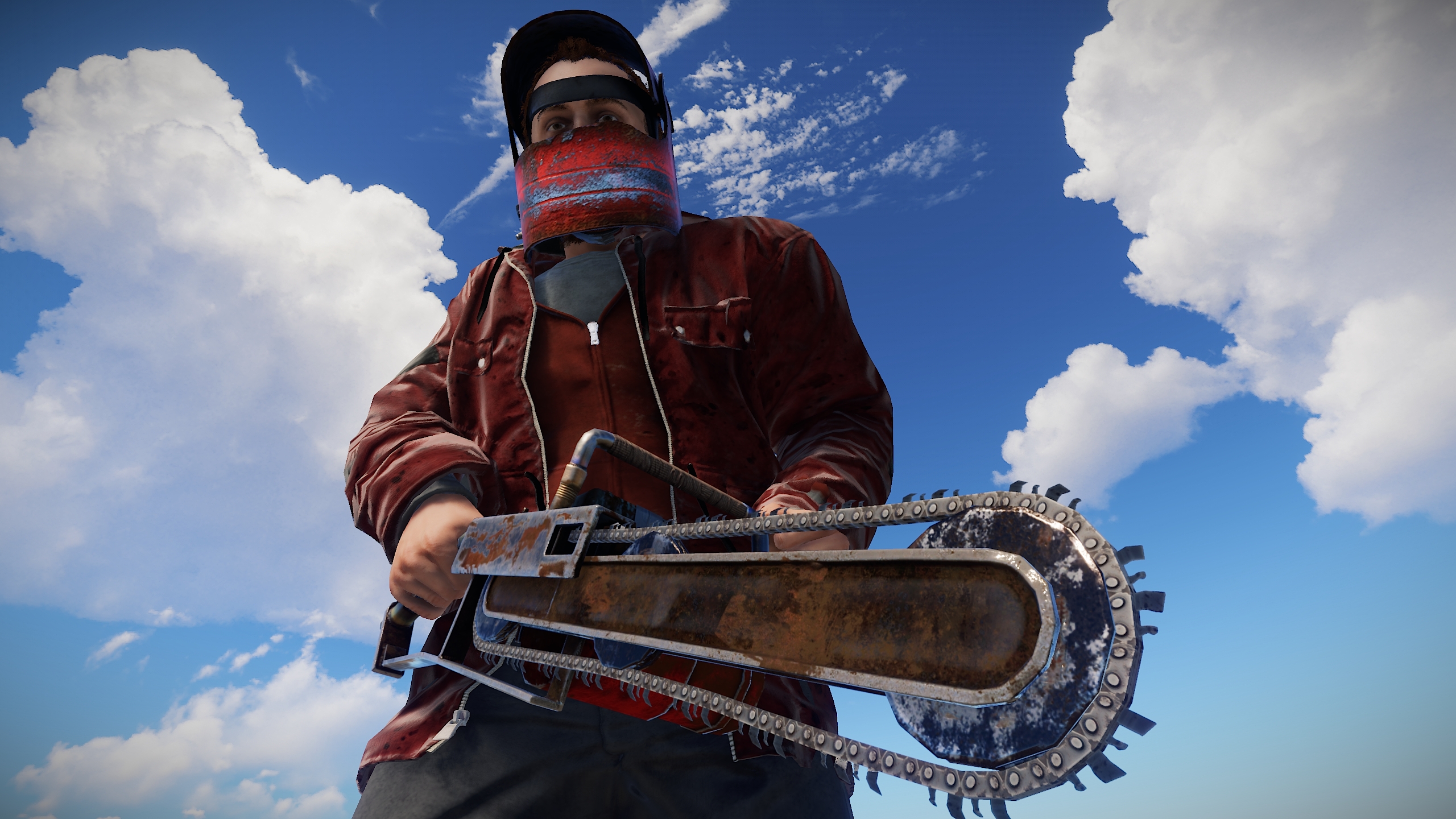
Devblog 198 arrived on March 1st, 2018, as Rust's first big patch after leaving Early Access - and it didn't ease off the gas. This one added the Chainsaw and the SPAS-12 shotgun, gave scientists a serious AI upgrade, made repairs dramatically cheaper, and previewed the CH47 Chinook helicopter that would soon start delivering loot to the island. The patch wiped maps, but blueprints carried over.
The Chainsaw
The Chainsaw, with art by Tom Butters, finally made it into the game. It runs on Low Grade Fuel and has to be started with right mouse - with only a 40% success rate per pull, so expect a few tries before it roars to life. It absolutely shreds trees and people, but that's about it: Helk deliberately chose not to make it a raiding tool yet, not wanting another item whose only purpose is to "screw over new players who can't afford a metal door yet (ahem, Flamethrower)." It's also loud enough to draw attention during use. You'll find it rarely in the red tool chests at vehicle-based junk piles.
SPAS-12 and Dragon's Breath
The SPAS-12 Shotgun joined the arsenal as an uncraftable, semi-automatic shotgun found in airdrops and Bradley/heli crates. It fires almost as fast as you can pull the trigger, lets you aim down sights while doing so, and carries a 50% DPS bonus over the Pump Shotgun - it's also the close-quarters weapon of choice for scientists. Alongside it came Incendiary Shotgun Shells, aka Dragon's Breath: larger projectiles that are easier to land, producing a magnesium flame on contact that slows movement and deals damage over time. Great for area denial, and found in airdrops and military crates.
CH47 Chinook Preview
Helk put serious work into the CH47, targeting release in the next patch. He built a base helicopter class extending the base vehicle class and made it physically based - meaning proper physics, and pilotable by humans on modded servers. The AI flies it by translating its intentions into simulated button presses, as if it were a player, which is more complicated but pays off: a crew of scientists can be mounted to the vehicle like players, promising interesting radtown encounters once it starts delivering supplies. The patrol helicopter is slated to move to the same system eventually for better movement. Pilgrim also showed off the Chinook Locked Crate art the heli will drop, coming in padlocked and code-locked versions.
Smarter, Deadlier Scientists
Scientists invaded the Military Tunnels this patch and got a month's worth of AI work:
- They no longer walk through fences, are better at switching weapons and reloading at sensible times, and can no longer wander out of the Military Tunnels to roam the island indefinitely.
- Better cover selection, and they no longer gun each other down - they'll step aside for a clear shot.
- A new alertness system gives players a chance to go undetected: light sources, movement speed, standing versus crouching, distance and noise all affect whether they notice you.
- They relax their pose while walking instead of constantly aiming, and patrols now spread out instead of clustering into zergs.
- Scientists also spawn at some vehicle junkpiles - less aggressive than their tunnel colleagues, researching junk with the new Geiger Counter by day and carrying a flashlight at night, plus an M92 in case you get too close. Their spawn chance defaults to 0, adjustable by server admins via
npcplayerapex.npc_junkpile_a_spawn_chanceandnpcplayerapex.npc_junkpile_g_spawn_chance(0 to 1).
Killing them is finally worth it, too: scientists got proper loot tables with med syringes, scrap, and rarely even full weapons instead of random barrel junk, and per the changelist they also have slightly more health.
Repair and Balance Changes
Item repair got a major cost pass. The Repair Bench no longer has any wood cost, and repairing an item now costs 20% of its crafting cost instead of 50% - too many people were simply discarding items and crafting new ones. The changelist extended repairability broadly: mailboxes, all signs, banners and frames, and beds can now be repaired, and beds can be picked up with a hammer and building privilege. The Nailgun also got a slight fire rate increase - it's meant to suck somewhat as a no-blueprint PvP option, but the laggy-feeling firing cadence was frustrating, so it's now a little easier to use without upsetting the balance.
Upkeep Grief Protection
A major quality-of-life fix for the upkeep era: logging in to find your entire base decayed because someone destroyed your tool cupboard. Now, when a cupboard with resources in it is destroyed, those resources are used to purchase up to 24 hours of decay protection for all connected building blocks. It requires resources in the cupboard (so put a code lock on it), destroying it multiple times won't extend the timer past 24 hours, and blocks added after the destruction decay normally. As Andre put it, this brings griefing "back to the old levels we know and love."
Graphics: Reflections, Lighting and Trees
The visual overhaul from the Early Access launch continued at pace. Andre added a new World Reflections slider to the graphics options to fix Rust's long-standing inaccurate interior lighting: quality 0 removes directional sky scattering from object reflections (better looking and faster than the old pass), quality 1 adds terrain to the reflection pass and is the new default, and quality 2 includes low-poly proxy meshes of buildings so interiors no longer glow blue. Diogo, meanwhile, introduced an analytical approximation for global water reflections - atmospheric scattering, sun and moon - as a temporary (and admittedly heavier) solution while the team builds its own custom environment reflection probe renderer, which in early tests ran more than twice as fast as Unity's at 512 resolution with better accuracy. He also fixed a batch of foliage shader issues, including translucency tinting and dull grass shading, and globally enabled vegetation specularity and reflections.
On the world side, tree view distance improved thanks to the new imposter system: with Tree Quality above 50, trees now render across the entire map, while imposter switch distances were tuned so the lowest settings run better on weak hardware. Damian added two new player-height bushes native to North American climates - the Glaucous Willow and Spicebush, both usable as concealment - and previewed large oak trees due to spawn sparsely in fields and tundra the following month. Vincent replaced the constant-radius monument blending with custom terrain blend maps for more natural transitions, and the engine itself moved up to Unity 2017.1.3.
Skins, Signs and Under-the-Hood Fixes
A nasty workshop skin bug that stalled skin downloads via corrupt skin IDs was fixed on three fronts: the corruption itself was patched, the loader now skips skins Steam fails to start downloading, and any skin that doesn't download within 60 seconds times out and gets skipped. Paintable signs no longer randomly wipe their artwork on server restart, and the sign texture file cache now writes to disk asynchronously, fixing stutter on non-SSD systems. Andre also rewrote conditional model evaluation ("Conditional Models 2.5") so the server sends model states to the client as a compact bitmask - building blocks render faster and the door is open for more complex conditional pieces like wall corners.
Odds and Ends
Behind the scenes, matt.i's rebuilt hair-cap system neared completion (with stubble and shaved heads on the way), and Alex R finished the individual-sound pass of his mix/master project, moving on to higher-level balancing and smarter voice limiting for groups of sounds. The changelist rounded things out with the Xmas tree becoming uncraftable, the water purifier losing its ability to sit on barbecues and fireplaces, a foundation rotation exploit fix, searchlights no longer accessible without TC access, a weird sprint+aim exploit fix, star positions corrected relative to the sun and moon, and a couple of Hapis Island tweaks including making the southern convoy slightly harder to wall off.
All told, Devblog 198 was a confident follow-up to the Early Access exit - new toys, smarter NPCs, and fixes to the systems (upkeep, skins, signs) that players had been grumbling about for months. If the skin-loading fixes have you thinking about your own collection, you can browse current prices on our skin tracker.