
What's New in Rust's "Excavator Update" Update
August 2019 finally put the Giant Excavator into the game as a working, fuel-hungry monument rather than a static prop. Alongside it came terrain anti-hack detection, better small-map and Barren options for low-end machines, and a round of server and shader optimizations.
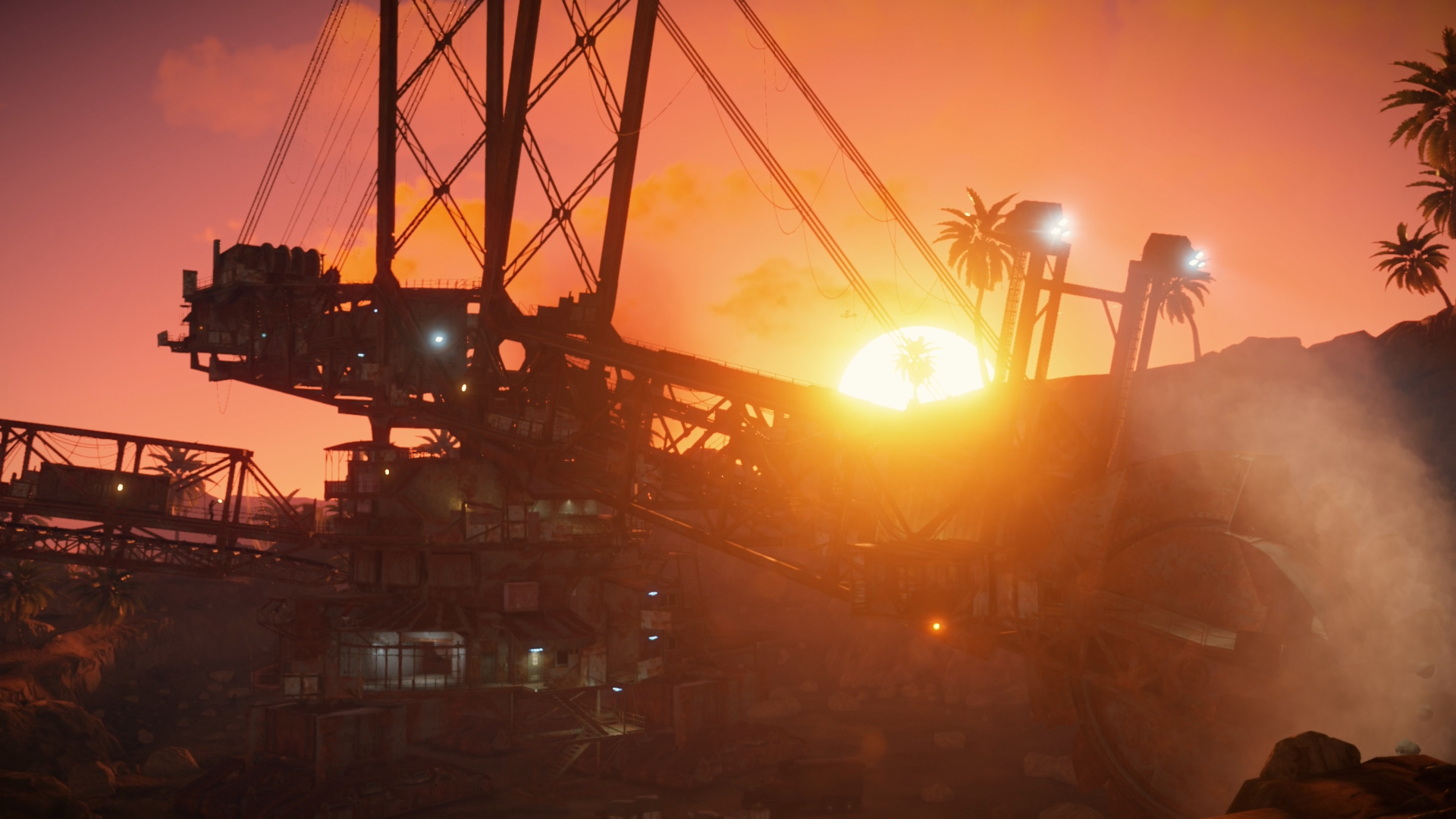
The Excavator Update landed in August 2019 and it's the patch that turned the Giant Excavator from scenery into a monument you can actually operate. The headline is a fully functioning mining machine that burns diesel and needs a crew to run safely, but the rest of the month was quietly aimed at players on weaker hardware - smaller procedural maps got cleaned up, Barren got more to do, and both the water system and the terrain shader got meaningful optimization passes.
The Excavator monument
The Excavator is complete and in-game, and it isn't a prop - it's a working mining excavator powered by Diesel. You can find the fuel at the Junkyard, at the Oil Rigs and at the top of the Dome. If you'd rather not go monument hunting, you can exchange low grade fuel for diesel, but it isn't cheap.
Actually using it is a multi-step job. First you clear out the scientists guarding the monument, then you make your way to the engine room and add fuel. From there you power up the engine, walk the catwalk to the control room, and select which resource type you want to mine. The mined resources get deposited in equal amounts at two separate drop points, which is the whole design tension: you need at least four people to run the excavator without leaving either the fuel or one of the outputs unguarded.
One detail worth burning into your memory before you fire it up - RF frequency 4777 is broadcast for as long as the engine is running. Anyone listening on that frequency knows the excavator is live, so counter-raids on an unattended crew are very much part of the design.
Maps and performance for lower-end machines
A chunk of the month went to making Rust more playable on modest hardware. The largest monuments were removed from procedural maps smaller than 3500 world size, which gives players on those maps more room to roam and build rather than having a handful of sprawling monuments eat the whole island. Barren maps, previously fairly empty, now spawn oil rigs, harbors and water wells for more variety and better loot options, and Barren's prefab mountains no longer spawn in the desert.
There's also a new warning message when you connect to a server running a large map on a computer that doesn't meet the minimum RAM requirement of 10GB. The intent is to steer affected players toward the smaller, higher-performance map options before they spend an hour fighting a slideshow. Related to that, a bug that could reject gun reloads when FPS dropped extremely low was fixed, which should help anyone playing below minimum spec.
Terrain anti-hack protection
A new anti-hack feature detects and kills any player who manages to get inside the terrain. The team flagged at release that there were a lot of edge cases still to test, particularly on custom maps, and asked for reports of false positives. Related, the monuments console command was being abused to locate caves, and that was closed off in the same patch.
IL2CPP testing begins
Facepunch started internal testing of Unity's IL2CPP compiler backend for the game client this month, aiming at both performance and anti-cheat security. A public test branch was planned for either that month or the next depending on how testing went, to be announced on their Twitter.
UI fixes
A batch of long-standing UI annoyances went out earlier in the month:
- Team member map font was extremely small and unreadable - fixed.
- Scope overlay being extremely small on larger screen resolutions - fixed.
- Misclicking accept would reject a team invite - fixed.
- Accidentally pressing "Create Team" while dropping items on low resolutions - fixed.
- Text overflow on the team dock when players have long names - fixed.
- The cargo ship map marker is now true size.
Server and rendering optimization
The water system got the biggest win. It handles queries for water height at any location on the map - buoyancy for boats, backpacks, bottles, anything that floats - and potentially hundreds of those queries can fire in a single server frame. It was accounting for roughly 10% of server frame time. The optimization made it 10-12x faster, dramatically reducing that footprint.
The terrain shader, one of the game's most complex, also got a pass. It now does a much better job of filtering out unnecessary work. The improvement is 5-10% at mid quality levels and higher at high quality levels, especially combined with anisotropic filtering and/or parallax. The gains apply at any quality level other than Potato.
Finally, demo mode record and playback had an issue where some networkable objects were duplicated - doors could appear open and closed at the same time. That's fixed.
The rest of the changelist
Beyond the headline items, the patch notes cover the usual spread of smaller fixes: deployables can now be placed under the Water Barrel, the cost of low grade at Compound went up, the server browser timeout limit was raised to 90 seconds, Hapis Island got fixes and tweaks, and player packet verification was optimized server-side. On the bug side there were fixes for RF Broadcasters being placed through walls, getting stuck when dismounting a helicopter on top of Compound buildings, large furnace placement under the terrain, passengers accessing minicopter fuel, and horses eating too much food at hitching posts.
Store skins
The month's store lineup leaned hard into the monument theme, with the Operator Helmet and matching Operator Hoodie, the Heavy Machinery Roadsign Vest, and the Diesel SAR all arriving alongside the excavator itself. If you want to see where those have ended up on the market since, they're all tracked in our skin tracker.