
What's New in Rust's "Devblog 63" Update
June 2015's Devblog 63 was a two-week patch. Spears became throwable, arrows stuck in things, walls gained an inside and an outside with different damage values, PVE server mode returned from Legacy, and the eighth procedural map iteration went live.
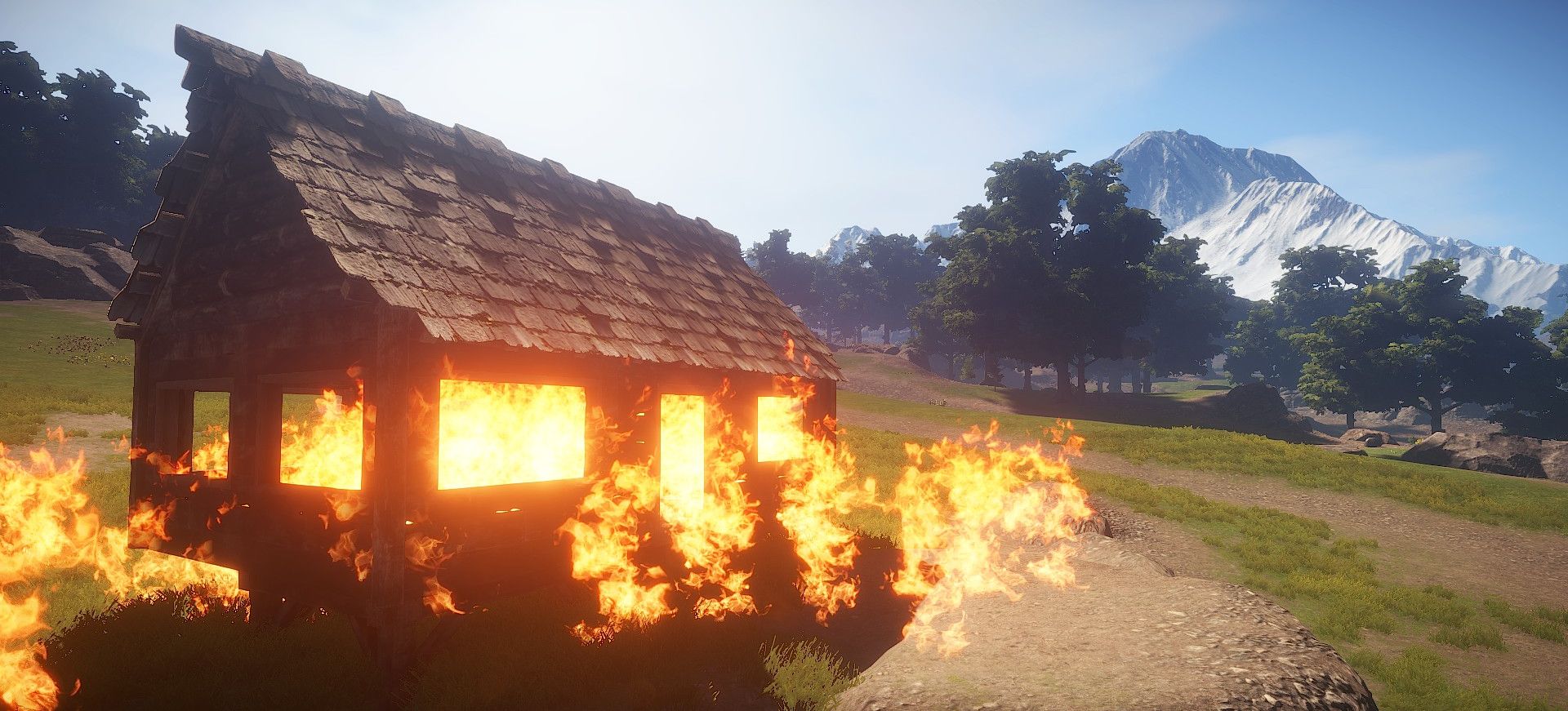
Devblog 63 shipped in early June 2015 carrying two weeks of work, since the previous week's patch had been held back. It's a meaty one: the full set of new ammo types went live, spears became throwable, building parts gained a distinction between inside and outside faces, PVE server mode returned from Legacy, and the eighth iteration of procedural map generation landed with a mandatory wipe.
Performance first
Garry led with framerates, and the numbers are worth noting: he was seeing a consistent 80-100fps, against 30-60 a month earlier. For anyone still struggling, the advice was to hit F2 and turn down anisotropic filtering and parallax mapping, which give the biggest difference. Servers needed wiping for the update, though players kept their blueprints.
Arrows, spears and grass
Arrows now stick into things — walls, floors, people, animals. They still have a chance of breaking on impact, in which case they simply vanish, because there's no gib model for them yet.
Spears became throwable, and stick into things the same way, with Facepunch noting they'd probably make more items throwable later.
Grass displacement returned from Legacy: grass now flattens where players and animals walk. The main purpose was helping you find things lost in grass — though dropped items don't displace grass themselves yet, so for now the technique is walking in circles flattening grass until the item turns up.
Ground pickups
There's now loose material lying around the world you can pick up: mushrooms, rocks, ore and wood. Garry was explicit that this is groundwork — more item types were planned, and the whole system feeds into the eventual farming mechanics.
Building shell
The most consequential change. Building parts now have a notion of inside and outside, and attacking the outside does substantially less damage than attacking the inside. Specifically: the external side of walls, the external side of doors, the sides of foundations, and the top of floors and roofs are all stronger.
Facepunch acknowledged the balance would need work and pre-empted the inevitable argument — expecting an equal volume of Reddit threads claiming bases are too secure, too weak, and exactly right. Their framing was worth keeping: it isn't always a case of making one thing stronger and another weaker, and it's often more interesting to add new items that solve the problem instead.
PVE mode
Legacy's PVE mode came back via server.pve. On a PVE server, players can't damage each other — damage you deal to a player is reflected back at you — and buildings can't be damaged when inside an active cupboard you aren't authorised on.
The motivation was partly about the studio's own focus: PVE forces them to cater to the survival side of the game without the noise and confusion of PVP. Facepunch were candid that there would be edge cases letting people hurt players or their buildings, and that it would be a trolling paradise for a while, to be fixed as issues surfaced.
Community entity
Garry worked with server modders on a long-standing limitation: they can do a great deal server-side but almost nothing client-side, so everything ends up driven through chat commands with no UI at all.
The answer is a dedicated entity that server modders can use, open source on GitHub and accepting pull requests. Any kind of functionality can be added to it and fired at via RPCs from the server; initially it could only create UI, and even that was limited. It isn't Garry's Mod-style modding yet, but for end users it means servers can finally display UI elements on your HUD.
Ragdolls and health bars
Ragdoll positions moved server-side. Previously ragdolls were entirely client-side, so one rolling down a hill was something you couldn't interact with. Now the position is authoritative on the server while the ragdoll itself isn't simulated there, which makes them look a bit odd — Battlefield-esque was the comparison. The upside is that ragdolls can now be dragged around on the server, opening up possibilities later.
Health bars got fixed. The barricade health bar that was wrong in every conceivable way is now correct, and cupboards, campfires, furnaces and storage boxes all have working health bars too.
- Fixed having to hold USE to pick up instead of tapping
- Fixed not being able to pick up some items at odd distances
- Fixed the bone knife animation
- Crosshair tips and health are less invisible in bright light
- Added
inventory.givebpallandserver.pve
The full ammo lineup
Maurino finished the new ammo types:
- Explosive rounds — easier to hit targets, splash damage bonus
- Incendiary rounds — bypasses some armour types, can start fires
- Incendiary rocket — area denial, can burn down wooden building parts
- 12 gauge slug — easier to hit targets, more accurate, less damage
- High velocity arrow — less damage, more accurate, faster
The fire system behind the incendiary weapons lets individual fires spawn child fires, which can spawn their own, with a diminishing chance each generation. It's a basic approach but effective. Once a system exists for extinguishing flames, the plan was to let objects catch fire and spread by proximity. Mining came close but was missing a few critical features, pushed to the following week.
Procgen8
André — writing briefly, having had his wisdom teeth removed the day before — listed what the eighth major procedural map iteration brings:
- New roads and new rivers
- An airport radtown
- New and improved powerlines
- Better prefab mountain and monument terrain blending
- Better terrain height map generation with pseudo-erosion and noise distortion
- Barrels only spawn next to roads and monuments
- Various atmospheric and biome visual improvements
Lighting overhaul and Hapis
Petur redid the entire lighting setup. Exteriors are now properly bright and your character dynamically adapts to it, which means night-time brightness and overall feel changed considerably — and at least for the moment, it's pretty dark. Terrain tones changed significantly too, and yellow grass returned in certain biomes.
Hapis Island was updated but explicitly not wiped until the next monthly wipe. It gained more roads and some empty road tunnels, which Petur described as placeholders for something far more interesting — he was thinking side corridors, stairways and lots of tight, dark interior space. Player spawn points were also ironed out, so you should no longer have to walk a mile to find a ramp off the beach.
Art and animation
Gooseman extended the improved turning-while-running animations from bears to all the remaining animals, added view models and world models for the flashlight and flare, started a generator model, and fixed the horse ragdoll skin not matching its living counterpart. Next on his list, delightfully, was player animations for being on fire.
Xavier continued the wolf headdress, with more substantial clothing items next including hand-crafted pieces from Megan's earlier concepts. Tom finished the high-poly model and sculpting pass on the new pistol, moving on to the low-poly version, texturing and LODs. Vince finished the first set of electric lights — a searchlight and a ceiling light — and moved onto the oil derrick model.
Megan developed the tier 2 furnace further, exploring it not just as a larger smelter but as a communal structure with room for at least four people. She did the high velocity arrow concept and icon simultaneously, since it's simple but awkward to make a stand-out icon from what is essentially a stick, and added colour to the rifle and pistol ammo icons to distinguish the fire, explosive and HV variants.
Paul finished a set of melee weapon ideas for close-quarters variety, and was moving onto clothing and armour exploration with the explicit aim of letting players distinguish themselves and build group identity. Howie started thinking about new Steam trading cards reflecting the current era of Rust, since Megan's existing set dated from the Legacy launch.
Rendering fixes
Diogo noted that as performance improved, more players were attempting 4K — and hitting a crash caused by a bug in the PVT code, since fixed and already on dev. He added a modified particle shader with extra emission parameters so flames can mix nicely with smoke particles, fixed missing shadows on some objects, and spent the rest of his time on Water2 parity across GL, DX9 and DX11, plus a mesh rewrite with complementary disappearing specular highlights and multiple lake support.
Procedural ambience
Alex built a Max/MSP patcher for generating wind and ambience, letting him author varied ambiences per biome and terrain type at a high level — turn up the intensity slider for stronger, more blustery wind, turn up the howl slider for the chilling sound you hear in the Arctic biome.
The final sound layers several parts. A base noise layer sits fairly static in the background unless intensity is cranked. Two gust generators work similarly but swing much further in volume and pitch and pan around randomly. Then four granular sample playback layers hold recordings for detail — birds chirping, leaves rustling — which play random slices of the audio files rather than playing straight through, so the result differs every time. The base and gust volumes automatically drive the detail layer volume, so leaf rustles get louder as the wind picks up.
More ambient stings were planned — owl hoots, coyote cries, gull squawks — to differentiate environments further, alongside finishing bullet fly-bys and improving neglected one-off sounds like door knocking and fire damage.
Facepunch also launched a mailing list for devblog notifications. Garry's plan for the following week was implementing the backlog that had built up, plus some experiments.