
What's New in Rust's "Devblog 64" Update
June 2015's Devblog 64 brought water catchers, hats that actually burn fuel, and a big under-the-hood win on building performance. The mining quarry was finished but held back for testing, and Water2 finally landed on the development branch.
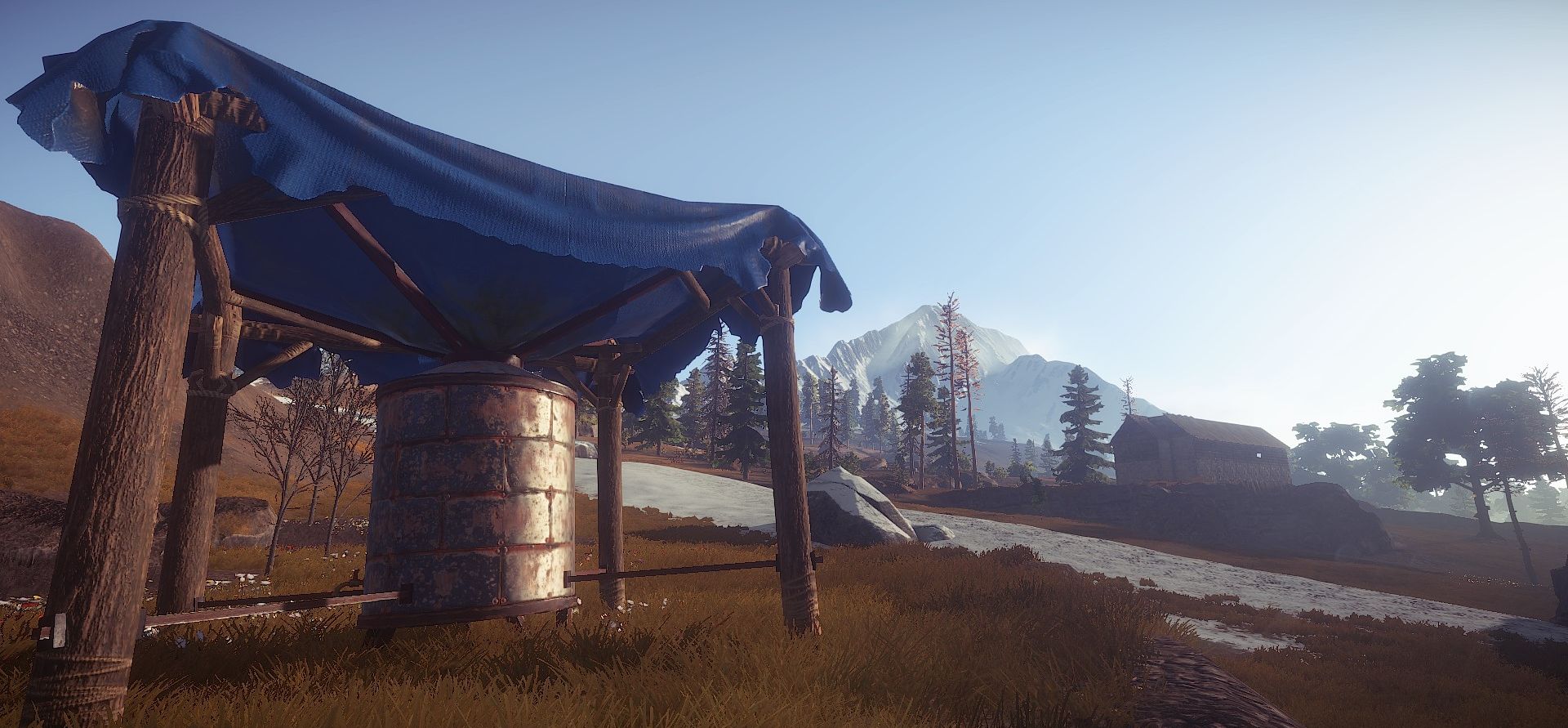
Devblog 64 went out in June 2015, and it's a good example of what a mid-2015 Rust week looked like: one clean new deployable, a handful of quality-of-life fixes, and a lot of foundational work that wouldn't pay off for weeks. Water catchers were the visible addition. The mining quarry was finished but deliberately held back for testing, and the rendering and water tech that shipped quietly underneath ended up mattering more in the long run.
Water Catchers
Water catchers were exactly what the name suggests - you place them outside and they slowly fill with water over time. You can then transfer the water into a vessel (only the water bottle at this point) or drink straight from the tap. They came in two sizes, the mini and the max.
Facepunch got ahead of the obvious complaint in the post itself: there was no rain in the game yet, this update didn't add any, and the catchers didn't behave differently in different biomes. All of that was planned, they just hadn't done it. "Don't worry, we're not idiots" was the exact phrasing.
Interface Cleanup
The catchers brought "items inside items" with them, and the UI had to grow to match. The selected item box was updated to accommodate that. Item actions became scrollable, on the assumption that some future item would have a ridiculous number of them. The splitting window got cleaned up and gained a bit of inline help, on the grounds that it was unintuitive and nobody had ever been observed using it correctly.
The context menu also started ordering itself properly - it had previously been ordered randomly, which is one of those bugs that's mildly maddening every single time you hit it.
Hats That Burn Fuel
The Miner Hat and Candle Hat got a small but meaningful rework. Previously they broke when they ran out of fuel, despite not actually consuming any fuel in the first place. Now both consume low grade fuel and simply run out when it's expired rather than being destroyed. You refill them by dragging and dropping fuel onto the hat's icon in the inventory menu.
Weapons and Ammo Balance
Maurino rebalanced the ammo types so that alternate ammo types are always better than using standard ammo - previously there were cases where the specialist rounds weren't worth crafting. The shotgun slug got the single biggest number change of the week, dealing twice as much damage as it used to.
On the art side Tom finished the new semi-automatic pistol, both the model and its Unity implementation, with Gooseman lined up to do the animations for it and the bone club the following week.
The Mining Quarry, Almost
Maurino finished the mining quarry implementation this week, but it stayed out of the build. It was untested, he was going on vacation the following week, and shipping an untested deployable before disappearing for seven days is a good way to leave the game broken. The plan was to run it on the dev branch overnight and patch it in the next day if it held up - which is exactly what happened in Devblog 64.1.
The pumpjack, the second mineral extractor, was slated for the week after the vacation. Vince had already finished the oil jack pump model and its animations, and moved straight onto a new windmill.
Building Performance
Andre spent the week on the performance cost of buildings, which had a specific and ugly cause: every individual building part was doing between one and six draw calls, and buildings render at a relatively far view distance. Multiply that across a large base and it hurts badly.
The fix was to combine building parts that are close to each other into a single mesh as soon as the lowest level of detail kicks in, using the LOD work Vince had prepared the previous week. Initial tests in the building test scene showed an improvement of 2.5-3.0ms, taking Andre's machine from 85 FPS to 115. Results would vary by setup, but the direction was clear.
The system was written to be reusable, with the intention of applying the same batching to other objects later - spammy deployables like barricades were named as an obvious target. Andre also flagged that the second half of the month usually meant assembling the changes for the next wiping update and another iteration of procedural world generation.
Water2
Diogo merged Water2 into the development branch. There were no dynamic reflections yet, which is why the water looked somewhat like a waving blanket, with the old reflections being brought back as a stopgap and proper ones due in a couple of weeks. The native water simulation went in too, ending up roughly 8x faster than what it replaced.
Shoreline wetness was improved and made available to any object using the standard shaders, so wet rocks would start appearing as soon as artists enabled the shore wetness flag on objects touching water. Water2 also supports multiple water instances that can be rotated, which is what makes lakes, swamps and puddles practical. Hapis Island's lake didn't make the cut before the update but was promised on the dev branch the next day.
Next on the water list: more quality and LOD options, precision fixes, removing underwater shine near the waterline, foam, removing SSAO on top of water, and a start on rivers.
Animation, Armour and Audio
Gooseman finished the on-fire player animation and started on the cold one. Xavier began a run of armour sets built around shared materials so they'd fit together without weirdness - mostly jackets and pants with the odd helmet, starting from an old Paul concept that uses road signs as armour plates.
Paul, meanwhile, was exploring wooden armour with direction from Helk: it should slow the player down and absorb somewhere in the region of 50-100hp, roughly two hits, before breaking apart and falling off. The existing painting system could be used to let players custom paint it.
Megan wrapped up a batch of concepts for knuckle dusters and hand protection, tied to punching animations planned for the future - the idea being that bare-knuckle fighting should injure you a little, so you'd want padding, and metal if you wanted the punches to really land. She also produced a pile of icons: a new low grade fuel icon, a new jerry can for mid-grade fuel, both water catchers, and the quarry, described as the fiddliest one so far.
Howie showed more engine work, sketching steam-powered variants that take wood or coal instead of gas, and started thinking seriously about base defence - specifically automated turrets so players have some way to protect a base while offline, possibly built around the existing guns.
Alex Rehberg added more ambient stings and raised their frequency, working toward a soundscape where most ambience comes from one-off stings rather than a static background loop. That structure would eventually allow reactive touches like cutting bird chirps for a moment after a nearby gunshot. He also did a first pass on bullet fly-bys, which makes being shot at noticeably tenser, plus cleanup passes on bandage, door and cargo plane sounds.
Odds and Ends
- Load time improvements.
- Laggy firefight improvements.
- Arrows and spears are easier to pick up.
- Arrows and spears no longer block gunfire and melee attacks.
fps.limitis now saved properly.- The client handles "server is full" properly.
- Fixed the deploy guide not rendering some parts of the mesh.
The stated target for the following week was farming - and the quarry, as it turned out, arrived the very next day.