
What's New in Rust's "Devblog 57" Update
April 2015's Devblog 57 gave Rust the rocket launcher and replaced text signs with a full painting system - the latter arriving as a side effect of chasing down a Unity memory leak in the old sign renderer.
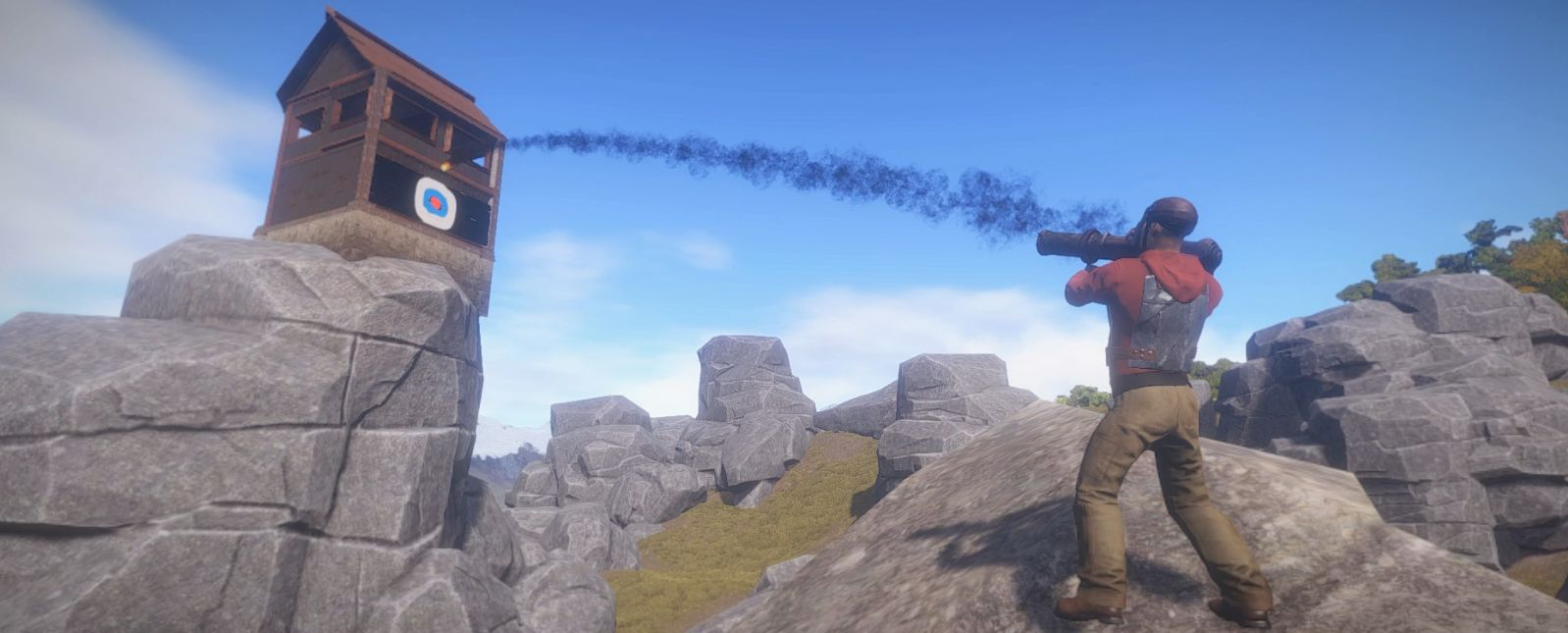
Devblog 57 arrived in late April 2015 with two features that shaped Rust's culture for years: the rocket launcher, which finally gave raiders a long-range answer to rock bases, and paintable signs, which replaced typed text with a drawing tool. The painting system is the more interesting story, because it only got built when a memory leak forced Facepunch to tear the old sign renderer out anyway.
Rocket launcher
The rocket launcher went in as a long-range ordnance delivery system with a heavy caveat attached: each shot is very expensive, and it's very hard to use. Minh handled the animations while Maurino wrote the code and particle effects overnight. Gooseman's contribution covered the view model animations and sound effects, all the third-person animations, plus the world model and LODs.
The memory leak that produced sign painting
A memory leak turned up the previous week, traced to a bug in Unity's UI.Canvas system: a canvas rendered exclusively by a camera leaks memory every frame once that camera is disabled. Facepunch made a reproduction case, reported it, and Unity confirmed and started fixing it — with no timescale given.
Rust was doing exactly that in the sign system. Signs worked by rendering entered text to a texture via a manually-driven camera, then drawing that texture above the sign. Between the leak and Unity erroring out when it ran out of UV space handling all the different font sizes and unicode characters, the whole approach was untenable.
Sign painting had been on the wishlist for a long time but never justified the time — until it also fixed a memory leak, at which point it paid for itself. It works exactly how you'd expect in game. Facepunch chose a limited palette over RGB sliders, and flagged that players should enjoy it while it lasts, since the eventual plan is to have you paint using materials from your inventory: charcoal, blood, mud, inks and dyes. Garry noted he took extra care implementing the system because he expected to reuse it in plenty of other places.
Decay, barricades and combat tweaks
Decay got its first refinement: it's now scaled by how landlocked a building block is, so interior blocks decay differently from exposed ones. Barricades became more susceptible to explosive damage, and can now be destroyed by melee — though they reflect damage back at you when you try.
- Bandages and syringes automatically revive players
- Waterpipe shotgun takes handmade shells for now
- Typing in chat while chat is off no longer locks up your movement
- Fixed an exploit where tapping crouch repeatedly while running suppressed footstep sounds
Building fixes and admin tools
- Fixed building blocks sometimes not snapping together
- Fixed it being difficult to add a floor to the top of a wall
- Fixed building placement effects not showing
- Window bars collider is now accurate
- Fixed sign skybridges and fixed solid bushes
- Fixed some blueprints being usable in the belt bar
- Fixed failing to connect properly when a server is full
- Improved performance when shooting; ragdolls now react to bullets and hits
- Devs and admins can hold F6 to see colliders and press F5 for info on whatever they're looking at
- Added
giveallandgivetoadmin commands
Stairs, and why ladders are coming
Vince worked on new stair blocks — L-shaped and U-shaped. Unlike Legacy, they won't be stackable, at least for now, because stacking complicated things considerably. The realisation behind that decision is a good one: people trying to build stairs that climb steeply in a small footprint were really just compensating for the absence of ladders, so the sensible fix is to add ladders rather than force stairs to do a job they're bad at.
Railings art was finished and awaiting implementation. You'll be able to place left and right side railings wherever you want them, and they aren't purely cosmetic — the more you upgrade a railing, the more cover it provides. Vince also resumed work on the new keypad.
Concept and art work
Paul sketched a craftable landmine, aiming for a junky-but-functional look that still gives keen-eyed players some visible indicator of where the mine breaks the ground. He did more RPG ammo type concepts, making sure each rocket type reads distinctly so players can tell them apart at a glance, and started on the research table — a tricky brief, since it needs to be instantly recognisable as research equipment while staying plausible for a post-apocalyptic scavenger.
Tom began building Paul's SMG concept, with iron sights, barrel and LODs still to do. Megan completed the brief for the first crossbow and made icons for the rocket launcher and its ammo. Xavier continued the second cloth head-wrap model and textures alongside fixing broken materials and restoring missing models and textures.
Howie worked on automated resource buildings for players to construct — an automated quarry and a water well, with design B for the well winning out and getting a further variation. Dan knocked together modular chain-link fence pieces for a custom radtown Petur was building, and worked on water catchers.
Sound
Alex added player injury sounds plus sound and effects to make the wounded state feel more intense, optimised the sound system further, and fixed sounds cutting off early when the object playing them is destroyed. He did field recording — leaf rustling, footsteps, wood and rocks bashing together — not yet in game.
His next project was giving himself control over how many sounds of a given type can play simultaneously, including limits per individual object. Unity caps how many sounds can play at once, so that control matters more as the game's audio grows, and it might help the lag some players hit when shooting: as he put it, there's no need to play long reverb tails for every gunshot when an AK is firing full auto.
Terrain, water and clouds
André got his weekend cloud improvements into the game and fixed issues from the previous week's version. Volumetric density tracing now works properly, giving a real sense of depth in the distance, and cloud shading was reworked into a more physically based, customisable approach.
He then started back-porting procedural map improvements to custom maps: grass can now grow on terrain-blended rocks there too, and biome variations use the same back-end as procedural maps — which allows terrain texture colours to shift with air temperature and rocks to be tinted the same adjustable way.
The second half of his week went into editor painting tools for custom maps, letting artists paint information onto terrain that game logic then reads — current biome, or the type of water or soil an object sits on. That data drives ambient sound node selection and spawn point suitability for players, trees and animals. It's entirely invisible to players, with the hope that those same tools eventually ship in an SDK.
Diogo went deep on water simulation and rendering, working on a makeover based on a robust, widely-used technique that scales well from deep ocean to lakes and puddles — still very early. He was also investigating why terrain parallax had been so poor lately and helping Petur with shaders.
Petur, waiting on André's forest spawning system, spent the extra time adding thousands of details to the custom map. He acknowledged perfecting it would take months, but the plan was to push it out for playtesting as soon as that final system landed — ETA still that month.
Anti-cheat: Patch Guard verification
EasyAntiCheat added verification for Kernel Patch Protection (Patch Guard, or KPP), the Windows self-protection mechanism that guards the integrity of kernel code and critical objects. When Patch Guard detects a forbidden kernel modification it triggers a CRITICAL_SYSTEM_CORRUPTION bluescreen — Microsoft's way of preventing drivers and antivirus from destabilising the system. Some cheats disable Patch Guard specifically so they can hide via kernel modifications.
With this update, Rust won't start if Patch Guard has been disabled, requiring a Windows restart with a normal boot configuration. Facepunch asked for patience while they ironed out hiccups in the new check.
Looking ahead, Petur was optimistic the handmade map would be ready the following week, which was also a compulsory wipe week — with the sensible advice that server owners shouldn't wreck their servers in advance in case the patch slipped again.