
What's New in Rust's "Devblog 56" Update
April 2015's Devblog 56 introduced decay so abandoned bases finally fall down, took the first real step toward custom maps with CraggyIsland, and closed the underwater and inside-rock base exploits. André also put real star constellations in the night sky.
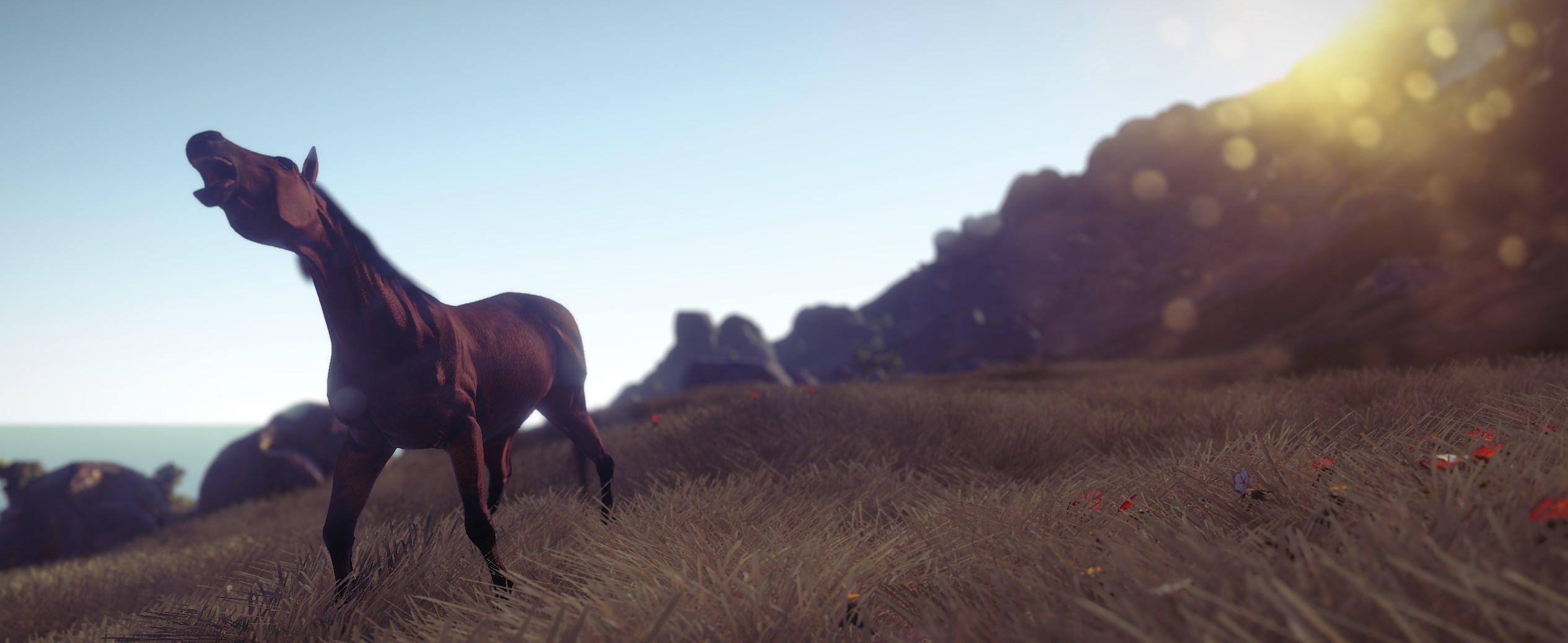
Devblog 56 landed in mid-April 2015 and carried two genuinely structural changes: decay, so abandoned buildings stop cluttering servers forever, and the first working proof of concept for non-procedural maps. Around those sat a serious exploit-closing pass from Maurino, a batch of animation and sound work, and — because it was that kind of era — horses and real star constellations.
Decay
Buildings now decay over time. The implementation was deliberately as simple as possible and, for most players, should be completely invisible day to day. The end result is that abandoned buildings eventually fall down. Facepunch expected it would get more complicated as they watched it play out, but preferred to ship something simple and learn from it in action rather than theorise a complex system up front.
Non-procedural maps and CraggyIsland
Garry looked into what it would take to support non-procedural maps. The long-term goal was always to let players make their own, and it needed to happen sooner rather than later — partly so Petur wouldn't be blocked from making his handmade map actually playable rather than just good-looking.
The result in this update is CraggyIsland, a tiny island shipped as a proof of concept. Player spawning and various other systems didn't work properly on it, but you could run around and build, which was enough progress for one week.
Server performance
The previous week's patch caused a lot of performance problems, which in hindsight was predictable — it hadn't been tested on 200+ player servers before going live. The issues were identified and fixed quickly.
The biggest single problem was physics CPU usage, caused by the changes to dropped items. Piles of dropped items colliding with each other turned out to be expensive in a way Facepunch admit they should have anticipated. The fix was to stop dropped items colliding with each other.
Sign crashes
Signs had been crashing a lot. The root cause was Unity failing to create the font texture because too many glyphs were being packed onto it — an error historically associated with "Best Fit" being enabled on text labels. Best Fit automatically resizes font to fit a rectangle, and because of how Unity's font handling works, it adds glyphs to the texture for every size it tests, wasting enormous amounts of space.
Garry stopped using Best Fit for signs, which makes attractive multi-line text much harder — so signs are now limited to one line. If that didn't fix it, the plan was to restrict further, and failing that, abandon fonts entirely and let players draw on signs by hand. He also fixed bugs where sign text changed size when you walked away and came back.
Closing the base exploits
Maurino went after two well-known exploits. Underwater bases worked because you can't jump onto ledges out of water — you need a smooth shore gradient — and you couldn't use tools underwater, making such bases very hard or impossible to raid. Two changes killed it: tools now work if your head is above water, and you can jump out of water onto ledges the way you can in any other first-person shooter. Not perfect, but a start.
Inside-rock bases got their last hole plugged too. Garry had fixed most of it the previous week, but the crouching player size was very slightly too small, so under certain conditions your eye point could peek up inside a rock and let you place a sleeping bag in there. Crouch size was increased just enough to prevent it.
Interpolation
Everything that moved looked jerky, as though it were running at 15fps. The cause was the interpolator catching up to the most recent positional sample and then leaving the entity sitting there until a new one arrived. Adding a small fractional-second delay (lerp.lerpDelay) smoothed it out completely — the only visible gameplay difference being that moving objects look right.
Stars and clouds
André added real-life star constellations, meaning in theory you can navigate by the night sky. It was flagged as a work in progress with the likelihood that some hero stars would need boosting for players to actually pick them out; star brightness was cranked for the screenshots.
He also refreshed the clouds, which were long overdue. The new implementation uses a smart but fake method of tracing cloud density that avoids the performance cost of real ray tracing — put together only hours before the blog went up, so it shipped rough. The important part is that their shading and coverage can vary widely, which gives a solid foundation for dynamic weather later.
He also fixed a batch of OS X and Linux issues: the game not fully closing on exit, missing terrain textures, bullet impact decals turning things pink, and not being able to place doors inside caves. Cloud shading also gained translucency.
Animation, art and sound
Gooseman built world models for all the weapons so dropped guns show the actual item rather than the default bag, rigged a new rocket launcher view model (the old one had no rocket to put inside), added a better impact effect for shooting a clothed player, and made animations for bandaging yourself and bandaging others. He also toned down footsteps so they no longer look dinosaur-sized, and added snow footsteps.
Paul concepted explosives: a Rust-appropriate grenade based on a baked bean tin to replace the stock model, and a range of RPG ammo ideas — one for the standard rocket now, with others reserved for different effects later, such as napalm for area denial. He also worked on redesigning the code lock's look.
Tom diagnosed the head bug and got back onto new heads, showing the first three with unique normals, with LODs being the time-consuming part. He also modelled the bean can grenade, got it in game with LODs, and started on the rocket projectile.
Vince finished the barricades, all with gibs for destructibility, leaving Garry to implement the remaining ones over the following weeks. Work started on new door locks, but partway through redesigning the keypad the team agreed they needed more options and something better aligned with Rust's style, sending it back for another concept pass.
Dan did a gib pass on placeable objects — large storage crate, furnace, small wooden box — with lootable objects like barrels and the newer loot crates queued next. Xavier continued on Paul's headwraps, with the first of two models due in game soon. Megan sketched crossbow concepts, aiming for a cobbled-together feel that still reads as dangerous while fitting alongside the other guns, and did the headwrap icon.
Alex finished a change letting any damageable object define its own impact effects and sounds, and gave loot barrels unique sounds — the start of giving every object its own sonic character. He did a first pass on wolf sounds, which he found trickier than the bear because people know what dogs sound like, and began work on player damage and wounded-state sounds.
Diogo worked on screen-space water with a rocky start but decent results, improving water visuals while making sure there are low-quality fallbacks that favour performance.
Scott made the case for interactive monuments. Most monuments up to that point — the lighthouse, the radio telescope — were one-shot landmarks that existed for navigation. With the new bridges, the idea is something players can interact with and change: build a base on top of one, repair gaps and charge people to cross, or hide underneath like a troll. Game meshes were finished and heading in-game with collision.
Petur prepared the updated batch of trees, expecting better performance and appearance especially for distant trees, added a ring road to the custom map and began roughly blocking out custom radtowns — with forest spawning systems due next, at which point the map would be close to playable.
Balance and fixes
- Ammo crafting times balanced to around 15 seconds across the board
- Thompson rate of fire nerfed, with vastly improved sound
- Explosions now do raycasts, so they won't destroy the contents of a house through walls
- Grenade throwing distance and explosion effects improved
- You can only repair a building block if it hasn't been attacked for 10 seconds
- Most clothing uses the ClothFlesh impact effect instead of blood; metal armour shows metal impact effects
- Burlap Head Wrap implemented as a default item
- Clicking no longer interrupts bandaging; censorship re-added to ragdolls
- Fixed Arctic Crystal Ores having 0 health, cargo plane scale being 50% too small, and some barrels culling out too early
- Fixed incorrect display names for crates and living players when looting
- Horses added (not rideable); load screen has different music; ambient sounds don't start until you're in game
- Ragdolls fall over properly instead of kneeling in place; sleeping bags removable from the death screen
- Fixed tracers not drawing, wind not affecting trees, trees popping in and out, and alpha cut-off on a bunch of trees and billboards
- Disabled SpeedTree smooth LODs as a performance test; shader level now targets only specific shaders
- Updated EAC, which should fix OS X and Linux hanging on exit
Facepunch also noted a workflow shift: they'd largely moved from Trello to GitHub, on the grounds that Trello degrades the more it's used and needs constant maintenance to avoid becoming an unaccountable mess, while GitHub issues self-manage — categorised, assigned, and gone when done. Their issue page was public, with the resigned expectation that spam would eventually force them to close it.