
What's New in Rust's "Devblog 58" Update
End of April 2015 brought Hapis Island, Rust's first hand-crafted map, after months of quiet work from Petur. Alongside it came AI optimisations for high-population servers, terrain displacement, checksum verification and the beginnings of an in-game map.
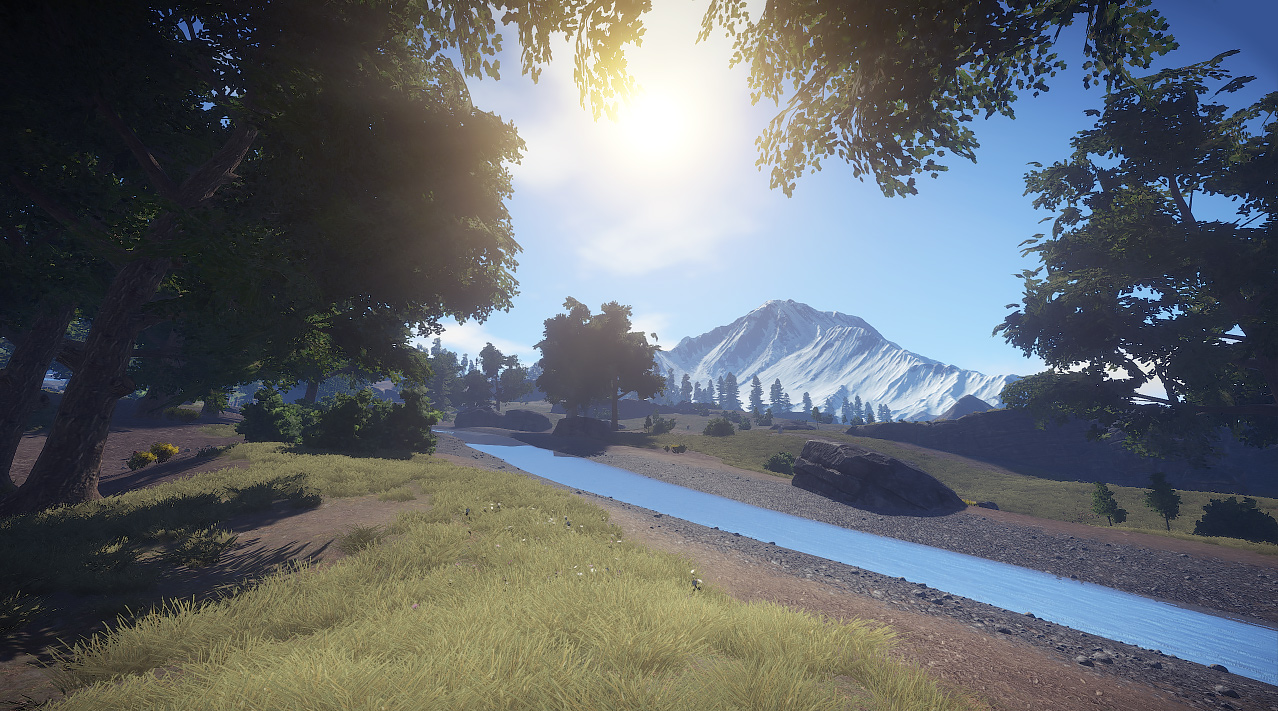
Devblog 58 closed out April 2015 with the release of Hapis Island — Rust's first hand-crafted map, and the payoff for months of quiet work from Petur plus a lot of custom-map plumbing from André. It shipped deliberately rough, with Facepunch openly expecting it to play badly at first, and everything else in the update sat around making high-population servers hold up better.
Hapis Island
People had been calling it "the legacy map", and while the two share some traits — a ring road, most obviously — Petur was clear that Hapis is a brand new and very different map. This was the first iteration, and the warning list was explicit: bugs, floating objects, waterfalls that look like vertical rivers, and the general state of a thing being played for the first time. The layout of the land was expected to change considerably as it was refined around gameplay.
Servers running the map were also warned they might get weekly forced wipes during this initial phase, since the map changes were going to be large.
How custom maps actually work
André used the release as a moment to explain the backend. Custom maps still need certain procedural elements to allow player interaction with the world. Forests are the clearest example: they dynamically grow, get chopped and regrow according to forest areas and biome information the artist specifies. The growth art didn't exist yet, so it was effectively a binary process, but you can deforest parts of a custom map the same way you can on a procedural one — meaning less-visited forests grow denser over time.
Water bodies other than the ocean weren't really functional yet, with a rework of the water checks planned for the following week so lakes and rivers actually affect the character.
Procedural fixes and wipe
The update forced procedural map wipes too, though the changes were fairly minimal: radtowns 2 and 4 are no longer randomly scaled, some cases where bridges ended up partially underwater were fixed, and the test prefab mountain's placement improved.
A decor density slider was added affecting both map types, blending out decor objects that can't be interacted with and are small enough not to affect gameplay — worth checking in the F2 menu to see whether it helps your framerate.
Checksum verification also went live on both procedural and custom maps, as announced a few weeks earlier. If your locally loaded map differs from the server's state, you get disconnected with a checksum mismatch — which means either your install is wrong or the server is on a different version.
AI optimisation
Garry's assessment was that servers handled 100 players without breaking a sweat, but things got noticeably harder past 200 — and the biggest cost was AI.
The AI was designed to think on intervals, with those intervals randomised so entities don't all think on the same frame and cause spikes. That wasn't actually working. After a small lag spike from any other cause, the AI ticks would bunch back up and only slowly spread out again, which created a snowballing failure mode: bunched AI ticks make the AI tick slowly, which bunches them further. Profiling produced several changes to make it stable.
Mesh collider optimisation
Garry had written a pile of code for building skinned mesh colliders — taking all the vertices and bone weights, multiplying vertices by the bone weight matrices, then creating a new mesh and setting it as the collider. It worked fine. Then he found SkinnedMeshRenderer.BakeMesh, which does exactly the same job in native code, so it's faster and produces no GC churn. The practical effect is fewer lag spikes when shooting.
User info and admin controls
Rust gained userinfo — client-set variables the server can read, working the same way as in the Source engine. It's used for god mode and skin changes. Admins can set god true in console, which sets their userdata so the server knows they're immune; previously that variable was global to all players.
Three more were added: skincol, skintex and skinmesh, changing the player's skin colour, texture and mesh. Facepunch didn't want to add these, but requests came in from machinima makers, and the reasoning was pragmatic — if they didn't add it, a server mod would, so they may as well make it easy. All three are admin only.
The map system
Garry started work on a map, long-requested but approached carefully — his view was that shipping a straight top-down map would waste gameplay opportunities. At this point he had it rendering and navigable.
The terrain work from André and Diogo made the rendering side easy: the terrain normal map, height map and splat maps were all already available, so throwing them into a shader produces a legitimate-looking top-down view almost for free. The intent was for the map to only reveal areas you've actually visited, and for you to be able to draw all over it — targeted for the following week.
Terrain displacement and water
Diogo took a few days off the water rework to implement per-pixel displacement for the terrain shader. There was already a fake deformation effect, but it could only add so much depth. The new technique goes much further — with the caveat that it's performance intensive and only active at the highest terrain quality setting, with lower settings falling back to the old method. The water remake was progressing well, targeted for deployment mid-way through the following week.
André continued on clouds in spare moments, researching a fully volumetric approach for the near-to-mid future. Since that might hurt framerates on lower-end hardware, he decided to get the current semi-volumetric layered clouds to a decent standard first as a fallback — this update contains shape and shading tweaks, especially for horizon clouds and general cloud translucency at sunrise and sunset.
Art and animation
Gooseman fixed footsteps spawning too frequently and made them more visible, particularly on grass. He improved rocket launcher iron sights so the front and rear sights line up with the centre of the screen, added movement animations for all animals with foot placement better matched to movement speed, and fixed a bug where the horse sounded like a popcorn machine from generating far too many footstep effects. He also rigged and animated the bean can grenade view model with custom sounds and effects.
Tom finished the SMG including LODs, ready for implementation, updated the revolver material to be shinier and rustier, and started a new RPG ammo type. Vince made a new version of the keypad plus a simple keylock for doors, and slimmed down some building skins to make placing signs and future wall fixtures simpler.
Xavier spent the week on organisation — eliminating extraneous folders, deleting unnecessary textures, resizing large textures to cut memory use, and assigning proper materials so models render correctly. He also started taking advantage of unique world models for dropped items, with plans to make world models for all the game's clothing.
Paul painted up the research table design the team liked best. Since the old Legacy research kits were blue, that colour scheme carried into the table to make it distinctive, while keeping handmade elements like thick welding and rusty bolts. Megan explored alternative lighting — first candles and fire, then settling on electric lights and wall or ceiling hangings, with the idea that you could paint bulbs to change their colour — and made the map and note-paper icons. Howie refined earlier concepts and worked on more paintable signs and objects to take advantage of the new paint system. Dan finished the smaller water tank and reworked the larger one after Howie supplied a better concept.
Sound and music
The loading music added the previous week is by the same composer behind all the Legacy Rust music, who releases under the name Atrium Carceri — with plans to commission more from him over the following months to build up the game's ambience. Overall music volume was lowered and it now obeys the music volume slider.
Alex tweaked footsteps so sprinting sounds less like an angry man stomping around, did a first pass at campfire and furnace sounds, tuned river sounds and added variations — with the eventual goal of playing faster running water sounds where the river is steepest. He added jump and landing sounds and a first pass at horse footsteps. His work on limiting how many sounds individual objects can play at once appeared to help the full-auto firing lag, though not eliminate it, and he started moving animal footsteps onto the same system as player footsteps so a bear walking through snow actually sounds like it.
Fixes and balance
- Fixed rocket launcher starting with one ammo
- Fixed explosive damage not resetting the repair delay on building blocks
- You can no longer upgrade building blocks while they're under attack
- Serverside projectiles are invisible until they're in motion, so rockets and grenades look less buggy
- Added the missing normal map to the grenade; grenades now have a minimum damage distance
- Reduced hammer refire rate
- View models drift less in ADS, making gunfights much more responsive
- Re-added missing eating sound effects
- Fixed sign textures disappearing; menu building caching improves performance when looking at something; spectators can use chat again
Two forward notes closed the blog. Players had asked Facepunch to hide the server name in the escape menu, because it reveals which server a streamer is on and leads to them getting ghosted — a solution was promised for the following week. And with player counts running high relative to comparable games, Facepunch signalled that Legacy would probably be removed from the default install soon, remaining playable only by switching to the Legacy branch.