
What's New in Rust's "Devblog 55" Update
April 2015's Devblog 55 folded in the delayed terrain patch and added the two silliest items Rust had seen - a playable guitar and a working camera - alongside barricades, hand grenades, a full medical rework and the end of consumable spam in fights.
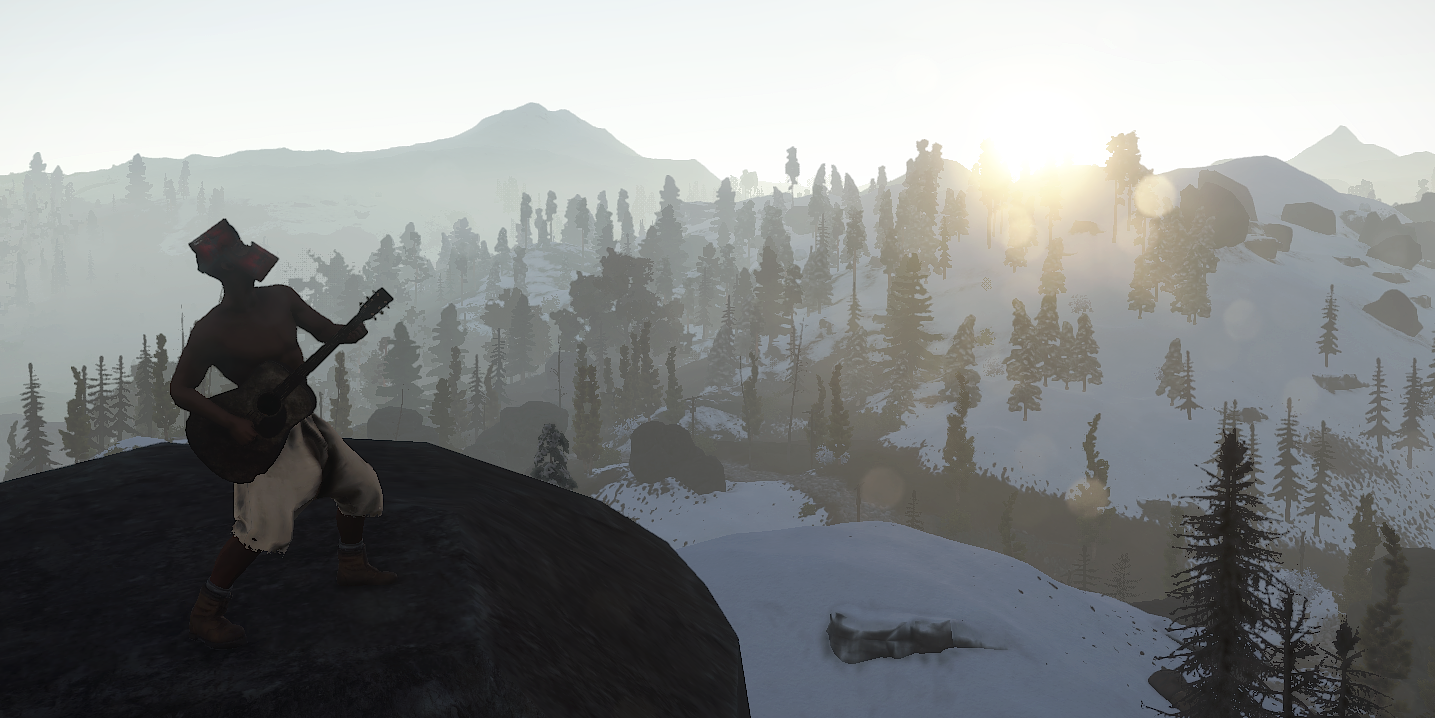
Devblog 55 shipped in April 2015 and rolled in everything that had been held back from the previous week, plus a fresh batch on top. It's a strange mix even by Rust standards: serious combat rebalancing and performance work sitting alongside a guitar that exists purely because the spear holding pose happened to fit one. Barricades came back from Legacy, medical items got a proper rework, and radiation stopped being an instant death sentence.
Performance options
Garry spent a good chunk of the week on performance, and a few user-facing switches came out of it.
A shader level slider was added to the tweaks menu, reducing shader complexity so weaker graphics cards use a simpler version. Turning it down was expected to improve framerates massively on lower-spec machines. Full screen mode on Windows went back to exclusive mode, which has performance benefits on some configurations.
Then there's grass. After a long history of Facepunch insisting there would never be an option to turn grass off, Devblog 55 added a slider that turns grass detail down and off — with immediate and explicit caveats. It was a temporary test to measure how much difference it actually makes. The expected outcome was that players would eventually be able to reduce grass detail but not remove it, and that the lowest setting would obscure the ground more than high detail does, so turning it down never becomes a competitive advantage.
Trees remained the sore spot. André and Petur had made them considerably more performant, but forests — especially under canopy — were still rough. Older Unity versions had a "Max Mesh Trees" setting that capped how many trees rendered properly and billboarded the rest, which scaled beautifully. Unity 5 doesn't implement it despite the setting still being present, and Unity Premium Support said it wasn't considered a bug with no plans to reimplement, suggesting Facepunch add their weight to a bug report from December 2013 instead.
The guitar and the camera
Garry had wanted to slip the guitar in silently and let players discover it after the patch, which didn't work out. Its origin story is genuinely that simple: he noticed the spear holding pose and thought a guitar might fit it, downloaded one from the asset store, and it did. About 30 minutes of sourcing sounds and hooking it up later, it was in game and playable. You change notes by adjusting your screen pitch and pressing left or right mouse button. His conclusion was that Rust should probably have more "useless" items like this.
The camera came along at the same time. It was primarily a development tool for taking nice depth-of-field screenshots for the blog, but with zoom restricted it became spawnable in game. Left click takes a screenshot via Steam, holding right mouse zooms, and holding middle mouse locks focus — otherwise it focuses on the centre of the screen.
Barricades
Vince's barricade models were implemented, working the same way they did in Legacy. Three types were in at this point, with the barbed-wire versions slowing players down more. Vince outlined the full plan: six barricades in total following Paul's concept art, three offensive ones that damage players on impact and three defensive ones to take cover behind during gunfights. The last of the set, made of stone, can be stacked into a quick defensive wall — though building on top of it probably won't be allowed.
Alongside that, unique world models for dropped items were set up. Only a few items had them at this point and some were placeholders, but the system was in and ready.
Combat and medical rework
Maurino tackled a problem that was making firefights absurd: players equipping a stack of consumables and spam-eating them mid-combat. With the large medkit healing 100 points, gunfights could drag on for several minutes. The fix, borrowed from Legacy, is that consumables now heal over time at roughly 2 per second, and taking any damage forfeits all pending healing. The syringe still heals instantly.
The medical items got restructured around that. Bandages are no longer instant consumables but held items — you have to equip one rather than mash a number key mid-fight — and you can bandage other players with right click. The syringe uses the same code, so you can heal others with right click too. Medics became viable.
The hand grenade was implemented in a sprint since the art was already sitting around, with balancing on weight and damage still to come, and Megan quickly produced an icon.
Radiation rebalance
Radiation was badly out of whack — entering a radtown gave you full rads with no hope of survival. The new model is more legible:
- Radiation poisoning is 1:1 with damage taken — 80 radiation poisoning means 80 damage by the time it runs its course
- The higher your rad level, the faster rads metabolise, so you take that damage quicker
- Maximum accumulated rads raised to 500
- All clothing now provides some minor radiation protection, so a geared player has meaningfully better odds than a naked newspawn
Weapon and building balance
- Assault rifle nerfed — lower rate of fire, more recoil
- All weapons had ADS FOV reduced, except the bolt action which was increased
- Tracers made thicker to match their new texture
- Bandages made cheaper
- Metal helmets (coffee can, bucket, facemask) protect less against bullet damage
- Metal facemask and body plate cost much more
- Firearms are more expensive, with a wider cost gap between them
- Armoured building parts cost far more and stone parts cost a bit more, making sheet metal more viable
- Your player no longer uncrouches without head clearance
Procedural generation and terrain exports
André's list after a weekend of performance work with Garry:
- PVT disabled by default since it caused issues for some players and only helps some hardware — the setting is still saved if you want to enable it manually
- Rocks use less memory by properly cleaning up child objects
- LOD multiplier added to the grass system, used by the grass quality slider
- Mountains no longer placed partially outside the world, and blend better with terrain
- Monuments use a similar terrain blending system to mountains, giving artists more control over surroundings in future radtowns
- Roadside poles switch sides if one side of the road is blocked
- More bridge placement and road network generation improvements
- Terrain resolution now 1 vertex per world unit, matching the upcoming custom map
- Ores spawn in smaller clusters again for more even distribution, and fewer overhang rocks on beaches
The metal building and hangar monuments were turned into radtowns with actual loot. Layouts and most assets were still placeholders, but it meant no more walking down an endless road to reach a tiny building that does nothing.
For debugging — and for the community — André added terrain data export via data.export (heightmap | splatmap | biomemap | topologymap | alphamap). The RAW output is binary and mirrors the internal layout of the terrain backing stores as Unity prefers them. Photoshop can display all the exports semi-correctly, so with experimentation the data is workable, and André committed to continuing support for the exports in future updates specifically to help community map generators.
He also announced that the last known world checksum calculation issues were fixed, with checksum verification on server join due to be enabled by default over the following weeks — meaning players with an incorrect checksum get kicked unless the server owner disables it.
Art, animation and sound
Gooseman improved various existing player animations (crouchwalks, runs and so on), added a natural sitting pose for campfires, continued in-place turning animations for each hold type, and added left/right leaning when a sprinting player rotates quickly for more natural movement.
Paul concepted burlap hoods and, at Helk's request, animal pelt headgear including a wolf head hood — aimed at players wanting a more tribal, savage look. Xavier used Paul's burlap head wraps as a testbed for new techniques for rough cloth items, with the high-detail work generating texture information reusable across other items including updates to the existing burlap set.
Tom fixed the leg UVs and finally diagnosed the recurring seam problem: vertex normal positions change on export from Maya, inconsistently. He finished the skull LODs and worked on the whale, getting it suitably decayed.
Alex spent the week recording and processing new bear sounds, and started on wounded player sounds and per-object impact sounds so smaller trees and barrels can each have their own sonic identity. Diogo fixed shader bugs left over from the big terrain merge, including a texture tearing issue near the water's edge that badly affected some ATI/AMD owners — and the solution he landed on should open the door to cheap waves and other per-pixel displacement effects later.
Fixes
- Fixed being able to loot players from a long distance, and while they're alive
- Fixed network toggle exploits and sleeping bag placement exploits
- Signs limited in where they can be placed, to prevent lemming bridges; signs can now be placed rotated
- Added
teleport(players only) andteleportany(any entity) admin commands - Tweaked animal speeds; fixed chicken ragdoll using wolf colliders
- Fixed decals sticking around forever, and decals rendering pink on OSX
- Fixed vitals sometimes not showing and the bleeding notification not appearing
- Fixed items ejected from furnace, campfire or storage box falling through the world
- Fixed queued damage effects sometimes appearing after respawn
- Fixed instances where exceptions weren't being reported properly
Facepunch closed out an unusually productive fortnight by flagging what was next: decay — a long-requested feature they intended to approach quite differently from how it worked in Legacy.