
What's New in Rust's "Devblog 54" Update
April 2015's Devblog 54 was mostly André's month-long terrain rework surfacing at once - cliffs, prefab mountains, proper ocean-versus-lake logic and a whole new colour palette - alongside crash reporting, shader preloading and a decal system. The patch itself slipped a week.
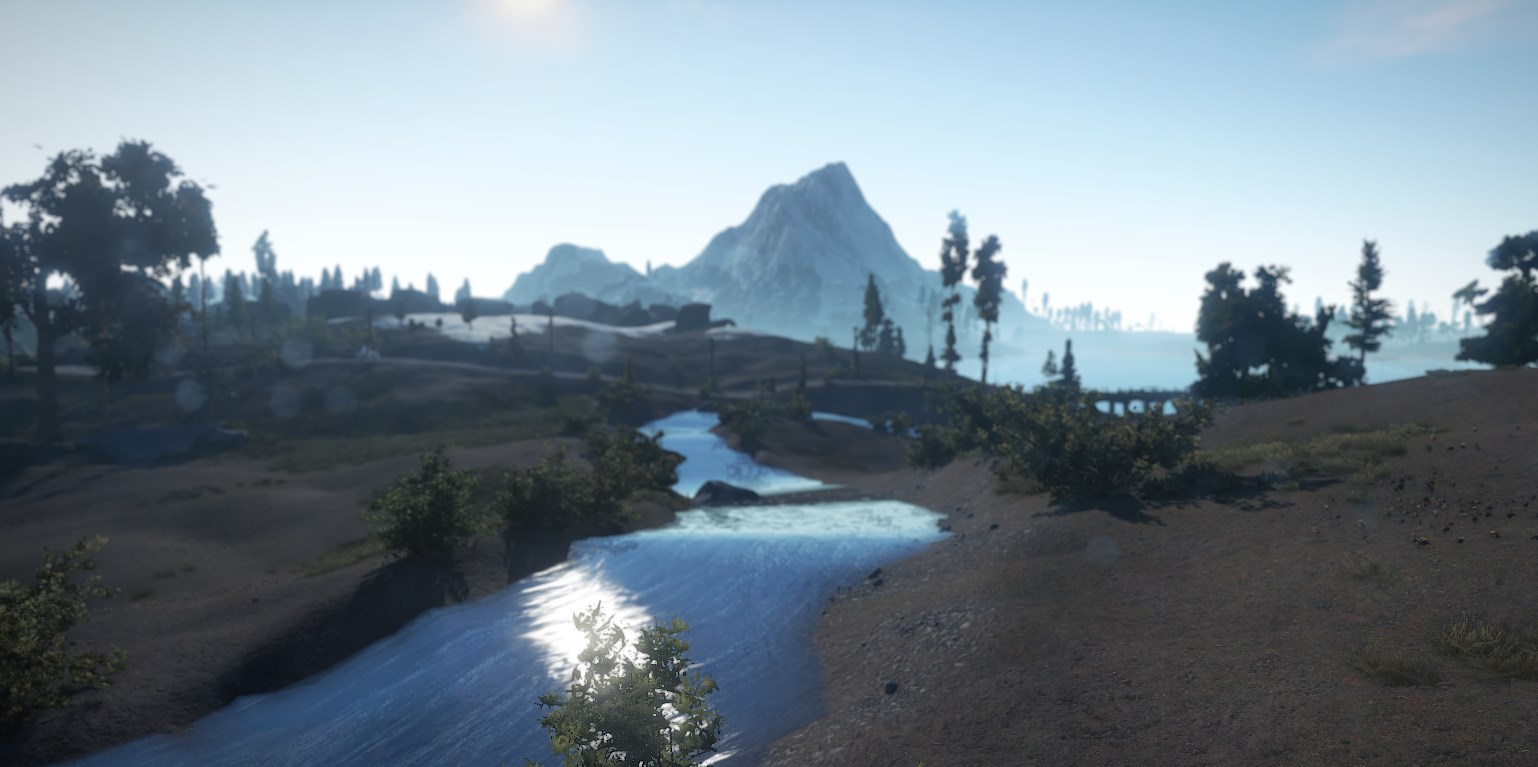
Devblog 54 went up at the start of April 2015, and it's an unusual one: the blog shipped but the patch didn't. Facepunch pulled the release for another week of testing, so this was a preview of a month's worth of work rather than a set of live changes. The bulk of it is André's procedural terrain overhaul, which touched almost every visual layer of the world at once, plus a batch of engine plumbing from Garry that fixed some very long-standing annoyances.
Roads, bridges and rivers
Another round of fixes went into road, bridge and river placement — with the same caveat as the previous month, that it wouldn't be perfect but there'd be considerably less weird behaviour. Paths got wider and use a different texture to make them more noticeable. Bridges are less clunky and now modify the terrain around them so everything fits together properly.
Rivers only get placed if they exceed a certain length, which eliminated river sources appearing right next to lakes, and various cases where a river mesh could overlap itself or other meshes were fixed. River mesh tessellation was increased for nicer, more natural water flow, and the colour was pulled back from looking neon.
Monument placement and prefab mountains
Radtown and monument position finding improved substantially. The old approach guessed a position that might make sense, checked the surrounding terrain, then accepted or rejected it — which discarded a lot of viable options and left some maps missing their bigger radtowns entirely despite a suitable spot existing. The terrain anchoring system now searches for the perfect placement altitude on every attempt, guaranteeing no potential fit is missed. Smaller maps can still fail to place everything, but that's somewhat by design.
More interesting long-term: André got a first prototype prefab mountain from Petur and built a system that places it into the procedural terrain. That means artists can hand-design landscape features which are then smoothly fitted into a generated world. The advantage is visual quality — expensive processes like hydraulic erosion can be simulated on a handmade mountain over several minutes, which is far too slow to run at level load. At this stage it was barely more than a proof of concept.
Ocean versus lake
Water body generation now runs a proper ocean vs. lake analysis. The immediate results are no more lighthouses in lakes and a guarantee that players spawn at the actual coastline. The longer-term payoff is that the game can now distinguish salt water from fresh — which matters for whether the water you're swimming in is the sea, and whether drinking it would save or kill you, if drinking water ever gets implemented.
Cliffs, rocks and a new palette
Proper cliffs, micro cliffs and overhangs were added to the procedural map. Cliffs appear wherever terrain falls off very steeply, micro cliffs on fields and hillsides with a slight drop, and overhangs mostly on beaches. The improved rock assets Petur and Bill made a few weeks earlier were folded in, rock cluster count went up, and their placement improved.
Rocks got a lot more flexible. A new material parameter system allows shader properties to be tweaked on every individual rock, replacing the three static rock colours with smooth colour transitions based on the biome the rock sits in — and texture resolution now stays consistently high no matter how far a rock is scaled up. Grass and decor vegetation can also grow on top of some rocks, and Diogo's new terrain blending was applied.
The old terrain colour map was replaced with a set of four colours per texture, one per biome, getting far more out of each terrain texture while preserving nicer transitions. The procedural map was also updated to the new colour and texture palette Petur had been building for the Legacy level, meaning a vastly different look and feel across the entire terrain.
Petur and Dan produced a new set of decor clutter assets for forests, grasslands and beaches. Forests got substantially bigger and, combined with the clutter and rocks, look noticeably better — though the trees themselves were flagged as still needing another pass. Trees were added to roadsides, and crystals appeared in the snow biome, dropping ores for now with vague plans for a new resource type attached to them.
Finally, dynamic decor adjustments were made modular so artists can tweak decor parameters in ways that make sense to them, which should smooth the path from concept scene to shipped content.
Crash reporting and shader warm-up
Two pieces of infrastructure landed. Crash logs now upload on startup — previously Facepunch captured all in-game exceptions but had no visibility into hard crashes at all. They weren't being parsed yet, but once a parser was in place the crash statistics would let them target resources properly.
Shader warm-up fixed the stuttering that happened when you entered the game and looked around, or fired a gun for the first time. Shaders are now preloaded — something Garry described as a thing they should have been doing six months earlier.
Decals
Rust had gone a long time without a decal system, which most modern engines support because decals are useful everywhere. Unity had no real support for it, so the implementation is a hack: Unity projectors, which perform badly, limited to a fixed number visible at once via custom culling code written specifically because Unity can't cull projectors based on the current camera. There were known issues — decals don't rotate with a door, for instance — but the point was having a system in place so it's ready when a proper solution arrives.
Better performance measurement
Garry's blunt assessment was that Legacy's one big advantage over the current version was performance, and that they'd been measuring the wrong thing. Framerate alone isn't useful. What matters is how much time goes into rendering, culling, animation, physics and game logic separately.
Analytics accordingly went from measuring one thing to measuring seventeen. The practical difference is that when average framerate drops 10% in a week, the graphs can now say "average physics went up by 5ms" and point at the specific change responsible.
Art and animation
Gooseman created gibs and sound effects for wood, stone and metal walls breaking, and worked on in-place rotation — showing the player shuffle his feet when turning, instead of the previous magic-trick spin — with jitteriness still being smoothed out.
Alex did a first pass at ambient sound for the new rivers and worked on rustling sounds for bushes, with all sounds made and code written, leaving only trigger placement on the remaining bushes. Player injury sounds, jumping and landing sounds, and animal sounds were queued next.
Dan finished the low-poly repair bench with a texture pass and a quick LOD, and moved onto gibs. Xavier continued standardising clothing: the first usable version of the new clothing shader, ensuring all pants and boots work with everything else without clipping oddly, plus written documentation of the standards so other artists can work faster — with an eye on where that leads if user-generated content ever happens. He also fixed a batch of materials.
Tom kept sculpting heads, hit seam problems again, and took a break to model something Facepunch had discussed a while back — a severed head, floated as a melee item, a warning on a pole, or the basis of a secret society. LODs still needed doing, so what was shown was the view model.
Vince enhanced the rooftop blocks, giving them LODs and destroyable states. The long-overdue result is that you can build continuous rooftops without needing the extra half block, and the increased roof gradient gives a feeling of more interior space — though you can't walk in or use that space yet due to collision limitations. Barricades were next on his list.
Balance and fixes
Maurino played a weekend of Rust and cleaned up a pile of small irritations:
- You no longer constantly bleed out when wounded, so revival is genuinely an option
- Sleepers can't be wounded — they just die
- Furnaces now give some comfort; sleepers add half comfort to campfires relative to awake players; dead bodies no longer add comfort
- Fixed a tool cupboard placed next to a wall blocking foundation placement beside it
- Snap traps always wound instead of killing
- Tracers look considerably better
- Bone knife craft time increased from 0 seconds to 60
- Implemented Dan's repair bench model and gibs, and his new radtown loot crates
- Fixed some clothing not showing blood impacts
Elsewhere, ammo counters now show how much ammo is in your weapon directly on the icon, blueprints are hidden while looting, and you can drop items by dragging them outside the inventory.
The patch itself slipped. Facepunch apologised to server owners who'd wiped in anticipation — the build essentially existed but hadn't been on the dev branch long enough to push live, with a lot of testing outstanding. Players could opt into the dev branch on Steam to help, and the release was targeted for the following Thursday.