
What's New in Rust's "Devblog 53" Update
Late March 2015's Devblog 53 gave Rust two things it never had: signs you could write on, and a wounded state so dying stopped being an unexplained cut to black. It also kicked off a serious performance campaign and revealed a hard PhysX collider limit.
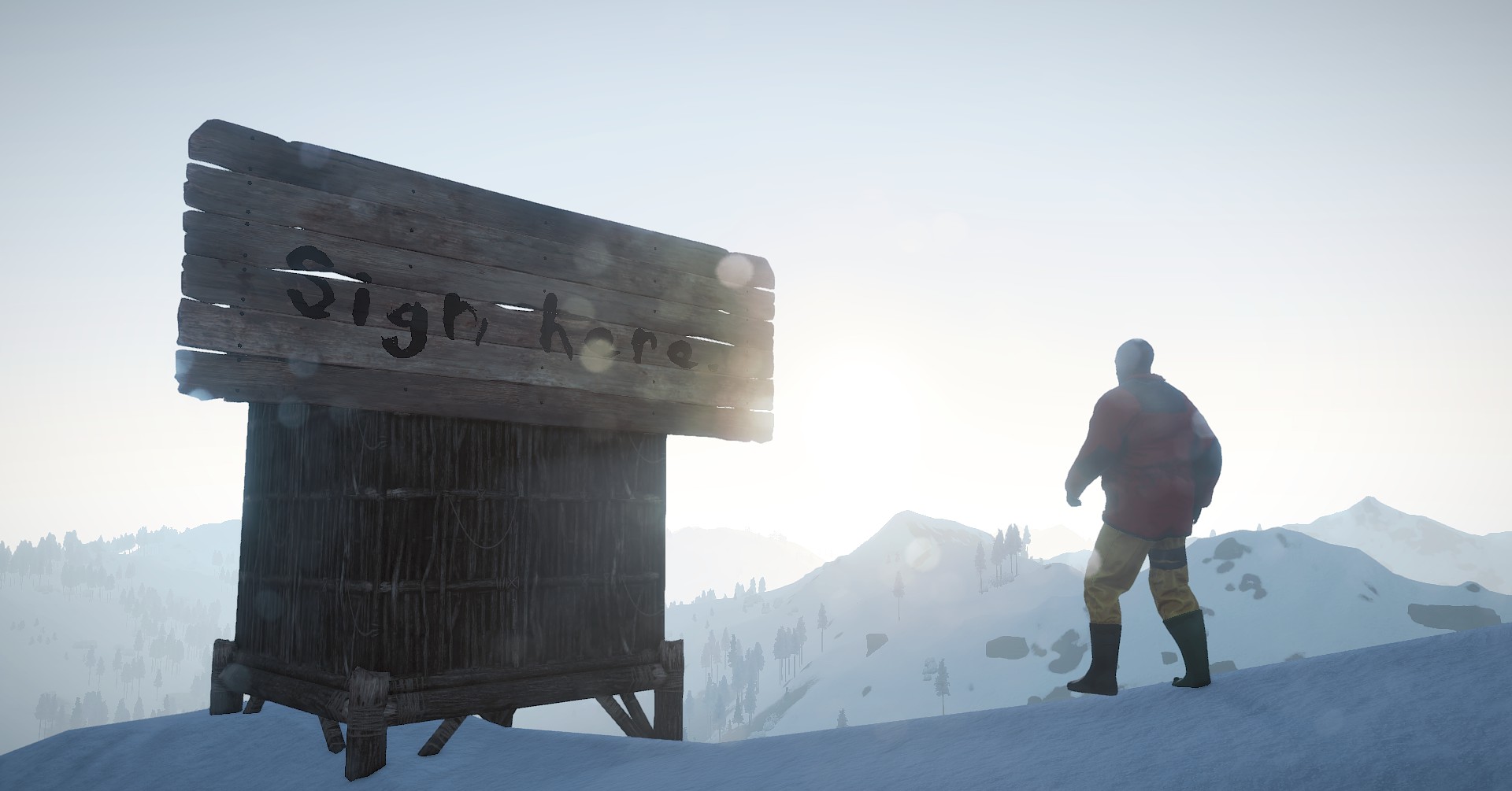
Devblog 53 arrived at the end of March 2015 and was one of the more substantial updates of that period — new features, real performance work and a balance pass all in the same week. The two changes players felt immediately were signs, which instantly became the game's primary vehicle for player expression, and the wounded state, which turned dying from an abrupt cut to black into something you could actually understand and sometimes survive.
Signs
Signs are crafted and placed like any other item, and they respect tool cupboard rules — if a sign sits inside your cupboard's radius, only authorised players can change its text. You can also lock the text permanently, at which point nobody can edit it, including you.
They came in multiple sizes, some craftable by default and some requiring a blueprint find. All were wood, with a deliberately messy hand-written font, and Facepunch flagged that different sign types with nicer fonts were the long-term plan.
Getting them working took a surprising amount of under-the-hood work. Facepunch wanted signs placed using the same rules system as building blocks — more control over where and how players place things, and no sense in maintaining two separate item placement systems. That meant making the building placement system generic enough to work with any entity, with the warning that building in general might have picked up some new bugs or behavioural changes as a result.
The death routine
Dying always sucks, but the old implementation made it worse: the death screen simply appeared and you had no idea what had happened. Two changes addressed that.
First, players now get wounded — knocked to the ground, unable to do anything except look around and shout. While down, other players can loot you or help you up. After a number of seconds, if nobody helps and nobody finishes you off, you die, though there's a small chance you recover and get back up on your own.
Second, headshots still kill instantly, but you now keep seeing through your ragdoll corpse's eyes for a few seconds afterwards — the same behaviour Legacy had — which usually gives you enough information to work out what killed you. And ragdolls themselves stopped being jerky, after Anthony Yakovlev at Unity pointed out what Facepunch were doing wrong.
Performance
Performance was described bluntly as "a bit of a joke right now", and the response was to overshoot deliberately and scale back later if things looked wrong.
- Skinned colliders were being rebuilt every frame whether or not anything had changed. They now rebuild only when needed, which produces decent gains when shooting at players and animals.
- The building block LODs from the previous week worked, but not dramatically — so shadows are now off on distant LODs, which is a big boost when there are a lot of them on screen.
- The conditional models system was rewritten to only operate within a radius of the player, and to only spawn the models that should be visible rather than spawning everything and hiding what isn't wanted.
- Layer culling was added — a Unity feature that culls different layers at different distances. Deployables like campfires and cupboards can be drawn only within 100 metres while big environmental rocks draw at 1000. It achieves something similar to LOD culling but is far cheaper, because it's based on distance from the camera rather than the object's size on screen.
The PhysX collider ceiling
Garry followed up on the physics breakdown reported the previous week. Unity spoke to Nvidia, and it turns out PhysX 3.3 has an undocumented limit of 262,000 colliders. It's fixed in PhysX 3.4, but Unity had no plans to upgrade. The awkward part is that Rust servers were hitting the failure at around 160,000 colliders — a 100,000 collider gap — so Garry asked Unity whether colliders might be leaking somewhere. Either way it was going to be a problem for the foreseeable future, with plans to start taking hopefully non-hacky steps to detect or prevent it.
ISO noise
The earlier gamma changes worked well at killing the gamma exploit, but darkened the image more than Facepunch liked. ISO noise was added as a replacement approach: a noise filter that gets louder the darker the scene gets. It serves the same anti-exploit purpose but looks better — Facepunch skipped screenshots on the grounds that it's the kind of effect you need to see in motion.
Sound
Alex fixed a long-standing desync between weapon strike sounds and the sound of the object being hit — wood breaking, flesh rending and so on. The cause was that weapon sounds fired off the weapon animations while hit-object sounds came over the network from the damage system. Both now play in sync, and a first pass went in on all the generic impact sounds including gunshots.
Reverb tails were added to every gunshot sound. These had originally been kept dry in the hope of using Unity's built-in reverb to add tails dynamically, but its quality and flexibility weren't good enough. Smaller tweaks and a couple of minor ambience system fixes rounded it out.
Art and animation
Minh went over the animals improving their flinching animations, and cleaned up various player animations that looked rough. Xavier worked on making the clothing system more intelligible — a proper ruleset and guides so clothing can be produced much faster in future — alongside a custom shader supporting things like highly customisable tints.
Tom fixed the head LOD UVs, which had stopped matching after the character meshes were updated for the new heads and were producing wild-looking LOD swaps. He also modified character textures to work with the new skin feature, and was sketching out new heads plus a new resource with a visual gathering point — exposed stomach innards and rib cage.
Dan finished the driftwood sets for Petur and moved onto a new repair bench, with the high poly done and texture work next. Megan finished the last of the icon revamp, aiming to unify the set and make icons easier to distinguish at small sizes; she flagged metal fragments and wolf meat as the ones most likely to need revisiting based on feedback.
Vince worked on making building skins breakable, the challenge being to keep the gib meshes cheap and lean on particle effects to cover their lack of detail. Particles and sounds didn't yet match the broken material type. He also fixed the invisible-floor problem where door blocks adjacent to floor and foundation blocks stopped the floor rendering, by simplifying the prefabs to not detect door openings for now. Building skin LODs were still rough, with some popping unavoidable at lower graphics settings, and the rooftop block wasn't LOD'd yet.
The Legacy-inspired map
Petur gave a status update on the handmade map, which was entering its minimum playable state:
- 4k in size
- Brand new everything — trees, lighting and fog, rocks, ground textures and shading, bushes, flowers, mushrooms — all of which would eventually be ported into the procedural maps too
- A twin biome: a snowed-up, elevated centre surrounded by temperate forests and plains
- Possibly a second adjacent island with a more arid climate if it works out, which would mean boats and/or bridges
- Explicitly not a port of the old Legacy map — the layout is only inspired by it
The plan was to release it fast and rough so players could watch it evolve, with a target of the following month.
Diogo, working alongside Petur and André, unified the terrain shader code to be lighter and more accessible, enabling smooth transitions from terrain to any mesh so objects integrate naturally with the ground. A dynamic layer composite system was added to support features like particle accumulation and wetness on any shader, and the lowest quality mode got a decent base texture in both Legacy and PVT rendering paths.
Balance and fixes
- Consuming food and medicine plays sound effects
- You can only eat a piece of food every 2 seconds
- Max caloric HP regen restricted to 60% base + 40% × comfort level
- Shooting or aiming projectile weapons now stops sprinting and performs the action, rather than being disallowed while sprinting
- Pressing the sprint key while auto-sprinting disables it
- Salvaged hammer nerfed — range brought in line with other weapons in its category — and its cost increased
- Stone pickaxe damage slightly lowered
- Bandages made easier to craft
- Pump shotgun nerfed, because it used to do 300 damage per shot
- Fixed guns and melee weapons failing inside caves, and fixed crazy sky rendering
- FPS graph disabled because it hurt FPS; the FPS display is now more accurate
- Fixed the server sometimes showing the wrong client IP, corpses sometimes being unlootable, and chat opening when renaming a sleeping bag
- Tweaked tooltip, crosshair and health HUD, plus placement guide colours
The following week's patch was flagged as a first-of-the-month update, meaning a wipe — and with it, a month's worth of André's accumulated terrain work landing all at once.