
What's New in Rust's "Devblog 196" Update
The last Rust patch before leaving Early Access brought working Water Well monuments, a level design refresh of Military Tunnels for the incoming Scientists, far more cliffs and hills on procedural maps, and netcode work that cut peeker's advantage substantially.
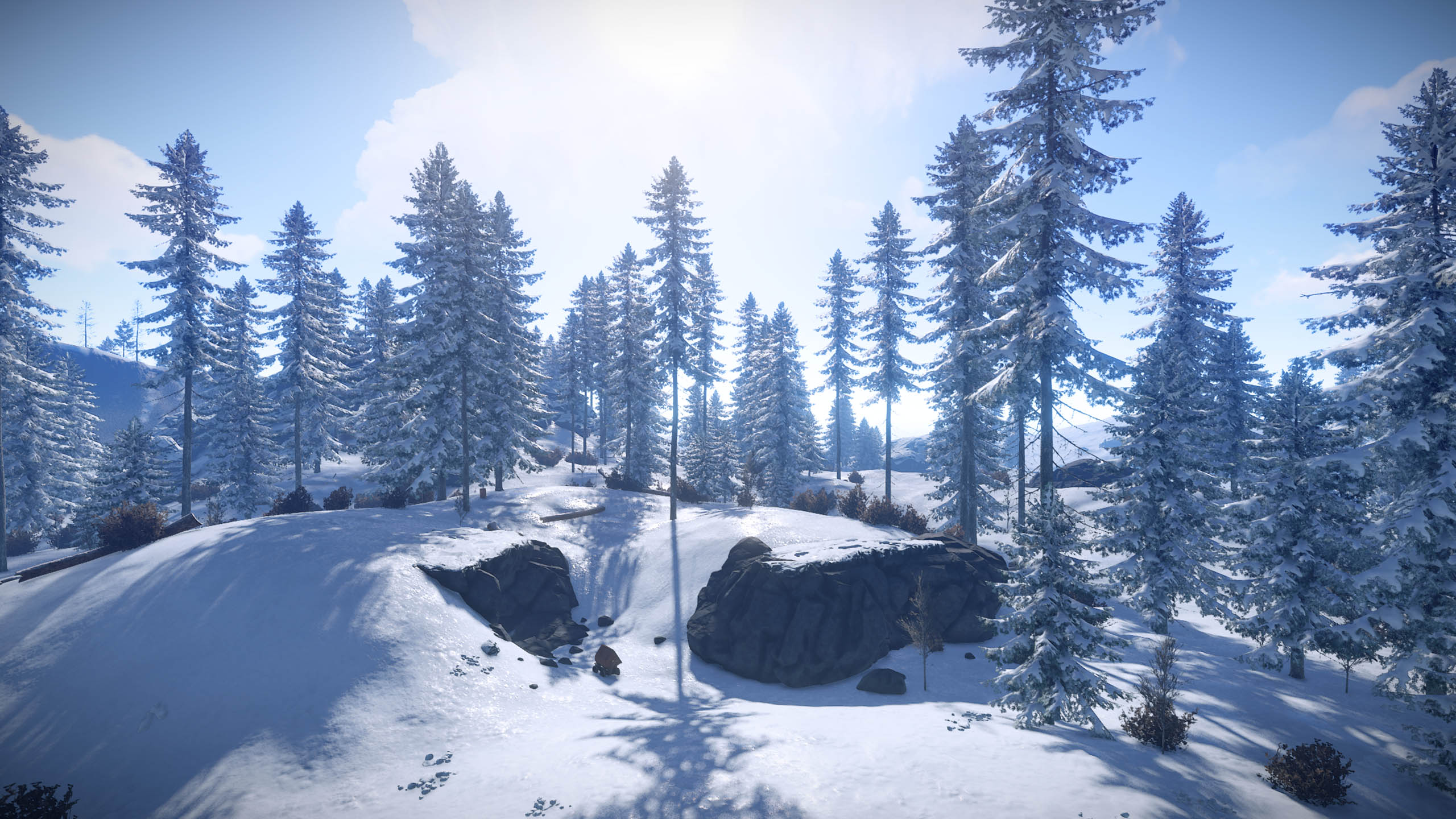
Devblog 196 shipped at the start of February 2018, the last patch before Rust left Early Access. It's a world-focused update: the Water Well mini monuments went live with working pumps, Military Tunnels got a proper level design refresh to support Scientists, and procedural maps gained a lot more cliffs and hills. Andre also did serious netcode work on interpolation and peeker's advantage. This patch wiped maps, with blueprints and maps both going the following week.
Water Wells
Vincent's Water Well monuments arrived with a functioning well at each one. Walk up to the handle bars and press your use key to pump water, then collect it from the barrel beside the pump. Each pump costs roughly 5 calories and yields 50 water, values flagged as subject to change. They spawn in temperate forests and the arid biome, and were also added to Hapis.
Military Tunnels refresh
Military Tunnels had been left deliberately bare-bones years earlier, back when it wasn't clear whether it would end up a focused PvP space or a PvE experience, so the interior was near-empty with just enough loot to function. With Scientists moving in, that no longer worked, so the level design was refreshed to make combat and traversal inside considerably more varied and combat-friendly. Vincent was clear there's more detail and unique visuals that could still be added, but the refresh alone was expected to substantially improve the place.
Tutorial and game tips
Around 60 achievements went in, and the tutorial task list was fleshed out to roughly 15 steps: Getting Started, Tools & Weapons, Sleeping Bags, Building a Base, Securing a Base, Claiming an area, Hunting, Protection, Storage, Furnaces, Metal Weapons, Exploring Pt 1, Projectile Weapons, Exploring Pt 2 and Research - the last four still incomplete at this point. Tutorial titles still needed displaying and the incomplete steps needed more functionality, but combined with the contextual tips it gives new players a real sense of how to play.
For everyone else, game tips can now be switched off in the options menu, or via the convar gametip.showgametips false.
Netcode: interpolation and peeker's advantage
Network entity position interpolation was rewritten to reduce the delay between where the server sees an entity and where the client draws it. The effect is most visible on the test sedan, where the gap between the server's car and the client's ghost was drastically reduced - and that test ran with client and server on the same machine, so any real ping stacks on top. The improvement came from better velocity estimation plus movement extrapolation, and it applies to every moving entity in the game.
That fed directly into peeker's advantage - the reason it can feel like you're being killed around corners even on a good connection. It comes from the gap between what you see, what your opponent sees, and what the server sees. The server takes priority, but there's still the one-way ping from server to client during which a moving opponent can shoot you. Reducing it meant minimising both the client interpolation delay and the delay between incoming and outgoing packets on the server, so Andre rewrote code to ensure packets containing player position updates leave the server immediately after they arrive. Together the two measures cut peeker's advantage by tens and in some cases hundreds of milliseconds.
Memory leak resolved
The elusive memory issue from the previous week was tracked to EAC, which was causing certain page file memory - specifically texture data Unity has to keep in RAM even after uploading it to VRAM - to be continuously loaded into physical RAM. Technically not a leak, but it meant Rust demanded more physical RAM than it needed, which mattered a lot on low-memory machines. Fixed and confirmed: the game now requires significantly less physical RAM.
Terrain, spawns and building blocks
Procedural maps now have far more cliffs and hills, especially in the temperate and arctic biomes, with hilltops visually redesigned around additional clusters of massive rocks. Andre described it as a first step toward more verticality, something he didn't want to leave Early Access without at least starting.
Players and monuments can no longer spawn on tiny offshore islands with no route to the mainland - both now only spawn where a walkable path to the main island exists. Rivers also got a nicer colour.
The pillar building block was removed. It saw very little use and carried significant upkeep disadvantages, though conditional models for wall frames were planned to address the people who liked pillars aesthetically. In the same pass, wall frames now provide the same stability as walls and doorways, which makes bases easier to plan and turns wall frames into a good way to add stability. Double sheet metal doors also lost their wood cost.
Rendering work
Diogo and Matt started a second pass on hair shaders, aiming to make the intersection between hair and skin seamless by writing hair information onto the skin surface itself. That should particularly help at the lowest quality settings, which were problematic, while looking even better with TSSAA enabled.
Disappearing shadows with culling enabled were mitigated. Culling can't use light sources as reference, so it relies on the first-person camera perspective to cull both objects and their shadows, previously with a simple distance test. That range is now extended based on an object's height and altitude - not foolproof, but a significant improvement.
On trees, Damian finished the new models including snow biome variants for all of them, but adding them to the build was delayed pending new billboard generation tooling. Diogo was building exactly that: an imposter system, imposters being a more capable form of billboard that bakes mesh data into much simpler representations so far more can be drawn efficiently. Rust already had a built-in billboard system, but it was limited and inflexible. Once the new one landed, both render distance and tree density could go up, with the trees targeted for the following week.
Scientist AI
Scientists learned to open doors and break down barricades, which required updating the navmesh system since animals shouldn't be able to do either. Rather than wandering randomly around Military Tunnels, they now move between patrol points, which lets Facepunch place them where they make for better gameplay and stops so many getting stuck in corners through bad RNG. The Military Tunnels refresh meant every AI hint for cover, patrolling and spawns had to be redone, and the AI now accounts for transparent walls like fences when generating navigation meshes - so they no longer ghost through fences or barricades. They remained disabled by default, enabled with squadmanager.squad_disable false.
Art and audio
The last viewmodel clothing models were finished, with remaining work on visible seams (notably the Hazmat Suits), smoothing skinning, and a materials pass possibly using detail normal maps to fake extra cloth weave - complicated by the fact that the inner arm is where UV seams get hidden, so detail maps risk making them more obvious.
Alex R set out to finalise every sound in the game and the overall mix before the Early Access exit. He'd worked through just under 1500 sounds, a little under half the total, starting with the older ones needing the most attention. The work is mostly standardising individual volumes, plus EQ tweaks to kill resonances and smooth bass, and fixing granular problems like a single overly loud rock click inside a gravel footstep. Once individual sounds are done, a higher-level mix pass follows - balancing gunshots against footsteps, cutting high end out of ambience to make room, and potentially making the mix dynamic by dropping ambience during firefights.
Admire animations continued across the AK47, double shotgun, Eoka, MP5, water bucket and rock. Chainsaw work also progressed: the original plan for a detailed segmented cutting chain came in at 21,000 triangles for the chain alone, which was unworkable, so it became one continuous mesh with the teeth drawn using an alpha on the same UV, offset in one direction to simulate the animation. That saved an enormous number of triangles and spared the animator a very complex rig.
Elsewhere
Savas KOTH got a recycler and had its loot table updated with recently introduced items, plus a fix for players spawning in the ocean. Hapis old caves now have lighting, and floating barrels at Site A were fixed. An ice lake exploit that let players build near trucks was closed, and there was another EAC SDK update.
The devblog also carried the news that Minh "Goosey" Le would be leaving the team in March - one of the very few people able to model, rig, animate, program, and create particle and sound effects, often within hours.