
What's New in Rust's "Devblog 188" Update
Devblog 188 wrapped up November 2017 with a major gunplay pass: stance recoil only when moving, finalised semi-auto recoil, and instant full-velocity grenades. It also added glowing outlines on dropped items and previewed the mining quarry monument.
Devblog 188 closed out November 2017 with a gunplay pass that mattered a great deal to how Rust plays. Recoil and aimcone rules were reworked so that standing still and tapping is as accurate as crouching, semi-auto weapons had their recoil design finalised, and grenades stopped messing about with hold-to-throw charging. Alongside that came glowing outlines on dropped items, a first look at the mining quarry monument, and a big map generation rework queued up for the next wipe.
Accuracy, recoil and semi-autos
Stance recoil now only applies when you're moving or after your first shot. In practice that means running and gunning still carries a minor aimcone penalty, but standing still and tapping is just as accurate as crouching. Crouching keeps its 50% reduction to recoil and screen bounce, so it still has a purpose - the change simply makes slow, deliberate tap shots perfectly accurate. The Thompson, which had been left out of the aimcone redux a few months earlier, finally had its excessive aimcone corrected.
Semi-auto weapons got their recoil system finalised and rolled out across every affected gun. Tapping at range is far more reliable now because aimcone is reduced to almost nothing, nearly all horizontal recoil was removed, and aimcone only creeps in when you tap very fast at targets well beyond a weapon's intended range - pistols being the obvious example. Even then it stays lower than most shooters. Aim sway on semi-autos was also cut significantly, since it was mostly an annoyance that felt wrong rather than a meaningful skill check.
Grenades
Grenades became much quicker to pin-pull and release, and the "hold longer for a longer throw" mechanic was dropped entirely - they now always throw at full velocity, which also means they go farther. Facepunch flagged this as something they might revisit, but the immediate goal was to make grenades behave like grenades in every other game.
Object outlines
A new system allows a glowing outline to be drawn around any object, and for this patch it was applied to dropped world items. If an item is partially occluded - by grass, typically - you get an outline around it so you can actually find it, and the outline brightens when you're aiming directly at it. The effect is disabled at night. The team was explicit about being cautious here: the feature could expand to other elements, but not at the cost of plastering giant overlays across the world and killing whatever immersion the game has.
Map generation improvements
Andre started a significant map rework targeted at the next wiping update. Monument placement now simulates a large number of potential layouts and picks the one that fits the most monuments on the map, rather than the old behaviour of finding spots for the high-priority monuments and shrugging at the rest even when better arrangements existed.
Roads are no longer cut in half by rivers or flooded with water, and monuments can specify the exact points the road network should connect to, so roads enter and leave a monument in a way that lines up with the roads built into the monument itself. Work remained on the visual transition between procedural and static road sections. The long-standing "user-provided triangle mesh descriptor is invalid" error that struck on certain seeds was fixed in the same pass. Powerlines were moved onto the same layout algorithm as roads, letting them connect through power substation monuments the way roads form intersections.
On biomes, the arctic was trimmed slightly after growing out of hand in the previous month's wipe, and the arid biome was nudged up - with an open question about whether temperate should have been the one to grow instead. All of this shipped with the next wipe alongside the new building system.
Occlusion Culling 2.0
The expanded visibility culling announced the previous week started producing real numbers, in extreme cases cutting rendering time in half, particularly indoors. It wasn't flawless - rotating the camera very fast or opening a door quickly could trigger false negatives, leaving newly visible objects invisible for a frame - and stabilising those cases was the focus. The revamped culling shipped available for testing but disabled by default; you could switch it on with culling.world 1 in the console.
Mining quarry monument
Damian began work on a new monument type built around static stone quarries. Only a few would exist per server, deliberately turning them into contested resources. They're small enough that players can wall them off and build a compound around one, and the devblog showed the first variant in progress.
Skins and the Python
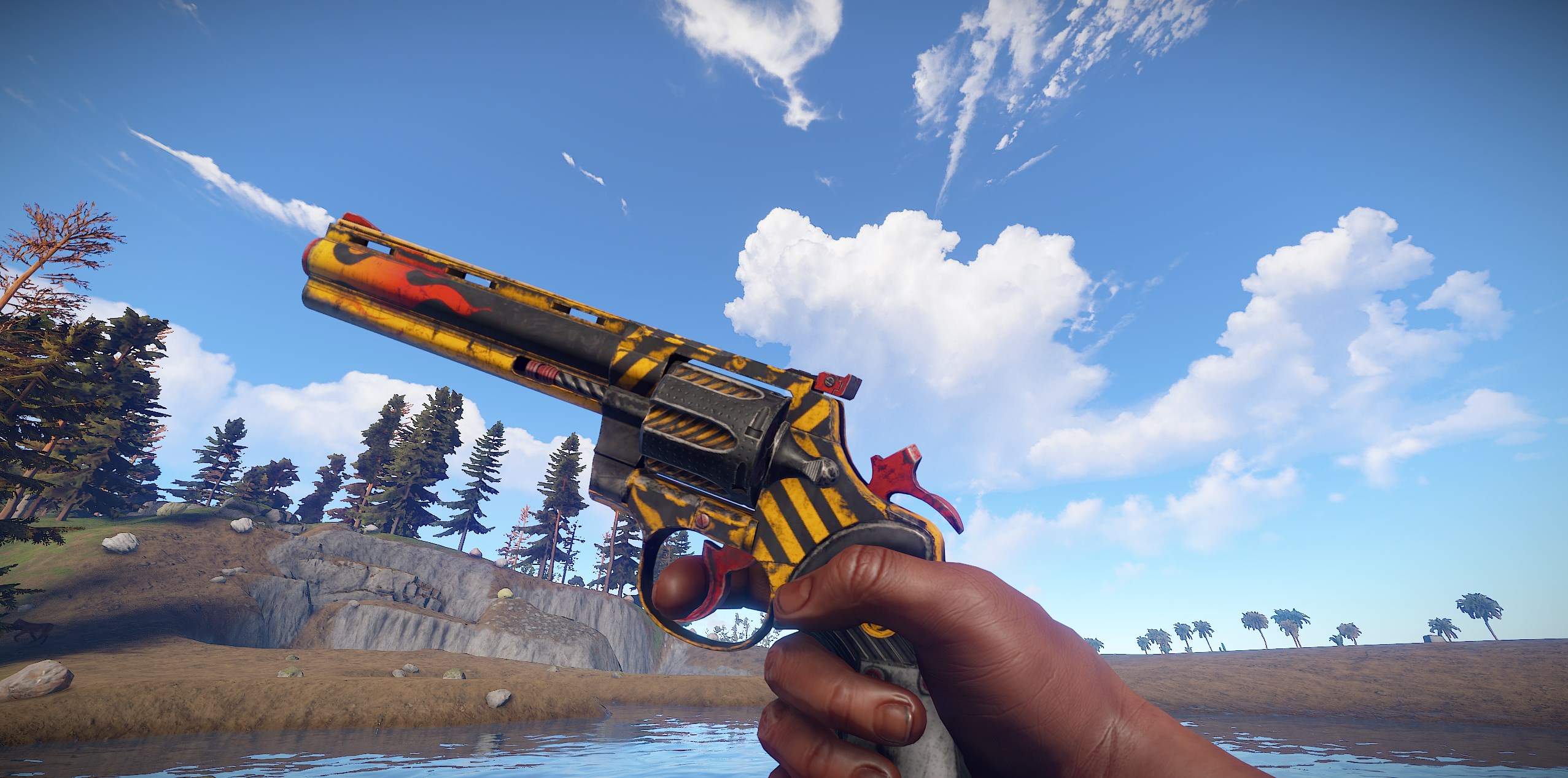
The Python became skinnable this month, with two store skins to go with it: the Devourer and the Phantom. Two more skins went in supporting Charitable Rust ahead of that weekend's event - the Charitable Rust 2017 Hoodie and the Charitable Rust 2017 Relief Crate.
Art and assets in progress
Hair colour went live, with five options - Brunette, Auburn, Dark, Ginger and Light - applied consistently across head, facial and body hair. The underlying system can produce any colour, but the initial set was kept deliberately natural, with more planned and a stated intent to make the duller combinations more interesting.
The craftable hazmat suit was close but missed the patch; the oxygen tank and its tubes still needed texturing. The second lootbox - an advanced toolbox, a battered red toolbox holding more advanced tools than the primitive box - was finished and ready to implement, with small identifying details like a Post-It note added so the boxes read differently at a glance. The old small furnace was reworked to bring it up to the standard of newer assets, targeted for the following week.
Audio and AI
Alex spent the week cataloguing and finalising sounds, having started tracking every sound in the game in spreadsheets. Deployable placement sounds were the main target - many were too percussive and thin, so some were beefed up and others redesigned from scratch, with missing ones noted for future work. Footsteps got a pass too: concrete was dirtied up because it felt too clinical for Rust, dirt steps were smoothed so they're less stompy, metal footsteps (especially jump landings) were quietened, and levels were evened out across footwear and surfaces. New on/off sounds went in for the ceiling light, small furnace, and campfire, with more open/close/ignite/extinguish sounds planned over following weeks.
On the AI side, animals should no longer attack players through foundations or walls, and a broader rework of animal behaviour began - work that would also form the base for scientists, with the goal of making the AI more designable and more predictable.
Fixes worth noting
- The BoneFollower bug that broke mods using parented entities as mountables was squashed, so modded helicopters and horse riding no longer teleport you back and forth as the vehicle moves.
- Tree minigame Xs no longer appear so low that you have to crouch. Colour blind options were acknowledged as the remaining gap, with a global colour blind convar under consideration.
- Dark sign painting UI, hair shader reflections, mounted object delay and jitter, and lingering odd satchel behaviour were all fixed, plus an EAC SDK update and stricter dropbox placement.
Between the recoil finalisation and the map generation work banked for the next wipe, Devblog 188 was more consequential than its modest feature list suggests. If you're tracking the skins that came out of this era, the Python's first two store skins are still worth a look on our skin tracker.