
What's New in Rust's "Devblog 189" Update
December 2017's Devblog 189 shipped Building 3.0 and base upkeep, ending the era of free megabases by making the tool cupboard consume resources on a sliding tax scale. It also added the junkyard and mining quarry monuments and reworked procedural map generation.
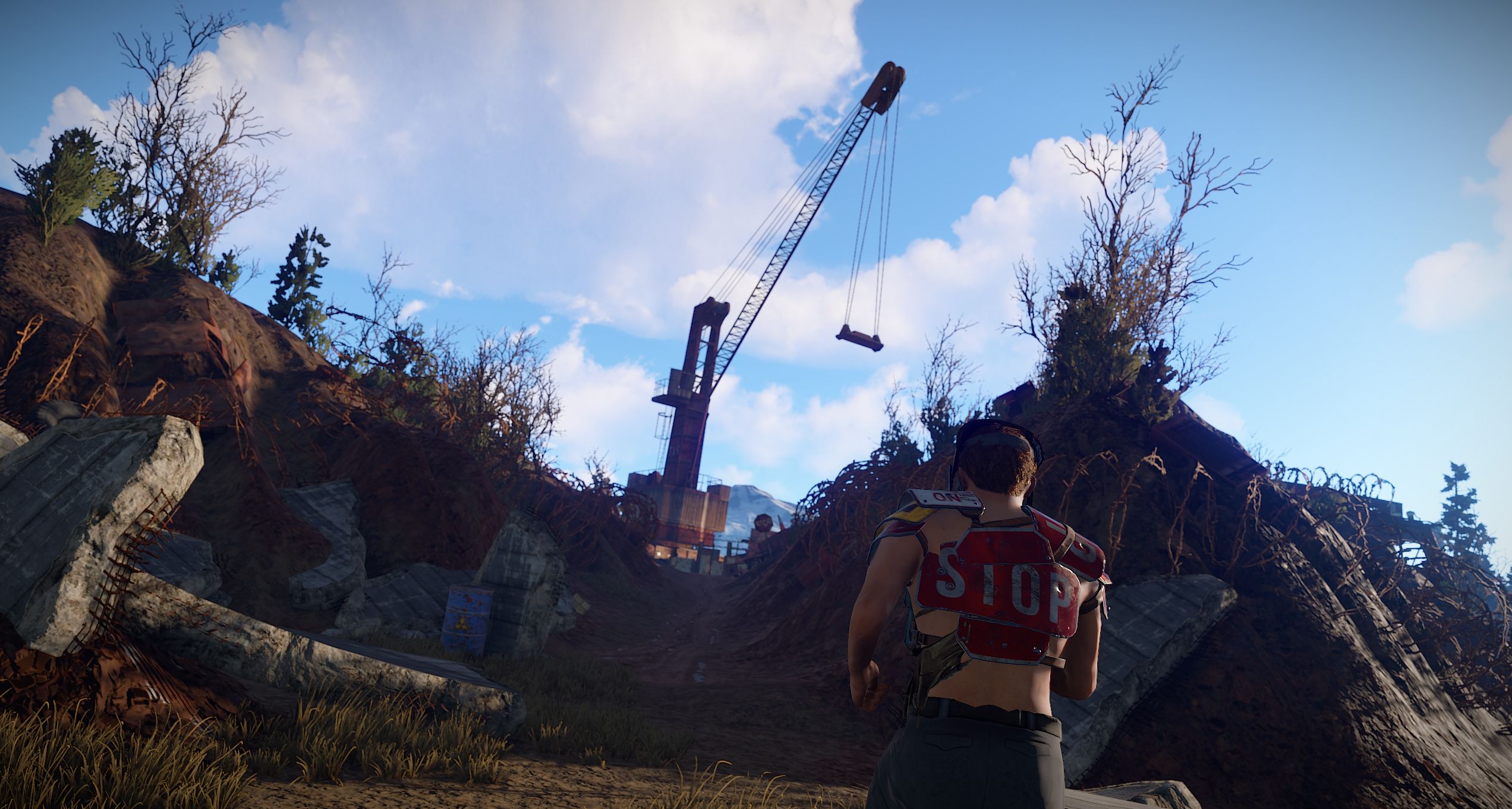
Devblog 189, shipped in December 2017, is one of the genuinely landmark Rust patches. It brought Building 3.0 out of the branch and into the live game, and it introduced base upkeep - the tool cupboard tax system that ended the era of free, permanently pristine megabases. On top of that came two new monuments, a complete rework of procedural map generation, and a long-overdue pass on Hapis Island. This one wiped servers and blueprints.
Building 3.0
The new building system landed in full. The headline changes:
- Foundations can be placed at a half height offset.
- Half height walls were added to even out those offsets.
- Various wall stacking exploits were fixed.
- Roofs now occupy wall sockets, so they can no longer be used as honeycomb layers.
- Building privilege is emitted by the entire building rather than a single point.
- There can only be one tool cupboard per building.
That last pair of changes is what made the upkeep system possible - if the whole building projects privilege and only one cupboard can exist inside it, the game finally has a clean definition of what "your base" is.
Building upkeep
This is the change everyone remembers. Previously, as long as a door was opened, a base wouldn't decay for days. Two problems came out of that. Servers leaked entities badly, because a neighbour opening their door kept your abandoned base alive indefinitely after you'd left for good. And there was no ongoing cost to building enormous near-unraidable structures - farm a million stone once, spend it, done.
The tool cupboard can now store resources, and those resources are consumed to keep the base from decaying. It works like a progressive tax: the first blocks are cheap to maintain, and the cost per block climbs as your base grows. The launch values, all configurable by convar, were:
- 1-15 blocks: 10%
- 15-40 blocks: 15%
- 40-75 blocks: 20%
- 75+ blocks: 33%
So a two-by-one pays 10% of the base's cost per 24 hours - effectively nothing. A giant clan base needs a serious resource stream just to stand still. The stated design goal was to push players toward intelligently designed bases using traps and triggers as defences, rather than simply stacking 50,000 HP of stone in a raider's way.
Decay now works from the outside in, so the centre of a base survives longest. Default decay timers per tier:
- Twig: 1 hour
- Wood: 2 hours
- Stone: 3 hours
- Metal: 5 hours
- Armored: 12 hours
An unmaintained all-stone base therefore sheds a layer every three hours. Conversely, if upkeep is being paid, the base slowly repairs itself at the same rate it would have decayed - so hard-to-reach walls and sealed-off sections heal on their own once you put resources back in the cupboard.
Facepunch were upfront that this would be unpopular and that the numbers weren't final. The idea of a grace period before decay was raised and rejected, on the grounds that players would just drop resources in for a single tick and pull them straight back out to reset the timer. Follow-up work was planned for the next week: help text and pop-ups explaining what's happening, and a visualisation of the building privilege zone while holding the hammer. Server owners who wanted the old behaviour could run decay.upkeep false.
Cost rebalancing
With upkeep making budget builds far more relevant, several costs were revisited. The Armored tier - almost never used because of its absurd price - dropped from 50 HQM, 400 stone and 300 wood to a flat 25 HQM, with armored doors reduced to 20 HQM. Experimenting at the Tier 1 workbench fell from 100 scrap to 75. The Stone Spear no longer requires a workbench at all, and the Dropbox moved from Tier 2 down to Tier 1.
Grenades, part two
The previous patch's grenade changes only solved half the problem, so the rest went in here. Grenades now inherit the player's velocity the way they do in other shooters, meaning a running jump throw sends them considerably farther. The F1's blast radius was also doubled, making them meaningfully more lethal and, hopefully, actually worth carrying.
Procedural map generation
The monument placement algorithm was completely reworked. Rather than placing high-priority monuments and accepting whatever fit afterwards, the generator now finds the distribution that packs the most monuments onto the map, addressing seeds that produced huge empty wastelands with nothing to explore.
Procedural roads now connect to the roads built into monuments, with each monument specifying its own in and out points. It looks far more realistic, and it opens the door to future AI patrolling the road network from monument to monument. A batch of road bugs went with it: roads are no longer split in half by rivers, gaps between roads and terrain were closed, and roads can no longer end up partially flooded. Road visuals were updated too - roads sit more flush with the terrain, read more clearly across the landscape, and look more interesting. The original plan of alternating dirt and asphalt segments was pushed to a later date.
Power lines moved onto the same layout algorithm as roads, producing something that actually resembles a power grid. A neat side effect: where power lines meet at an intersection, a power substation monument spawns there.
Biome-wise, both the arctic and arid biomes grew slightly, and a bug was fixed where ice lakes were blocking spawn locations and leaving the arctic biome almost entirely without monuments.
Junkyard and mining quarries
The junkyard monument went live. It's built differently from Facepunch's earlier monuments - more detail-focused, with pockets of action and plenty of choke points, deliberately controlling the flow through the space instead of offering the wide-open layouts and many routes older monuments had.
The mining quarry monuments also shipped, with three variants spawning per map. Crucially, old deployable quarries are no longer craftable - only the monument quarries function. They spawn in Tier 2 areas of the map, in different biomes depending on the world seed, and their rarity was intended to make them heavily contested. Each quarry produces a different resource and is marked accordingly on the map: HQM, Sulfur, or Stone/Metal.
Hapis Island overhaul
Hapis got a long-overdue round of work from Alistair:
- Launch Site added
- Ice sheets and icebergs added
- New "Pumping Station" and "Abandoned Boat" loot areas
- New static quarries
- The old caves brought back
- Complete rework of Site A
- Site B moved to the east coast
- Fixes to loot and ore scarcity, and to older radtowns
More Hapis work was planned for the next force wipe, mainly bringing the remaining old radtowns up to date with newer assets.
Quality of life
When a placement guide turns red you now get an actual error message explaining why, rather than having to guess - a sensible addition given how much the building rules changed in this patch. Health bars are also no longer permanently displayed on building blocks and deployables; they only appear when an entity is below 95% health or when you have the hammer equipped, which cleans up the view considerably at night.
Occlusion culling, Steamworks and voice
Occlusion culling work continued after the previous week's false negatives. The process was reviewed and made more conservative in several places, and a workaround landed for the frame delay problem - alongside a rewrite of the system's worst bottleneck, now 6x faster. Trees are culled with everything else, and dynamic items like drops are supported. Shadows were the remaining sore point, with popping or disappearing shadows caused by objects invisible to the camera still needing to be visible to lights. The convar was renamed while stabilisation continued: culling.env 1 to enable, culling.env 0 to turn it back off, with another week of testing planned before enabling it by default.
Steamworks was updated to 0.7. More notably, P2P voice was removed. Voice chat had been routed through Steam's P2P network so players sent voice data directly to each other rather than through the server, but people were using it to discover other players' IP addresses and DDOS them, so it went back to the traditional server-routed approach. The upside is that server-side voice opens the door to loudspeakers, phones and tape recorders down the line.
Art and audio
The small furnace was reworked again after community feedback, landing with a more nostalgic look - and it's skinnable. Water effects were in progress for events like bullets hitting water and underwater explosions, along with tweaks to the water effects produced by vehicles moving through water, with boats in mind.
Deployable audio got a heavy pass: new on/off and ignite/extinguish sounds for essentially everything, a new sound for aiming the searchlight, and unique active loops for objects that never had one (the refinery and searchlight among them), plus polish on existing loops. Open/close sounds for lootable objects began rolling out, with the two wooden boxes and the small furnace covered this week and the rest to follow.
The full changelist runs long, but a few smaller fixes are worth flagging: monument chainlink fences can now be shot through, the hammer highlight on wooden triangle foundations was fixed, and the odd camera movement on jumping introduced in the previous patch was corrected. Between Building 3.0, upkeep and the map generation rework, this was the patch that reshaped how Rust bases are built and maintained - and much of that design still holds today.