
What's New in Rust's "Devblog 181" Update
October 2017's Devblog 181 was the cleanup pass after blueprints landed: rebalanced Launch Site, Bradley and airdrop loot, a tripled workbench radius with its exploit closed, map grid coordinates, and a proper fix for why stone nodes had become impossible to find.
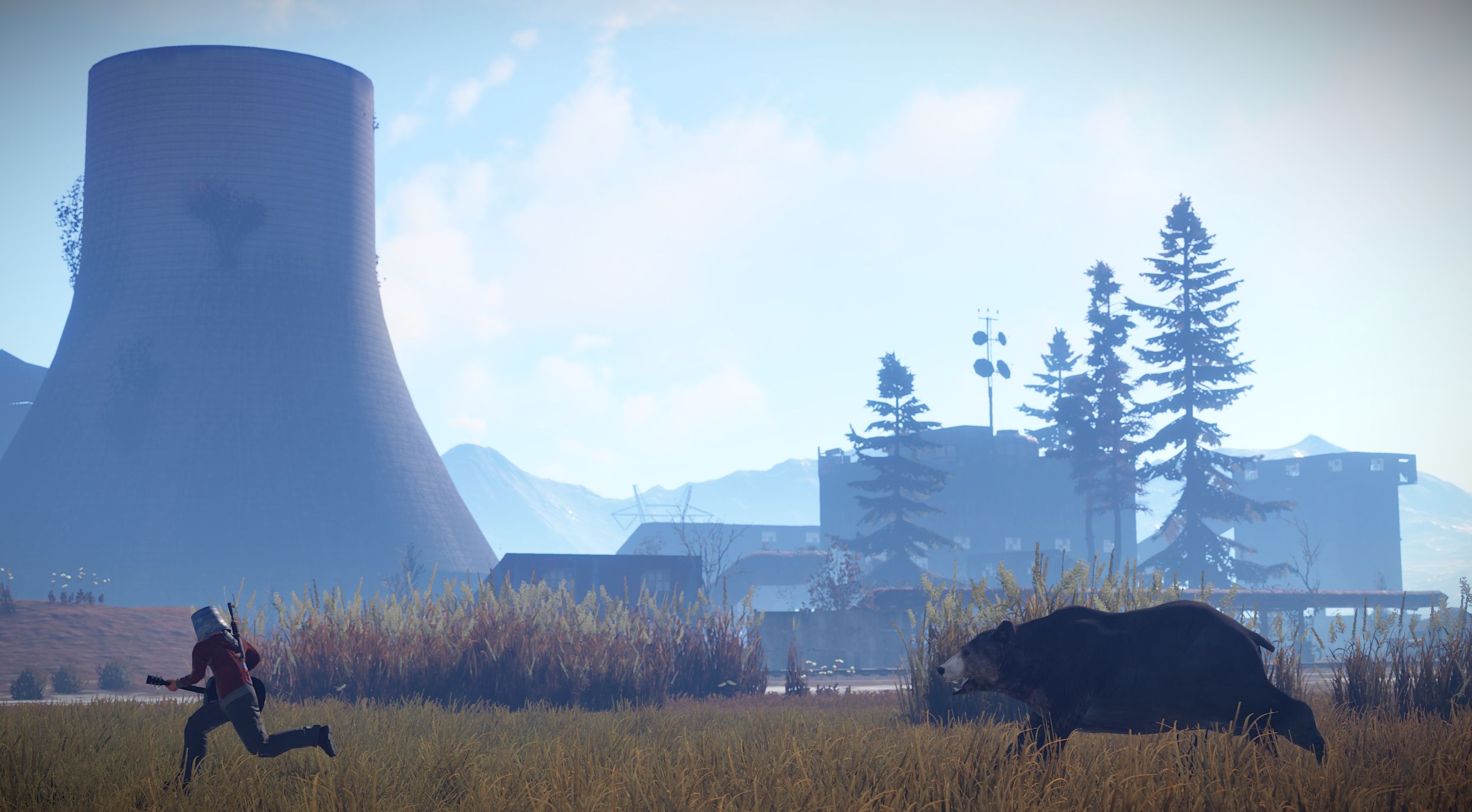
Devblog 181 arrived on 12 October 2017, one week after blueprints landed, and it's exactly the kind of patch you'd expect: a long list of balance corrections, exploit fixes and oversights caught in the wild. Helk rebalanced airdrops, Launch Site and caves, fixed a workbench exploit he'd watched happen on stream, and added map grid coordinates. Andre fixed the reason stone nodes had become impossible to find, and killed a packet exploit that could take servers down.
Map additions
Now that the map is a default feature rather than a craftable piece of paper, Helk felt freer to improve it. The headline addition is a toggleable grid overlay with coordinates, off by default and switched on with the top left button. Each grid square is 150x150 meters, lettered along the horizontal axis and numbered along the vertical. He described it as a little ugly with minor artefacts while the map is in motion, but functional — and it solves the perennial problem of describing a location to a friend.
The other new marker is a crash site explosion icon. Whenever the Bradley or the patrol helicopter is destroyed, a yellow and red explosion icon appears at that location and sticks around for about 10 minutes. As Helk put it: have fun waiting for the fires to go out to get the loot now.
Vending machine tooltips were fixed so a blueprint being bought or sold displays "(BP)" next to the item name instead of just the item name, which had been misleading. For modders, map drawing is enabled (a bug where those drawings persisted across game sessions was fixed) and support was added for drawing a radius of any colour — aimed at gamemodes like Battle Royale that want to render a radiation radius.
Launch Site, Bradley and airdrop rebalance
The most substantial gameplay changes target where high tier loot comes from. Helk's stated aim was that you should have to invest what you have to get something better.
- The Hazmat Suit no longer protects 100% against the highest tier of radiation. The cooling tower at the NPP and the top of Launch Site now leak a little radiation, so you can't camp up there indefinitely.
- Elite crates spawn half as many items, one fewer spawns at Launch Site, and they respawn every 2 hours instead of every 20 minutes. Hapis site B gained a chance to spawn elite crates.
- The Bradley's loot table now resembles the elite crates, and it drops 3 of them — so the good stuff requires actually destroying it with explosives.
- Bradley respawn moved from every 15 minutes to once an hour, it drops less ammunition to make room for other items, and its healing was slowed considerably: 10 minutes before it starts, another 5 to fully heal.
The logic behind the Launch Site delay was that with camping removed and respawns slower, large groups have to wait in more precarious places for longer, increasing their exposure to shots from other players — giving smaller groups a chance at the loot up top while big clans focus on the Bradley for a sure thing.
Airdrops went the other direction. Loot tables now make good guns like rifles and SMGs much less likely and lower tier weapons like shotguns and ammunition much more likely. The goal is to make airdrops a PvP event pitched at lower-geared players while Launch Site remains the high-end clan destination — with the side benefit of fewer people running automatic weapons within 20 minutes of a server wipe.
Blueprint and crafting cost corrections
A run of oversights from the progression launch:
- The Stone Spear and Water Purifier are now default blueprints, as they should have been. Small and medium wooden signs too.
- The Ceiling Light, Guitar and Planters dropped to a lower scrap tier, along with many other decorative items.
- The Flamethrower now requires a level 2 workbench instead of level 1, to stop people endlessly torching wood bases — funny, but a genuine problem.
- Hoodie and Pants dropped to a lower scrap tier requiring 75 scrap to research, down from 250.
- The Snow Jacket and Vagabond Jacket now cost 50 cloth to craft instead of 100 and 200 respectively, and spawn more commonly.
Helk also fixed a mistake in the blueprint system that had made Steam items — town signs, picture frames, hats — uncraftable even if you owned the Steam item, so players saw a batch of "NEW!" items on their next login. A related regression that allowed those signs to be researched was reversed: you can only craft them if you own the Steam item.
Cave loot and headgear
Cave loot tables were overhauled. Fewer Miner Hats and Candle Hats, and the ones you find carry less Low Grade Fuel — Helk mentioned having about 800 stockpiled. HQM drops fell to 1-2 instead of a solid brick of 5. Stone tools were added to the crate loot table with a reasonably high chance, in exchange for a lower chance of salvaged tools, which remain in the table but appear less often.
Head-mounted lights got attention too. The candle hat is much dimmer, because an errant zero in its light radius had made it the brightest light source in the game apart from the spotlight, with a range of 50 feet. The miner hat's emissive portion no longer stays lit for other players when the light is off, which had been turning wearers' heads into beacons. It also gained a blinding flare like the flashlight.
Protection values were added to the Boonie Hat, Cap and Bandana, which Helk was pleased about since they look considerably better than the Burlap Headwrap and you can stack them for as much or more protection. The Candle Hat now matches a cap and the Miner Hat matches a Burlap Headwrap — not much, but much better than nothing.
Workbenches, pickups and recycling
An exploit involving a chair and the workbench granted workbench access anywhere on the server. It's fixed — Helk noted he'd seen it on stream. He also tripled the workbench radius so you can move around a bit while crafting, adding a visibility check so people outside your base can't piggyback on it. Workbenches can also be rotated with a hammer if you somehow place one backwards.
That prompted a broader note on craft times. Suggestions to extend the radius to tool cupboard range struck Helk as lame; his preference was lowering all item craft times to no more than a few seconds, or adding a minigame that completes crafting instantly. He acknowledged having no craft time at all makes crafting feel less satisfying, and left it unresolved.
With the map rapidly filling with junk, pickup rules were loosened: you can now pick up most objects outside any tool cupboard range, so roadside garbage is free resources. The Repair Bench and Research Bench can also be picked up and moved. The Workbench was deliberately excluded — its high health would allow exploits like sealing someone in behind their own door — with a solution promised later.
Simpler deployable items now drop as blueprints rather than full objects in barrels and crates, which should reduce litter and might get people actually crafting them since no scrap is needed to learn them.
Since you can't repair items without their blueprint, a stack of broken high-end gear was a tease, so recycling ratios changed to give a minimum of 10% of an item's resources when recycling broken items. Items also remove attachments and ammo when recycled, and sewing kits contain half as much rope, cutting their recycle yield to around a quarter.
Base lighting got cheaper and better: Lanterns and Tuna Can Lamps are brighter with a larger radius, and the Lantern costs 25 Metal Fragments instead of 40, with minor colour and light animation tweaks.
One more embarrassing fix: peacekeeper mode didn't work at all. It does now. Helk declined requests to stop peacekeeper turrets shooting animals, on the grounds that turrets aren't meant to be out in the open and this acts as a deterrent — his ask was that people keep them in private areas rather than overlooking the beach.
Stone scarcity, finally explained
Andre solved a mystery players had been complaining about: stone nodes were far harder to find than metal or sulfur. The cause was that the resource spawner used a simple dice roll to decide what to respawn whenever something was harvested. That produces the right distribution if everyone harvests all resources at similar rates — but if players heavily focus one resource, that resource becomes progressively rarer as other resources block its spawn locations.
The spawn handler now respawns resources such that the end result always matches the desired distribution. If players harvest only stone and ignore metal entirely, only stone respawns. One caveat for server owners: on a loaded save the change applies slowly, since existing ore entities are unchanged — deleting them and letting them respawn from scratch fast-tracks it.
Andre also fixed a packet exploit that could bring servers down by making them spam messages into their log file. As a safeguard he added a debug.log convar that can be toggled to completely disable server logging at runtime. High external wall deploy volumes were tweaked to make placing that final wall piece when closing a compound less fiddly, without sacrificing the minimum enforced distance when stacking walls.
Vehicles, icebergs and viewmodels
Vincent started greyboxing vehicles on a separate branch, following the approach in Howie's concepts: build vehicles around a chassis or base that varies in length, with sockets on the chassis where modules plug in. How modules interact with the frame and each other still needed a lot of discovery and tuning.
Damian's iceberg week was mostly groundwork — a set of tiling materials built in Substance Designer for use across the snow biome, high poly ice sheet models, and experiments with texturing and blending techniques to remove seams across the large iceberg meshes.
Alex Webster merged the viewmodel cleanup. Visually the only change is a new set of arms, but the codebase is now in shape to start viewmodel clothing tests once Taylor has time to make test meshes. The changelist carries a long tail of viewmodel fixes from that work: hands intersecting when aim running on the pickaxe and big cleaver, arm clipping on the satchel charge, beancan grenade, m249 and sawnoff shotgun at max FOV, popping on the bone club's throw cancel, and an updated AK47 base pose.
Taylor continued the craftable hazmat suit, enjoying the cobbled-together look held together with duct tape and planning to weather the fabric heavily to contrast the scientist suit's clean finish.
Graphics fixes
Diogo fixed artifacts caused by a bug in the screen-space water reflections code — mild-looking in a screenshot, but potentially much worse depending on graphics configuration, lighting and motion. The previous week's viewmodel shadow fix had introduced a new bug in other visible areas, which took work to resolve without breaking the viewmodel, so interior shadows are back to normal. That same change had also left the viewmodel's legs below the knee invisible in shadow; leg shadows now show and match footsteps as closely as possible. He also went back to hair integration, improving the shader to support all anti-aliasing modes and helping with performance testing and pipeline work.
The rest of the changelist
The project moved to Unity 2017.1.2. Drinking is now only allowed when water reaches a certain depth, with improved water intersection test performance. Process memory usage was added to system info. Satchels have a slightly lower chance of being a dud, HQM yield from helicopter and Bradley gibs was reduced, and a Launch Site exploit that let players hide inside a wall was fixed.
The devblog also closed on a candid note about Steam reviews taking a beating — the team believed the changes were well received by most people and that reviews skew toward the annoyed, and asked anyone who wasn't annoyed to leave one too.