
What's New in Rust's "Devblog 180" Update
October 2017's Devblog 180 rebuilt Rust's core loop: blueprints returned, scrap and three-tier workbenches arrived, and nearly every item was locked behind research. It also shipped a genuinely new road network algorithm and the first arctic ice lakes.
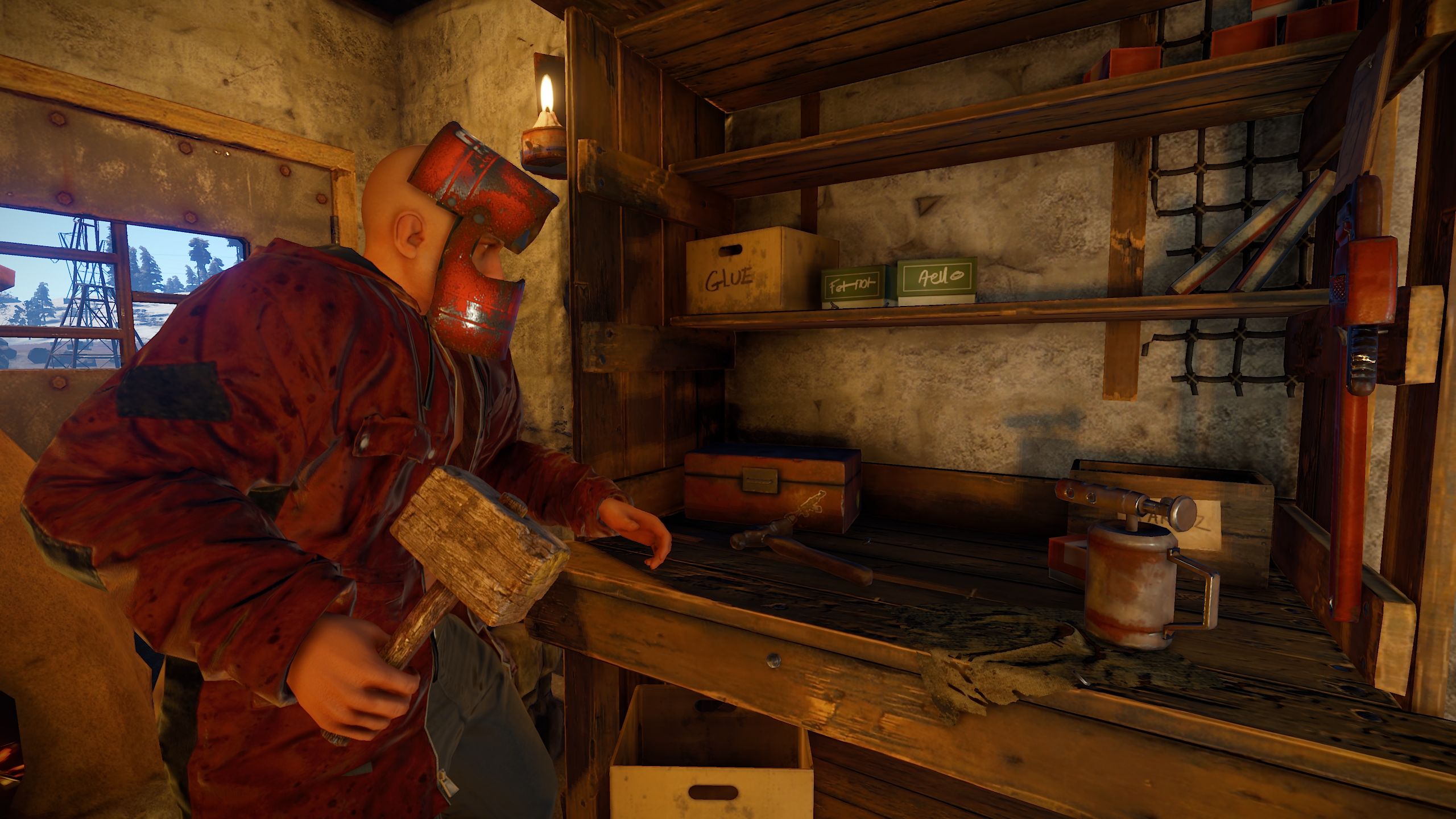
Devblog 180 landed on 5 October 2017 and it's one of the most consequential patches in Rust's history. This is the update that brought back blueprints, introduced scrap and workbenches, and locked nearly every item behind a progression system — the shape of Rust's core loop that still holds today. It wiped the servers, and Helk was refreshingly clear that it was neither finished nor balanced.
Blueprints 3.0
The motivation was stated plainly: the team, along with everyone else, was unhappy with how easy it was to reach top end gear and how little reason there was to keep playing after being killed. So the first iteration of blueprints' return went in.
Helk's disclaimer was extensive and worth repeating. It's in no way feature complete, probably completely unbalanced, and may contain oversights that break the game and need weekend patching. Nothing was set in stone — if an item cost 90,000 scrap, that was a bug, not a design statement. He also warned that a blueprint wipe in a month or two was likely once things were straightened out.
Here's how it worked at launch:
- You start with some default blueprints — campfires, furnaces, workbenches and storage. Helk noted there were about 50 defaults, which he described as insane, with the eventual intent to unlock them gradually through simple actions like crafting sub-items.
- Looting works as before, except anything you loot or any barrel you break has a decent chance to drop a full item such as a weapon or tool. Found weapons come with very low condition, so their direct usefulness is limited — the point is to give you a source item to research.
- Take that item to a research bench (found in the world or crafted) and turn it into a blueprint. The cost is scrap, with no chance of failure. Study the blueprint to permanently learn the item, or trade it to another player.
- Workbenches come in three tiers, each requiring significant scrap, and each requiring the previous tier to craft. No saving up and jumping straight to tier three — you go 1, then 2, then 3.
- Place a workbench, stand near it, and watch for the workbench status symbol on your HUD. While active you can craft anything at that tier and below, and items craft much faster when your bench tier exceeds what the item requires.
Components can be researched, but require scrap to produce — the same amount they required at the old research tables — and a tier three workbench. Helk also cut the HQM yielded from components by roughly 75-80%, calling the old numbers completely out of whack, and noted that quarries should be more valuable as a result.
One more change with real consequences: you can only repair items you have the blueprint for, with a pass granted for items you can't learn. The aim is to stop players stockpiling radtown weapons and never bothering to craft anything. Helk closed by saying progression had been an issue in Rust for about a year and he badly wanted it finalized so the team could move on to more exciting work.
Vending machines and mod support
To encourage the trading that blueprints make possible, vending machines became default blueprints and got much cheaper: from 50 high quality metal and 3 gears down to 20 HQM and 3 gears. Out of stock items now appear greyscale on the admin list, and an exploit that let players access containers through the side of a vending machine was fixed. Shopfronts also got a cost reduction.
For modders, spectators can now use the map, and sending the craftLevel RPC to clients with any non-zero value marks everything as unlocked client-side — no workbenches needed, and the UI stops displaying workbench requirements or new-item indicators.
Raid balance follow-up
Andre cleaned up exploits and imbalances that surfaced after the previous week's ladder and twig raiding changes. Ladders can no longer be blocked by concrete, stone or sandbag barricades, and high external walls and gates now require some padding between them when placed behind one another.
The new road network
Andre finally shipped the first iteration of a road planning algorithm he'd started months earlier. His assessment of the old one was harsh: roads were constantly interrupted and didn't connect in ways that made sense, because it was still built on a basic graph algorithm from roughly two years prior.
The new algorithm adds T and Y intersections wherever they make sense to simplify the network, the way a real road planner would. The result is no longer a loose collection of disconnected segments — you can clearly identify main roads and smaller side roads connecting nearby monuments.
It's still far from finished. He wanted to add more redundant connections even where they aren't needed to reach every monument, opening up shortcuts and connecting dead ends back into the main road to form more circular shapes. After that, road connection points on monuments so generated roads lead smoothly into a monument and continue out the other side. A useful side effect of the change: total road length increased substantially, giving junkpiles more room to spawn.
Elsewhere Andre optimized the format maps are stored in on disk to speed up loading, primarily as preparation for server-side maps — think modded custom maps — with the file format improvements letting him keep working on it in non-wiping updates. He also fixed drinking from rivers and lakes, which had been weird and buggy partly because you had to actually swim for the interaction menu to work.
Ice lakes arrive
Damian's ice lakes now spawn in the arctic biome. They serve no gameplay purpose at this stage and exist for visual variety, though they can be built on. As the first natural monument they took longer than expected, but he treated it as a learning exercise to carry into future ones.
The icebergs and ice sheets again missed the cut, still needing polish, optimization and playtesting. He'd made a set of tiling textures mixing ice and snow for them, with the next few days going into texturing every iceberg and ice sheet so they hold up both at distance and close up.
Graphics: foliage, viewmodels and the holosight
Diogo returned to foliage shading. The existing foliage shader was built quickly to meet an immediate need and had been serving as a placeholder ever since. The new implementation adds proper two-sided lighting, correct specular and subsurface scattering, with rollout planned for early the following week — though the actual transition would take longer, since artists need to review every vegetation material and possibly remake some meshes.
He also removed the player's own shadows from the viewmodel. He had mixed feelings, but the overwhelming opinion was that shadows cast onto your hands and weapon had to go, and the fact that Rust's shadows don't look great on lower settings didn't help the case for keeping them. The fix creates an exception so viewmodel meshes don't receive self shadows originating from invisible parts of the player's body — a step away from realism that's less distracting in practice.
The holosight had been rendering strangely with motion blur enabled, and fixing that surfaced a second bug where anything behind the holosight wouldn't blur. Both are now resolved. Other rendering fixes covered ambient occlusion around vegetation, player shadow projection being noticeable on ceilings, and sky reflection intensity mapping.
AI, hair and animation
ptrefall stepped away from the new steering tech, which was proving hard to stabilise after a string of failed approaches, and revisited animal behaviour AI instead. Movement and actions weren't running as separate behaviours, which meant animals that naturally flee could never fight back — no longer the case. Scientists can now shoot animals, and navmesh generates properly over terrain when animals are already in the area. Previously it was first come, first served, a glitch in how the custom terrain collision mesh was used that could cause secondary agent types to run through the terrain. He also started on group logic, working toward a light squad setup for Scientists using ideas from the steering experiments in a more confined form.
matt.i continued on player hair, where the remaining major hurdle is fitting hair to all head shapes — currently being approached with morphs and blend shapes. A useful side benefit is model variation, and as an experiment he built eyebrow shapes that blend between each other for more character variety. He was also fitting hair around all in-game clothing, with performance benchmarking underway.
Pilgrim nearly finished the BBQ, with textures almost done before moving to LODs and integration prep — and confirmed the lid closes so everything stores neatly. On animation, work went into using IK for foot placement on uneven terrain: Unity's IK gives decent results but needs a fair amount of tweaking around the animation and the IK on/off blend. Vehicle work covered steering animations for driving, which took effort to line the hands up with the wheel, plus surface-specific wheel smoke for water, grass, sand and so on.
The rest of the changelist
Bus stop and power substation spawn rules were improved, world serialization compression made more efficient, water map encoding improved, and t-shirts and longsleeves became much cheaper and no longer require a sewing kit. But everything in this patch is a footnote next to blueprints — this is the wipe where Rust's progression loop was rebuilt from scratch, and the following weeks were spent tuning it.