
What's New in Rust's "Devblog 179" Update
September 2017's Devblog 179 previewed the incoming blueprint, scrap and workbench progression system while shipping a major raid balance rework that stopped twig towers beating high external walls - plus pickup-able boxes, stackable ladders and the death of the map item.
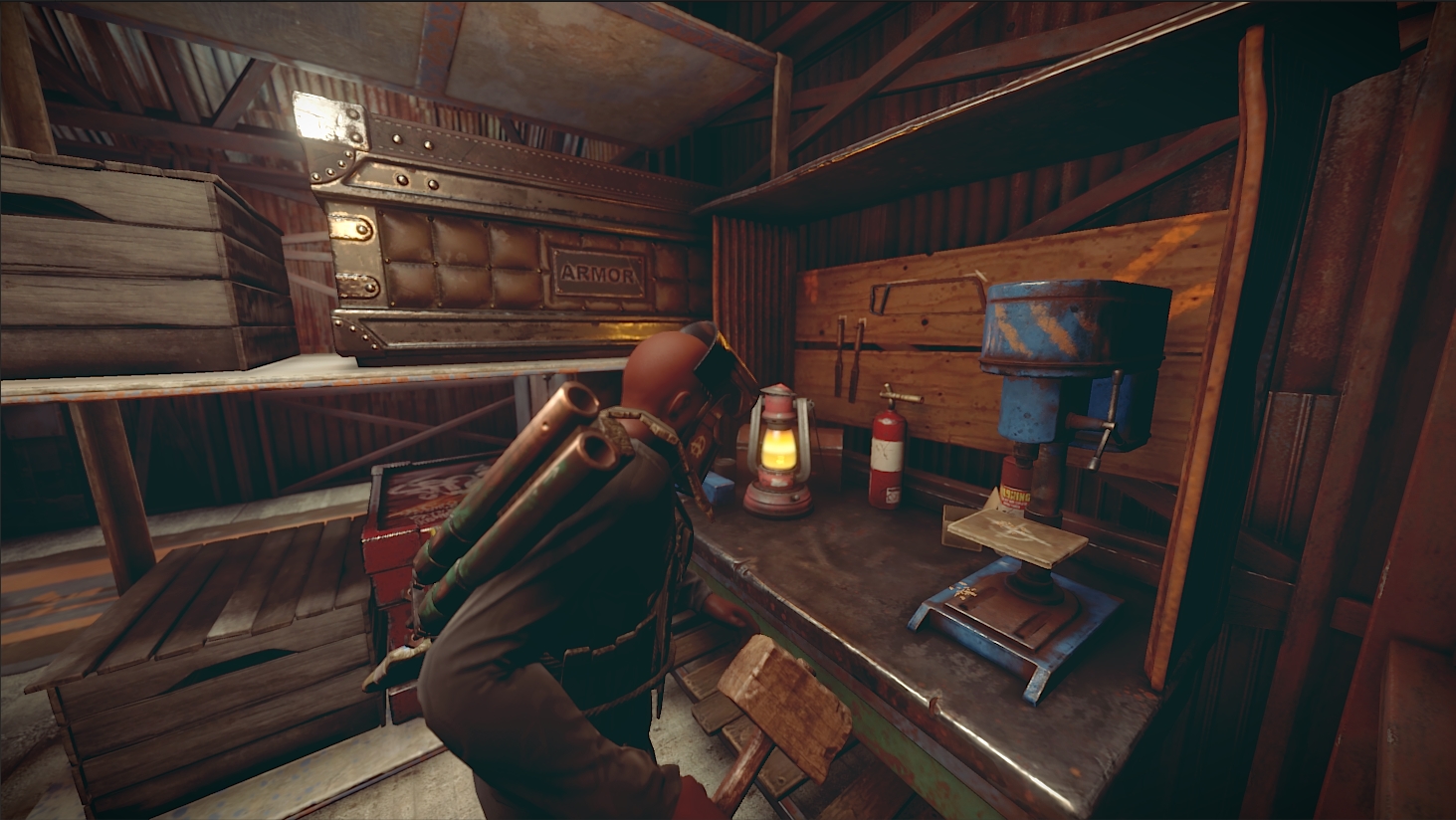
Devblog 179 shipped on 28 September 2017 and it's the calm before a very big storm. Helk spent the week building the progression system — blueprints, scrap, workbenches — that would land at the next forced wipe on 5 October. In the meantime the patch itself delivered a substantial raid balance rework, a set of quality-of-life base changes that let you finally pick up your own boxes, and the removal of the map item.
Progression: what's coming next week
Helk laid out the plan in detail ahead of the 5 October wipe. Outside of default blueprints like campfires and spears, everything is locked. To craft more advanced items you need to obtain blueprints.
The main route is the research table — by Helk's count, its fourth incarnation. You put a source item in along with a specific quantity of scrap and it produces a blueprint item. No percentage chance of success, no RNG, just a flat cost. A crucial consequence of that design: blueprints are items, so they're tradable. Helk spent significant time getting vending machines to handle them, so they can buy and sell blueprints — in the administrator menu you click the little blueprint icon next to an item to trade the blueprint rather than the item itself. Scrap is found in the world, and some items produce it via recycling.
The other pillar is workbenches. Items require a specific workbench tier to craft based on their own tier. Lower level workbenches can be found at some radtowns, though Helk was blunt about the practicality — have fun dragging all your materials there. Each workbench requires components that can only be crafted at the previous tier, so skipping ahead isn't possible. Workbenches also reduce craft times: the lower an item's workbench requirement relative to the bench you're using, the faster it crafts, up to a 75% reduction.
All of this forced a major loot table overhaul, since radtowns need to drop full items again to give players something to research. Helk called it a game changer and hoped for the best, stressing that everything was subject to change and that this kind of upheaval is exactly what early access is for.
Base renovations
The quality-of-life batch is the part players felt immediately. You can now place shelves over existing wood boxes — which is somewhat redundant, because you can also now pick up and replace small and large wood boxes, fridges and furnaces.
The caveats: the container must have an empty inventory, you need tool cupboard access, and you must have a hammer equipped. Picked-up deployables lose 20% condition, and they can now be repaired at repair benches. A knock-on benefit is that since boxes can be picked up, you can now change their skins at the repair bench.
The furnace costs 100 less wood to craft, but no longer spawns with 100 wood inside — because of how the code works, you could otherwise pick up and replace the same furnace repeatedly to farm the starting wood.
Goodbye, map item
Helk described the map item as a ridiculous hoop for a feature very few players used. You can now press G at any time to open the map. The tradeoff is that for now you can't paint on it or craft it — that'd be revisited if it turned out to matter. As Helk put it: enjoy spawning, pressing G, and typing kill in the console.
Raid balance: the twig tower problem
Andre made big changes to raiding this week, and explained the reasoning carefully. The driver was that high external walls could be circumvented by twig raid towers far too easily relative to the resources a wall costs to build and maintain.
The solution: only wooden ladders, twig foundations and twig floors bypass building privilege. That means you can no longer build twig over a high external wall, but twig floors remain available to work around building overhangs that would otherwise block ladders. He preempted the obvious follow-up questions:
- Why not ladders only? They tried that before, and everyone simply added overhangs to protect against ladders — every base ended up looking identical after a week, and ladders became useless.
- What about barricades blocking ladders on overhangs? Barricades were adjusted so they can no longer completely block ladders.
- Carrying all those ladders? Wooden ladders now stack to 5, and can be repaired.
- Boosting? If you'd rather leave one person behind per floor than spend the resources on a ladder, that's a fair tradeoff.
- High external walls still suck? Barbed wire placement and the damage volumes on high external walls and gates were improved so getting over a wall costs the attacker a good chunk of health.
- Roof camping? Roofs still aren't 100% safe, and roof campers have to spend real resources protecting themselves.
- Raid towers? Still viable if built outside the tool cupboard radius and extended in with an overhang — just no longer trivial, since you have to find and exploit weaknesses in a base's design.
External gate open and close animations were also sped up.
Fixes and small changes
Andre cleared out a run of irritants. The large furnace could no longer be placed once metal floor grills were above it, which made replacing a destroyed one nearly impossible — fixed. The loot crates spawned when a Bradley or patrol helicopter dies had invisible flames that still dealt damage, a regression from the previous week's entity parenting changes — fixed. EAC launcher issues that prevented EAC installing or updating — fixed.
He also added RAM usage to the performance text when perf is set to 5 or higher, specifically so bug reports and performance videos carry that information. And raw and spoiled meat no longer jump straight to the belt toolbar when picked up, a side effect of the earlier change that sent consumables to the toolbar.
Cars, quietly
Progression ate the week so car work was minimal, but the admin-only sedan gained headlights you can toggle with your light key, plus brake lights. The collision model got much more detail on the client, including different impact effects for hitting the seats (cloth) versus the body (metal).
Snow biome and art
Damian spent the week greyboxing the new icebergs and adding floating ice sheet meshes. To make them feel less random he handcrafted a couple of iceberg scenes to be placed into the procedural map the same way monuments are. He also started on the snow biome edge, adding ice sheets along the shoreline to extend the playable area into the ocean, ideally connecting to the iceberg prefabs so players can reach them on foot or by building bridges.
The icebergs weren't going to make the wipe — they needed polish and playtesting, and he preferred finishing them properly to rushing. The ice lakes, however, were ready: he built additional variants of different sizes and shapes and was waiting to merge them to main.
Alex Webster finished the remaining viewmodel files. The new arm mesh exposed an awkward wrist pose on the AK47's base pose — tricky to fix, since rotating the hand meant the fingers stopped gripping the gun from the other side, very visible in ironsight. The solution uses two separate poses. He also fixed an AK47 world model issue that stopped some skins displaying correctly.
Pilgrim paused the nail gun's low poly to build a BBQ, with the high poly modelled and sculpted and the game-ready low poly underway. Helk had asked for an amalgamation of two of Paul's concepts. Animation work covered climbing, jumping and swimming, which had been looking stiff.
AI
ptrefall found NPC navigation harder than expected — getting concepts working in a controlled environment is one thing, getting them working in Rust's actual world is another. He integrated the new navigation technology properly with the existing AI systems but fell short of patch-ready. On the same branch he has flexible navmesh resolution working for the navigation grid, which speeds up baking in areas that don't need detail, though it depends on the new navigation tech. He also fixed garbage collection trouble caused by bad equality operators in some structs used by the navigation grid.
With progression landing at the next wipe, this was the last "normal" Rust patch for a while.