
What's New in Rust's "Devblog 171" Update
August 2017's Devblog 171 wiped the servers and started walking back aimcones with a deterministic, learnable recoil system on the LR300 and MP5. It also rebalanced quarries around biomes, added a Steam achievement task list for new players, and brought icebergs back.
Devblog 171 landed on 3 August 2017 and it wiped the servers, which is usually the tell that something structural changed. The headline here was Helk quietly starting to unwind the aimcone experiment in favour of a learnable recoil system, but the patch also reworked quarry economics, added an achievement-driven task list for new players, and gave world generation another pass. It's one of those updates where the small print matters more than the trailer.
Learnable recoil arrives on the LR300 and MP5
This is the big one. Rust had moved to aimcones after players complained about the old recoil, and then players complained about the aimcones, so Helk started implementing a learnable recoil system in the vein of CS:GO. The key difference in Rust's version is that it isn't the aimcone that changes — it's the actual view. Your camera bumps around under sustained fire in a pattern that is deterministic per weapon, so if you learn the sequence (left, right, left, left) you can compensate and land more shots.
Rather than flipping the whole arsenal, it shipped on just the LR300 and MP5 — deliberately chosen because they're less accessible and less commonly used on vanilla servers, so a bad result wouldn't wreck the core game. For those two weapons the aimcone was cut by over 80%, with the view kick taking its place. Helk was upfront that this was early: smoothing and the lerp-away timing both needed work, and the patterns themselves were described as rudimentary and guaranteed to change. The stated goal was removing the RNG element and raising the skill ceiling — assuming the playtest went well enough to roll it out to the rest of the guns.
Ore nodes, survey craters and quarries
The ore hotspot minigame got a positioning fix after what Helk described as half a week burned on hemispheres and cylindrical placement functions that all turned out to be a waste of time. The end result still landed: hotspots no longer jump to the opposite side of the node when its shape changes, and each new one appears within roughly a foot of the last.
New this patch is survey crater analysis. Once you've uncovered a crater you can walk up and hold "E" for a few seconds to receive a note listing the minable elements and the rate they're extracted per minute from that area. It's a leftover from an abandoned survey charge minigame — the original plan was a hot/cold hunt where craters showed distance to a deposit and reaching it blew resources everywhere, as a non-quarry alternative to mining. Too many technical conflicts with how quarries actually work killed it, so the analysis note is what survived.
Quarry yields were rebalanced substantially, and importantly this touched quarries only, not general ore spawns:
- The static quarry at warehouses now produces 5x as much stone per minute as before.
- Placed quarries still yield stone as usual, but the additional resource depends on the crater's biome.
- Temperate biome gives Metal Ore. Arid gives Sulfur Ore. Arctic gives HQM.
- You only ever get one resource in addition to the stone — no more best-of-everything quarries.
Overall, quarries produce more per cycle than they used to, most noticeably with sulfur and stone. The static quarry change in particular was framed as a gamble: burn low grade fuel and see if the stone haul justifies it.
A task list, built on real Steam achievements
Garry shipped the first version of a task list aimed at the new-player problem: you spawn in, you're overwhelmed by choices, and nothing tells you what to do. The tasks are driven by real Steam Achievements, so ticking one off unlocks an actual achievement on your profile.
It only shows up on official servers, and the reasoning was practical rather than promotional — a linear task list is pointless if the server hands you an AK and 1,000 wood on spawn. The intent was to encourage and teach rather than set arbitrary "collect 50,000 stone" goals. At launch there were only two task lists; Garry built the system and handed it to Helk to populate, with the eventual scope running from building a campfire and hunting all the way up to a secure base.
Cobalt offices, and the first mention of "smalluments"
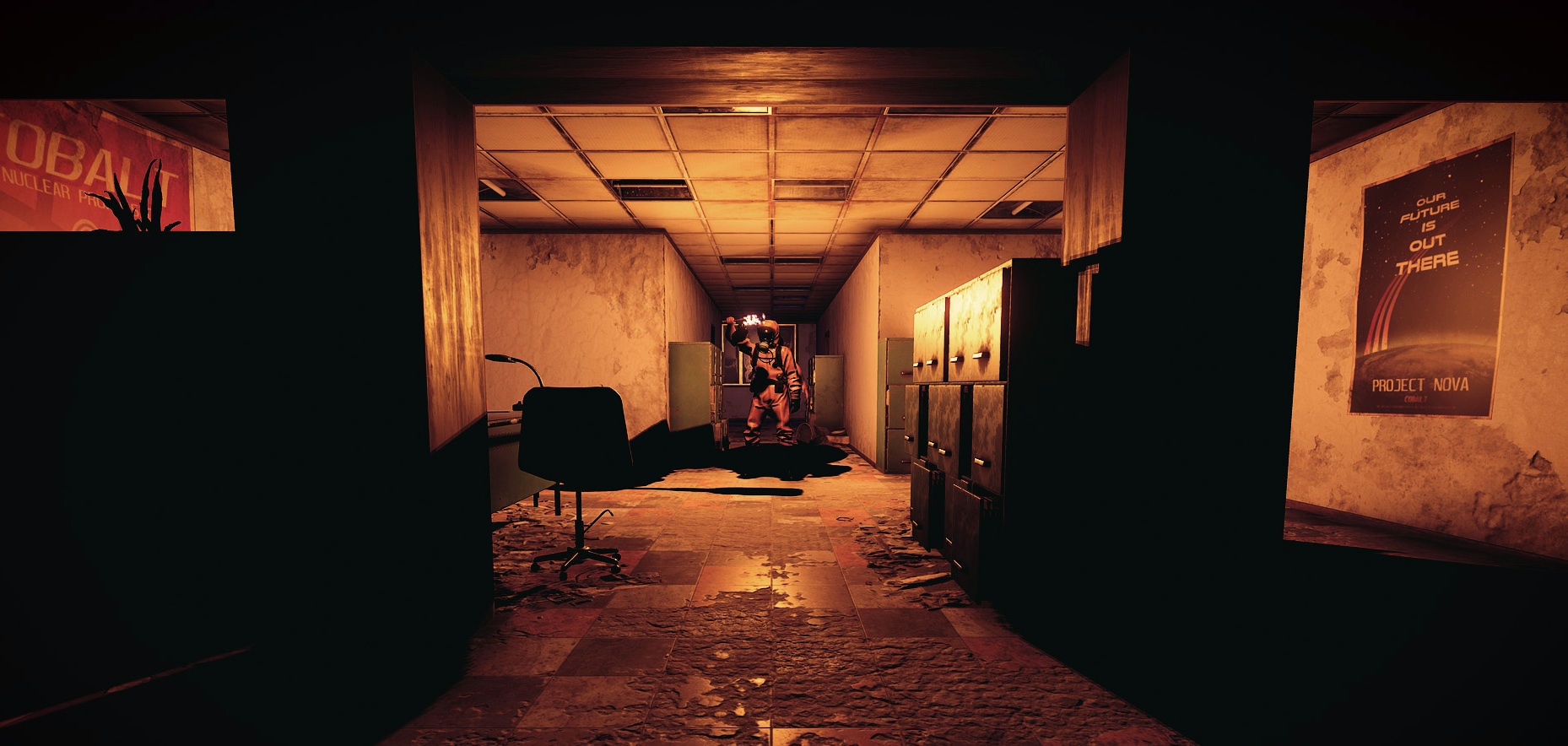
Vincent and Damian spent the wipe cycle filling the Cobalt Space Center office building with props and furniture, built as a series of assets styled after the 60s and 70s for a retro look. They're only found in the Cobalt offices for now, but the assets were designed to be reused in other interiors later.
With that done, the art team moved to smalluments — the community's name for the small roadside monuments that were about to become a staple of the map. They're fast to produce compared to a full office interior, and the goal was giving early players far more places to loot and explore beyond harbours, lighthouses and warehouses. The ones pulled out of concept limbo for the coming weeks: a gas station, a supermarket, and a small town.
World generation: mountains, icebergs and junkpiles
Andre spent a lot of the week on a new road algorithm meant to produce more circular road networks with intelligently placed T and Y intersections, eventually linking monuments into a continuous network — but it wasn't ready and didn't ship. What did land:
- Mountain splat transfer — terrain splat map improvements that carry the more realistically simulated mountain texturing from Hapis Island across to procedural maps. It looks better, generates faster, and was groundwork for biome-specific mountain designs.
- Icebergs are back. The ladder raiding changes meant they should no longer be overpowered base locations, and they add something to the distant skyline. Same icebergs as before for now, with a full northern icesheet revamp planned.
- Junkpile spawns — the respawn rate could fall short of guaranteeing enough junkpiles around roads on busy servers, so spawn attempts per respawn wave were increased.
Performance: garbage collection and texture memory
Andre called garbage collection the number one cause of performance problems during PVP, and noted it had undeniably gotten worse over time. With most other frame rate drop causes (workshop skins among them) already optimized, GC became the next target. The first step here was eliminating GC caused by the new ore hotspot mechanic, with the acknowledgement that there was a long way to go. The metric the team cared about was managed memory allocated, and players were asked to file in-game reports describing what was happening when they saw that number spike.
Texture memory got a more immediately noticeable fix. Every quality preset except the lowest two had been using maximum texture resolution, which spiked RAM usage badly when the graphics card couldn't hold everything in VRAM — a real problem for anyone on medium settings. Resolution is now a curve, with only the top two presets using the maximum. The itemskins convar also changed behaviour so that skin textures aren't loaded into memory at all when running itemskins 0, though Andre was honest that skins are well compressed and account for a fairly small slice of texture memory. Lastly, joining a server no longer loads every monument — only the ones that exist on the current map — cutting loaded textures and speeding up the asset warmup step in the loading screen.
Rendering, AI and the 500 player wall
Diogo fixed terrain specular values that had been looking off, restoring the shine and contrast the artists originally intended. That made the long-standing lack of reflection shadowing (a sun reflection that should be shadowed by a mountain, but isn't) slightly worse, so he found a way to fake it with no tradeoffs — not a fix for every case, but a big improvement where it counts. He also stumbled on a zero-cost fix for distant terrain seams caused by repeating the custom terrain atlas textures.
On AI, ptrefall worked mainly on the navmesh: linking patches so NPCs can cross between them, adding support for Andre's custom terrain mesh (which removed major overhead from Unity terrain navmesh), and starting on detection of which navmesh patches touch monuments and player buildings. An experiment combining hand-crafted and generated navmesh didn't reach the quality bar and was dropped.
The oddest fix of the week: Rust had a hard ceiling of 500 connected players per server. After hunting through their own code and finding nothing, Garry emailed Valve — it turned out to be a backend limit on Valve's end. Rust got whitelisted, so servers can now exceed 500. As Garry put it, that more realistically means over 400 players queuing for your 100 slot server. He also fixed a batch of problems with playing back older demos.
Work in progress
Pilgrim continued on the makeshift backpack, deliberately regressing the design a little for artistic reasons: the rope arm straps read as bland, so one side became jumper cables, and the bag itself was reshaped to look like there's something inside rather than floaty and empty.
Alex R's granular engine sound system moved from a short test clip to a full-length recording, which exposed problems tracking the length of the engine cycles being chopped out of the longer file. That tracking was reworked and now holds up much better across the recording, with a plan in place for the remaining wobble.
The rest of the changelist
Beyond the headliners, the patch notes cover entity pooling for ore hotspots and effect pooling for hotspot flares, reduced terrain grass height, updated item descriptions, an EAC update with a Linux fix, prefabs excluded from asset warmup, and optimized ore hotspot flare updates. Fixes included blurry UI elements, collider and lift issues on the rocket crane, rocket factory lift shaft problems, and rare ArgumentOutOfRangeException spam. The renderer_invalidate and collider_invalidate convars were removed outright as an exploit fix.
Looking forward, the roadmap out of this patch was clear enough: finish the learnable recoil experiment or bin it, keep grinding on garbage collection, and start dropping smalluments along the roads. The gas station and supermarket were already greyboxed.