
What's New in Rust's "Devblog 172" Update
August 2017's Devblog 172 gave Rust its first public roadmap, softened the LR300's new learnable recoil, added flare effects to flashlights and searchlights, halved searchlight costs, fixed longstanding ore harvesting rounding bugs and revamped the snow biome.
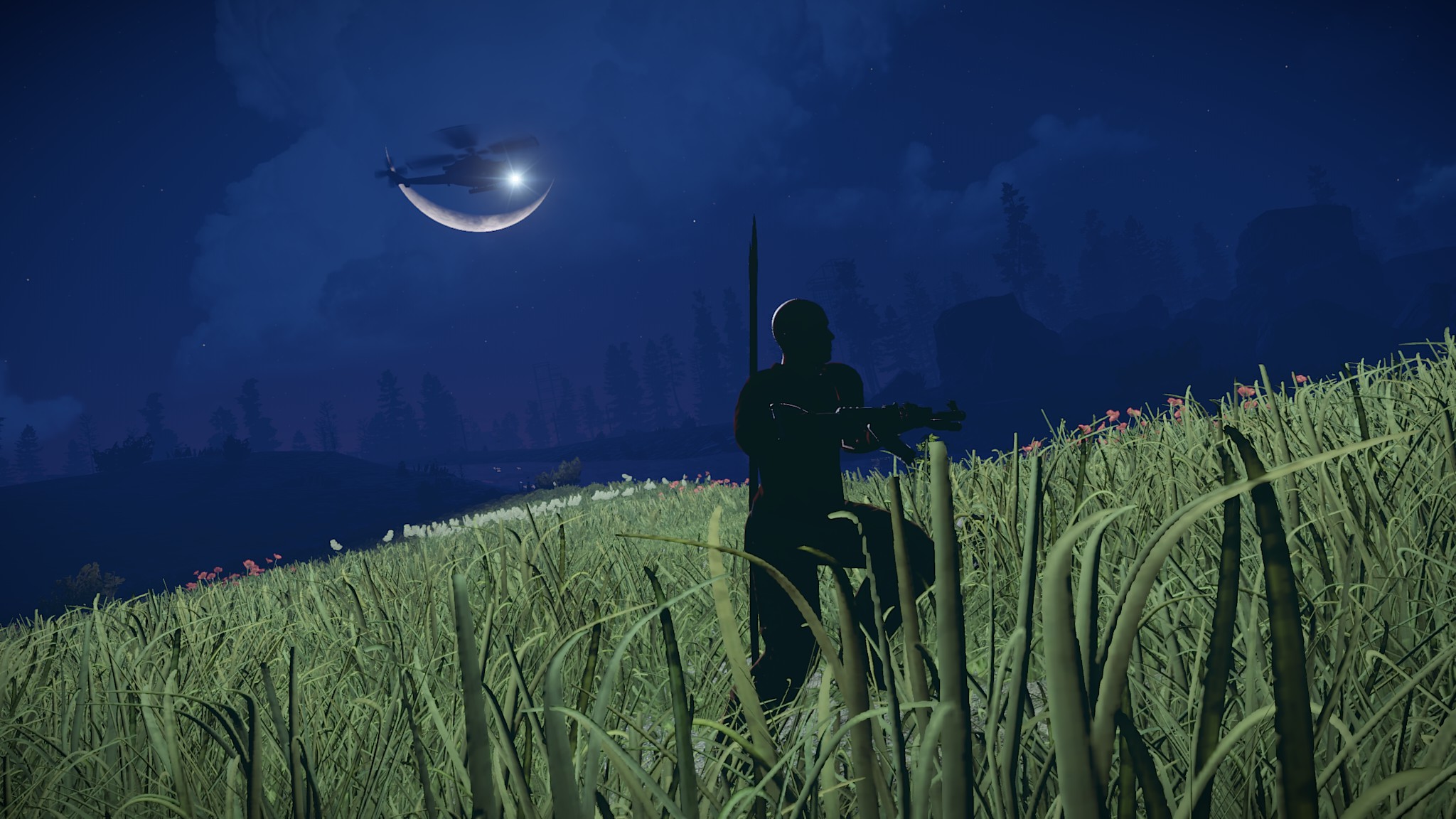
Devblog 172 shipped on 10 August 2017, a week after the learnable recoil experiment went live, and it's mostly a tuning patch — recoil tweaks based on the first round of feedback, a pile of ore harvesting bug fixes, and cheaper early game gear. The headline item wasn't a feature at all, though: Facepunch finally published a public roadmap. There's also a proper snow biome facelift and another chunk of garbage collection work.
The roadmap
Garry addressed a long-running criticism head on: that the team was floating without a plan, adding features on a whim with no end goal. His answer was that it isn't 100% untrue — they do get distracted and work on things for fun that don't push development toward the finish line — but the long term goals had always existed, along with a vague outline of how to reach them. So they published a roadmap.
The caveats were as important as the document. It's a rough guide of what they want to do, not a promise or a contract, and it was expected to change and adapt over time. Notably, optimization was deliberately left off it: there's never going to be a point where performance is declared "sorted", so it's treated as a common sense, ongoing effort rather than a roadmap item.
Recoil adjustments
After a week of feedback on the LR300 and MP5 learnable recoil, Helk made two changes. Horizontal recoil on the LR300 no longer kicks in until the 4th or 5th shot, which makes the weapon considerably easier to control in bursts. And the player.recoilcomp ConVar actually works now, so anyone who wants to disable recoil compensation can. The plan was another week of playtesting before revisiting.
Flares: flashlights, searchlights and the helicopter
Flares became a theme this week. Flashlights now have a flare effect, which makes them meaningfully more usable at night — they don't just illuminate other players, they disorient them and make it harder to aim back at you. The laser sight got one too, though noticeably less bright.
The deployable searchlight got the same treatment, plus a big price cut: down from 500 metal and 1,000 wood to 200 metal and 500 wood, roughly half price, in the hope of seeing more of them on servers. Between the cost reduction and the flare hiding the operator, they became a lot more attractive to deploy.
The helicopter searchlight got a proper repair job. Since Diogo changed how light was calculated a few months prior, its brightness had been far too low, and there was a separate bug where it aimed with an altitude offset of 20 units — meaning it mostly missed whatever it was supposed to be lighting up. Both were fixed, the light's jitter was toned down, and it got a flare as well.
Backing all this up, Diogo built a new system for approximating how much of an object's area is covered by an obstacle. Flares were its first use: they now scale up and down in strength depending on how much light actually reaches the lens. He also optimized the flare shader to offload work from the CPU. Most of his week otherwise went into backend work making texture packing more seamless.
Ore harvesting fixes
Helk dug into some odd tool efficiency behaviour and found a longstanding bug. Different tools have different destroy fractions — a rock is supposed to destroy 50% of a harvested object's resources, so a stone node with a maximum yield of 750 stone should give a rock user 375. Floating point rounding meant that wasn't actually happening. Fixed.
A related problem: if an object had only 1 of a resource left, it wouldn't yield it at all to a tool with a high enough destroy fraction. That now uses the destroy fraction as a probability instead — which, as Helk summarised it, means a rock has a 50% chance of getting a skull when harvesting a player. On top of that, some tools were actually yielding less when hitting node hotspots. Also fixed.
Early game balance
A handful of small changes aimed squarely at the first hour of a wipe:
- Gutting a trout yields 8 animal fat instead of 3.
- Hide armor pieces cost roughly half what they did.
- Bone armor costs 1 rope instead of 2.
- The stone pickaxe now costs the same as the stone hatchet: 200 wood, 100 stone.
Nothing dramatic, as Helk noted, but collectively it takes some friction out of getting geared up from nothing.
Snow biome revamp
Damian's work is probably the most visible change in the patch. Since the new grass came in, the snow biome had started looking dated by comparison, so he made new snow textures plus snow mound meshes that Andre set up to spawn during procedural map generation. The result is much bumpier snowy landscapes with small patches of melted ice scattered around.
This was framed explicitly as a first step in a gradual northern biome overhaul over the following months: remade icebergs, ice sheets floating on the ocean, frozen lakes, and unique smalluments like ships encased in ice. Damian was clear that none of it was set in stone and that monuments were the priority, but the intent was to make the cold north worth basing in.
Small monuments: gas station and supermarket
Vincent dedicated the month to small monuments, starting with the gas station. The design goal was a small, action-packed location surrounded by makeshift palisades and cover built from local materials, containing a small shop, a garage, a back office, a small warehouse and toilets. There's a tunnel someone dug under the garage that has since collapsed but may reveal something, and a hatch to the roof with extra loot. At this point it was greyboxed, with the art planned over the weeks up to next wipe.
Damian meanwhile greyboxed the supermarket building along with its props — store counters, magazine stands, a cash register — and started texturing and building the final mesh.
Performance and engine work
Andre spent most of his week eliminating dynamic memory allocations causing unnecessary garbage collections, which had been producing significant random frame rate drops. The areas he optimized were projectiles, ragdolls, corpses, effects and player meshes. Still a work in progress with plenty left to do, but the numbers already showed a vast reduction in garbage collections.
He also cleaned up the game log. Half of every log people sent in was stack trace spam — useful in principle, but the traces generated for basic status updates on every game start were pure noise and could bury an actually important entry.
ptrefall's week went into optimizing and bug-fixing the new navmesh grid system and cover system: testing, profiling and improving, which he freely admitted isn't exciting to report on but is necessary.
Still in progress: the APC, the bag and tank engines
The APC didn't make it, but progress was significant. Helk gutted the old pathing system and replaced it with something more dynamic — it's no longer stuck on a fixed path like a model train, and can pick any node and route to it via the shortest path. It still can't handle arbitrary terrain, but the new system makes that possible later. Next up was getting it to move to the best point to engage targets, then its weapon system, then effects polish.
Pilgrim continued on the smaller makeshift bag, with plans to work in a logo (or at least elements of one) from Paul's Cobalt posters.
Alex R's granular tank engine sound system now successfully tracks multiple harmonics in the engine recording. The system works by measuring the length of a single engine cycle, slicing audio to exactly that length, and splicing the slices back to back to synthesise an engine sound at any speed covered by the recording — so bad timing data early on throws off everything after it. Tracking multiple harmonics smoothed out the problem areas considerably. The last remaining issue was a few weaker harmonics tracking slightly off, solvable with a majority-rules correction. After that: tank tracks, gun turret movement, and then shooting and explosions.
The rest of the changelist
The full changelog also lists fixes for long tundra grass patches sometimes not being grounded, culling throwing errors in safe mode, and re-enabled shore wetness, alongside the rounding fixes for resource gathering and the working player.recoilcomp. Item descriptions got another update pass. Nothing here reshapes the game, but it's a solid week of paying down debt — and with the roadmap now public, the direction of travel for the rest of 2017 was finally on the record.