
What's New in Rust's "Devblog 170" Update
July 2017's Devblog 170 shipped the ore gathering minigame, where hitting shimmering hotspots on a node stacks your gather rate up to 300%. It also added game tips, dropped DirectX 9 and finally fixed the EAC Disconnected error.
Devblog 170 shipped on 26 July 2017 and delivered the ore gathering minigame Helk had teased a few weeks earlier - the first attempt at making mining a skill check rather than a mindless hold-to-farm. Alongside it came the beginnings of an in-game tips system, the retirement of DirectX 9, another round of skin cache optimisation, and a fix for the long-running "EAC Disconnected" error.
Ore minigame
Here is how the first version works. Nearby ore nodes display a shimmering hotspot. Hit the hotspot and you gather at 150%. Each successive hotspot you hit raises your gather rate further, up to a maximum of 300%. Miss one and the bonus resets to zero.
Crucially, you do not actually earn more resources from a node - you harvest it faster. Skill and aim get you through a node quicker than AFK-spamming it, which is the whole point.
The visuals were acknowledged as buggy: hotspots sometimes render white instead of orange and white, and they draw on top of viewmodels and grass. A more complete flare system for headlights, spotlights and similar was planned for the following weeks, at which point the hotspot visuals would be moved onto it.
Nodes are affected by sunlight, so hotspots are invisible at night unless you have a miner hat or candle hat equipped. Helk's plans from there included spawning hotspots off ores and possibly on cave walls rather than the nodes inside caves, revealing multiple hotspots whenever an ore's stage changes, and potentially factoring your accuracy into the finishing bonus.
Visual shelves
An experiment Helk described as promising: a type of loot entity that visually shows what is inside it and lets you pick items up directly from it. If it works out, the barrels in radtowns could be replaced with shelves, desks, lockers and pallets, which would feel considerably more natural and immersive than being pushed into the inventory screen to loot everything.
Tank
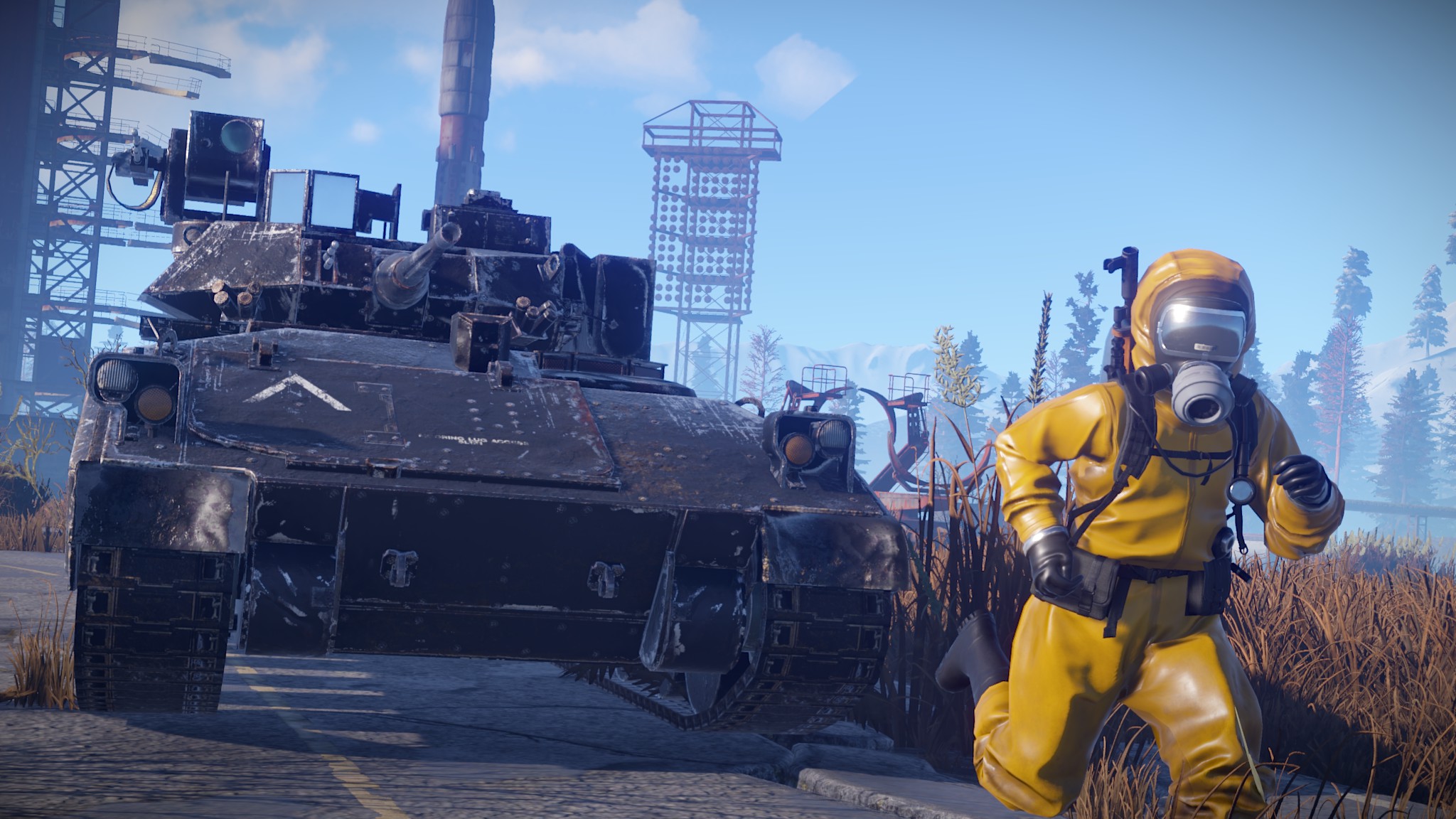
Work on the Bradley APC paused. Helk judged that recent patches had been weak on gameplay, so he stepped away from the tank to work on more immediately visible mechanics like mining. He hoped to have it in for the forced wipe.
Game tips and menu changes
Garry started building game tips, part of the accessibility work identified as a prerequisite for leaving early access. The recurring example is that new players do not know how to open the inventory, which is painful to watch.
The ambition is for the system to be intelligent rather than nagging. When he built something similar for Garry's Mod, its tooltip explaining how to open the spawn menu popped up roughly 200 times a day for five years - so this version tries to work out what you actually need based on your past behaviour. If you have opened the inventory 31 times, it probably does not need to tell you how. It was very much a work in progress with only two tips implemented, with plans to expand it to other things like "this door is locked" notifications.
Two main menu changes landed too. The exit button asks for confirmation again, on the grounds that it is apparently impossible not to click it accidentally. And since finding out how to actually start playing seemed to confuse people, a button was added for that - flagged as something to improve properly later.
Description fixes
Rust has a Unity script that scans prefabs, scriptable objects and static fields for translatable phrases, collates them, uploads them to Crowdin and pulls the language files back down. In several places the same phrase tag had been accidentally re-used - the sleeping bag and bed sharing a description, for instance.
Garry made the builder script emit warnings when it finds phrase tag collisions, since they are almost always user error, and fixed several of them. Descriptions and names are still imperfect, with an open request to report anything wrong or misleading via F7 or the feedback page.
AI progress
Pål spent the week improving the systems already in place. Scientists are getting better at using cover information to understand their environment and survive in it - and when they stand around looking silly, it is usually because the cover system could not generate good cover points. That will be much easier to control in radtowns where cover points can be hand-crafted and tuned; at present they are generated automatically on demand, with plenty of improvement still needed before scientists can read arbitrary environments well.
Admins can now spawn them with spawn scientist in the console, with the warning that they still need a lot of work. The navmesh grid saw less attention this week but was moved behind a nav_grid convar so admins can toggle between it and the regular navmesh. Under the grid system animals can only move within their navmesh patch, and player proximity controls whether NPCs are active or dormant.
DirectX 9 removal and performance
The DirectX 9 launch option was removed, since Unity is planning to retire DirectX 9 support in the near future. For anyone struggling with DirectX 11, the suggested steps were updating graphics drivers, trying the lowest quality setting in the launcher, and failing that adding the -force-glcore startup parameter in Steam, with support tickets encouraged for anyone stuck.
Andre also found more performance bottlenecks in the skin cache on lower-end machines with slow hard disks, severe enough to cause significant framerate drops and make the game near-unplayable for some people. He rewrote the workshop skin cache in native code, eliminated all garbage collection overhead from it, and moved all skin cache I/O onto a separate thread so it can never stall the main thread. In testing that removed the spikes entirely.
The EAC SDK was updated to the latest version, which EAC believed contained the cause of the "EAC Disconnected" error that had troubled players for a long time. Freezing when using the F7 feedback system was also fixed, and campfires gained grass displacement.
Backpacks and player variation
Pilgrim finished the backpack, adjusting its position so the arm straps sit properly when it is dropped on the floor, and moved on to a second, smaller bag made from rubbish materials - badly held together but functional. Because that concept is older he planned a couple of adjustments for visual interest.
He also relayed an interesting discussion with Paul about the character and personality of items and finding the right balance. An item should be distinct, but not too distinct - plain enough to blend in rather than reading as an obvious repeating texture on the terrain. It works for objects like workbenches partly because they are not in view constantly, but bags are different because they are part of the character. If a backpack were overly recognisable and special, and everyone had one, it would stop being special - which is not what a backpack is for. It just needs to sit well.
Taylor started implementing the player variation work, demonstrating it by spamming through random player seeds. A couple more types still needed implementing - the demo showed only white females while he worked on the other female race variations - before setting up hybrid sets. He was close to having enough sets for the variety he wanted, and hoped to get it all onto its own branch that week so he could start fixing bugs and oddities like neck seams.
Tank sounds
Alex R's week was the most technical of the lot. He got sample-accurate granular audio playback working in Unity, the first major piece of the tank engine puzzle, and moved on to automatically analysing a recording of a tank engine to determine exactly which slices of audio to play.
The approach uses DSP - FFTs plus harmonic product spectrum - to find the fundamental frequency of the engine sound at any point in the recording. With an engine, the fundamental corresponds to a single engine cycle, and it also reveals exactly what RPM the engine is running at throughout. That lets him map individual engine cycles from the recording to different RPMs, so the game can simply pass the current RPM into the granular playback system and have engine cycles stitched end-to-end into a cohesive sound that reacts smoothly to RPM changes.
It was working well and sounded smooth through RPM changes, though he was using a short snippet of a longer recording, so some static RPMs did not yet have enough engine cycles to sound natural. Cycle detection also needed tightening, since start and end points were not perfect yet, which made the engine sound looser and more sputtery than necessary - currently those points are chosen by looking for zero crossings near where a cycle should be, with phase information from the FFTs and analysis of higher frequencies in each cycle as the next avenues.
The changelist is otherwise light, with a reduced Semi-Automatic Pistol cost the only balance change of note.