
What's New in Rust's "Devblog 160" Update
May 2017's Devblog 160 added the Shotgun Trap, gave floor spikes and floor grills an actual purpose, extended decay to all twig, and squashed a planner entity leak that was costing large servers around 50,000 entities.
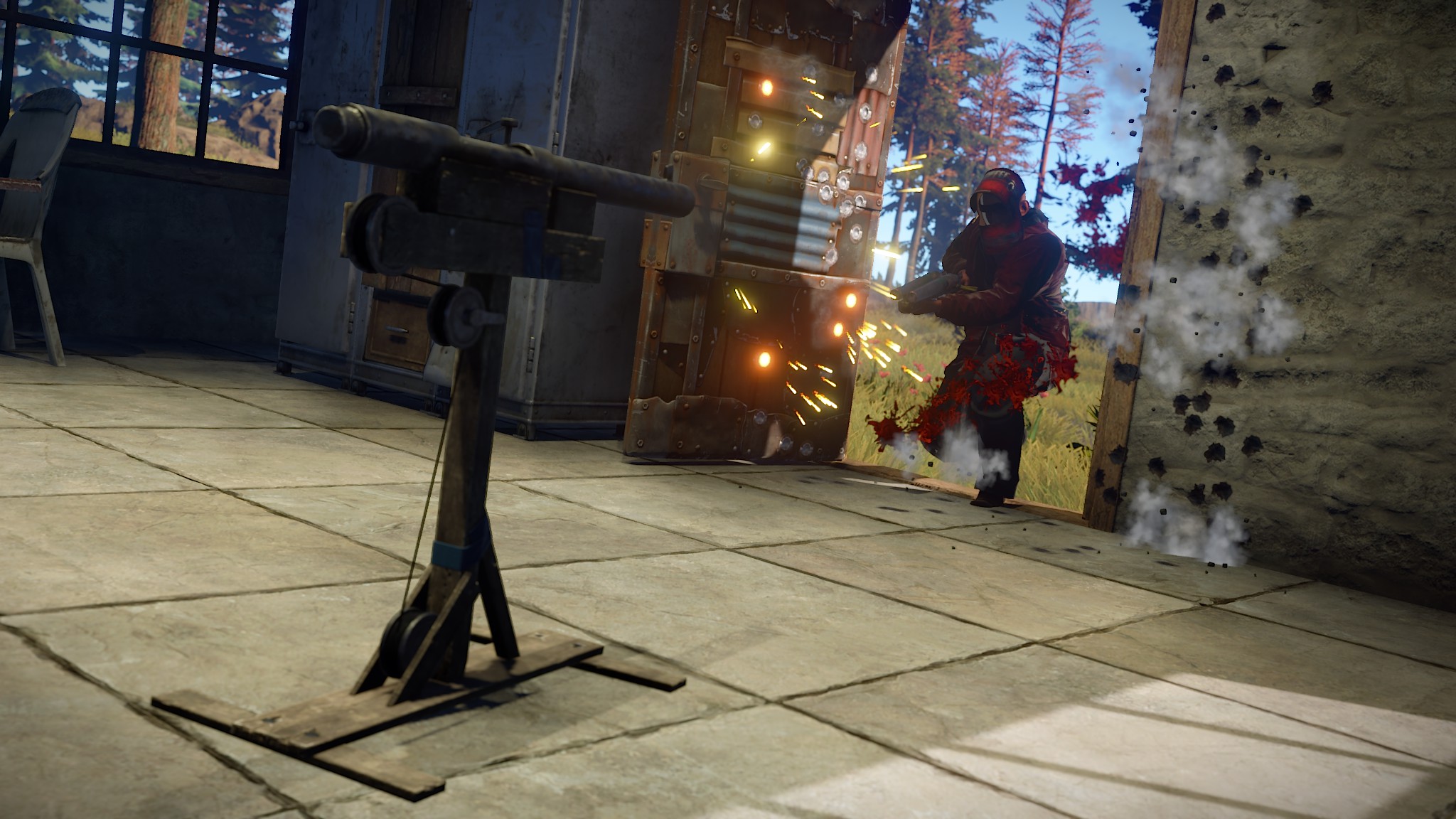
Devblog 160 shipped on 18 May 2017 and reads like a direct follow-up to the raid-tower revolution two weeks earlier. With twig now placeable inside enemy cupboard radius, the game needed better cleanup and better base defense - so this patch extended decay across all twig, gave the long-ignored Floor Spikes and Floor Grills a real job, and added the Shotgun Trap. It also closed out a memory leak that had been hiding in the game essentially forever.
Shotgun Trap
The headline addition is the Shotgun Trap, built from a Concept Limbooo design. It detects motion in front of it and, once triggered, fires homemade shells once per second until it runs dry. You can mount it on walls, ceilings, floors - wherever the approach needs covering.
Crucially, it only triggers for people who are not authorised on your Tool Cupboard, the same rule the flame turret follows, so you are not walking into your own defenses. Helk framed it as a stopgap toward richer trap systems - actual pressure pads were on his wishlist - but as the first cheap automated defense that works alongside turrets, it landed well.
The Flame Turret also got a small placement tweak so it hugs walls more easily, which Helk added after struggling to fit one in his own airlock the previous wipe.
Decay and cleanup
Andre's stated goal is to rework decay so it is both more intuitive and much better at solving the problems it exists for. Step one was optimising decay computation on the server, which lays the foundation for more complex decay behaviour later. With that done, decay was enabled on all twig building blocks, so leftover raid scaffolding decays away within two hours without the base owner needing to clean it up manually.
On the optimisation side, nearly all remaining Unity invokes were moved over to Rust's own optimised invoke handler, cutting overhead and making the code more robust.
Giving old building pieces a purpose
Floor Spikes had been close to useless, and re-enabling twig raiding made that worse. They now block foundation placement the same way barricades do. They remain easy to destroy with metal tools, but they can protect smaller bases and are useful for denying hiding spots around your entrance. Andre noted their health could be adjusted at the next wiping update if they still failed to earn their slot.
Floor Grills had the same problem - little advantage over a normal building floor - so they were given a specific niche: you can now build floor grills and floor frames closely above a Large Furnace, since they provide the required air ventilation.
There was also a correction to the pickup mechanic added the previous week. To stop the extended pickup on window bars and embrasures being abused for unintended cases, those pieces now lose half their health whenever they are picked up and need repairing with the hammer after being replaced. Window bars and embrasures also now store item condition properly.
The planner leak
The most satisfying fix in the patch came out of server dump files, where the second highest entity count on any given server was invariably the planner entity - the thing used whenever you go to deploy something. That made no sense until it was traced back.
The bug had been in the game forever, but the AI merge exposed it. Animals eat food and seeds; seeds used the planner entity to work out how they could be deployed. When an animal ate a seed, the item was simply deleted without cleaning up after itself, leaking an entity every time. The same thing happened whenever two stackable, equippable items were merged in the world - throwing bandages onto each other, for example - but that was rare enough that nobody ever caught it.
The result of the fix: entity counts on large servers should drop by around 50,000, with an accompanying reduction in memory usage after a wipe.
Shading revamp and art
Diogo spent the week testing and fixing integration issues from the new physical-based shading. It was effectively ready to deploy, but he deliberately held it back until after this patch so it could get a full week of player testing on Staging first. The showcase was the new skin shader running on the viewmodel hands, with the caveat that some textures were his own placeholder tweaks pending proper artist work - the same applying to player and worldmodel skins. A new hair shader was already underway for the following week.
Damian continued on the rocket factory building: the ground mesh is finished, the ground level got a dressing pass, scaffolding went up around the rocket, the interior geometry was polished, damage was added to the walkways, and layout playtesting began. Next up was finalising paths across the levels, finishing the jumping puzzles and adding ladder access between floors.
Pilgrim wrapped the LODs, gibs and prefabs for the revised dropbox from the previous week, made gibs for the single-shot gun trap ready for implementation, and then built the Scrap Pile from Paul's concept - the asset you now see when you break a barrel. Alex Webster returned to the player preview animations he had concepted earlier, giving them all the transitions to and from each state plus Unity animator states, ready for implementation whenever it is wanted.
Audio
Alex R started re-recording melee impact sounds, beginning with the salvaged icepick, which he singled out as a sound he hates. He recorded impacts with a length of pipe from an unused speaker stand, doing one set on concrete and another on packed dirt. The packed dirt turned out to stop the metal ringing out without adding much character of its own, and by striking straight rather than at an angle he avoided kicking up debris noise, so the results layer cleanly over the existing grass, sand and cloth impacts. He had previously produced soft material impact variations for most melee weapons by editing existing sounds, but the quality jump from real separate recordings was large enough to justify re-recording the rest the same way.
The water jug recordings were also made, with most of the editing done and the final sounds due the following week.
On music, the remake of the classic theme is now set up in-game and sounding good, with intensity changes noticeably smoother. The new playback system let the song be built from much smaller clips, which saves disk space and memory - the bassline is assembled from five different one-bar clips, where the old system would have needed six clips all eight bars long, roughly 10x the audio data. Another new song was underway, and existing tracks were being fine-tuned with an eye on swapping long clips for a few properly arranged short ones. Alex was close to done but wanted to sneak in another song or two before shipping the whole thing.
Rounding out the changelist: a fix for distant see-through walls when using TSSAA or motion blur, a fix for the AI "look rotation viewing vector is zero" error, and a fix for some older item skins that had stopped working.