
What's New in Rust's "Devblog 159" Update
May 2017's Devblog 159 fixed a semi-auto firing bug that had quietly rewarded scripters for years, buffed spears and crossbows, added the Mailbox and Water Jug, and made tool cupboards lockable to curb post-raid griefing.
Devblog 159 arrived on 11 May 2017 as the cleanup and rebalance week that followed the enormous scrap-and-raiding patch before it. The standout is a semi-auto weapon bug that had been quietly punishing normal players and rewarding scripters for a very long time. Around that sit a batch of weapon buffs nobody asked for but everybody needed, two new deployables in the Mailbox and Water Jug, and a serious attempt to make post-raid griefing more expensive.
The semi-auto firing bug
Helk found a long-standing issue with semi-automatic weapons. They would only fire under very specific conditions: the mouse button had to be unpressed on one frame and pressed on the next, with the weapon ready to fire. Click too quickly and the game would often fail to register the release, so the shot simply would not happen until those conditions lined up again.
The practical result was backwards - clicking faster made the weapon fire roughly twice as slowly. To get optimal fire rate you either had to time your clicks perfectly or use a script. Most semi-autos had a refire rate of 0.1s, meaning a scripter could dump a magazine in one to two seconds. With the bug fixed, Helk raised the refire rate on most semi-auto weapons to 0.175s. On paper that is slower; in practice most players will find the guns considerably more responsive, and the telltale full-auto rattle from scripters and mouse-wheel abusers is gone.
Weapon buffs: crossbow and spear
Nobody used the Crossbow, so its reload time was cut by 0.8s to get more bolts downrange in less time. A bug where the sight attachment point was parented to the arrow - which looked strange during reloads - was also fixed. On the ammunition side, HV arrows now show a metal tip as a temporary visual test, with new arrow types being considered.
The Spear got attention because people were throwing it even at point blank range, which Helk hated. Stabbing is now considerably more viable: melee range increased by roughly half a metre, attack rate very slightly increased, and the delay between the mouse click and the attack action cut significantly. It feels much more responsive, and it should be enough to hold rock-wielding nakeds at bay without throwing your only weapon away. A future nerf bringing throw damage down to match melee damage was flagged as likely.
Mailbox
Helk introduced the Mailbox while pre-emptively quoting the comments section he expected. It is deliberately simple: one slot to drop a note into, and when you close the inventory the note moves into storage that only someone with building privilege can access. It holds 12 letters.
The point is offline communication with neighbours. Want to make peace? Leave a note saying you live on the hill and to stop by. Shop out of stock? Leave a note saying what you want and when you will be back. Small feature, but one with real gameplay implications beyond roleplay.
Water Jug
The old blue Water Jug is back, complete with a viewmodel. The problem it solves is that hauling water in a Bucket was genuinely risky - the bucket has no lid, so deselecting it dumped all the water, leaving you exposed for the whole trip. The Water Jug has a lid, so you can fill it, put it in your inventory and stay armed on the walk home.
It is uncraftable and found in food boxes and crates around the map, and it recycles into 50 Metal Fragments. Helk acknowledged most players were not engaging with water and farming yet and said he would address that separately. Alex R also put together quick placeholder sounds for the new viewmodel, with plans to record proper ones off a jerry can the following week.
Cost and protection rebalances
A cluster of pricing and stat corrections landed:
- Fishtraps cost Cloth again instead of Rope, since the rope requirement meant nobody built them.
- Some signs were absurdly expensive - metal hanging signs cost around 1000 Metal Fragments. The two decorative signs now cost roughly 100-150 Metal Fragments each, a 90% reduction, and small and medium wooden signs had their prices halved.
- The Riot Helmet had been using the Bucket Helmet's protection values, apparently since it was added. It is meant to block 80% of all melee damage, and now does. Helk floated lowering its cost and moving it into purple crates.
- The Heavy Plate Helmet gained 10% more protection against bullet and arrow damage, putting it slightly ahead of the facemask.
- Rifle Body costs 250 Scrap to craft, maps and notes craft in 5 seconds, food crates spawn 3x as much food, and ration boxes no longer spawn scrap.
Tool cupboards and anti-griefing
Andre reworked Tool Cupboards specifically to discourage base griefing after a raid. You can now place a code lock on a cupboard, so an attacker has to destroy it before griefing your base, and to make that meaningful the cupboard's protection values were raised to match a wooden door. To stop the system being abused, cupboards can now only be placed on player-built constructions.
The underlying idea is that griefing a base you just raided should cost time or resources, which should make it rarer. In the same spirit, ladders, window shutters, embrasures and window bars can now be picked up with the Hammer while inside building privilege - which stops ladder griefing and lets you upgrade window inserts. Upgrade, rotate and demolish building privilege checks were also brought in line with how placement checks work, and locker deploy and building prevention volumes were adjusted to close an exploit.
Auto Turrets got a performance fix worth calling out. They only gathered targets once a second for performance reasons, but every turret on the server did it in the same frame, producing server hiccups every few seconds - increasingly noticeable now that turrets saw more use. Their thinking is now staggered, spreading the cost across many frames.
Lighting and monument fixes
Andre fixed a long-standing bug where the game would incorrectly switch to interior lighting mode with occluded ambient light near certain trees, rock overhangs and open sewer areas in monuments. While in there he optimised the environment volume tests used to darken caves and sewer tunnels, and disabled fog in those environments to get real darkness underground - which makes lights genuinely useful down there.
A batch of monument problems introduced with the AI merge were also fixed: bucket lifts failing to move, door animations not playing, research tables that could not be interacted with, and cave segments being culled when they should have been visible. Ceiling lights had their maximum placement slope raised so they can go on angled surfaces including roofs, making bases easier to light.
Rendering overhaul begins
After a long stretch of bug fixing and performance work, Diogo started an overdue rendering and shading overhaul. Rust's existing physical-based shading implementation could look unrealistic and inconsistent, with fundamental problems that needed solving to bring the game up to par with modern titles.
The new pipeline is based on a widely tested industry standard and will be rolled out gradually, with the old and new pipelines running side by side to give artists time to transition. It uses simpler, more compact data while enforcing physical-based material rules more strictly, aiming for a more realistic look with memory savings on the side. The first comparison shots showed the old skin shader against a new one featuring deferred screen-space subsurface scattering, with rollout starting the following week - skin shader first, then hair, then revamped foliage and vegetation.
Monuments and art
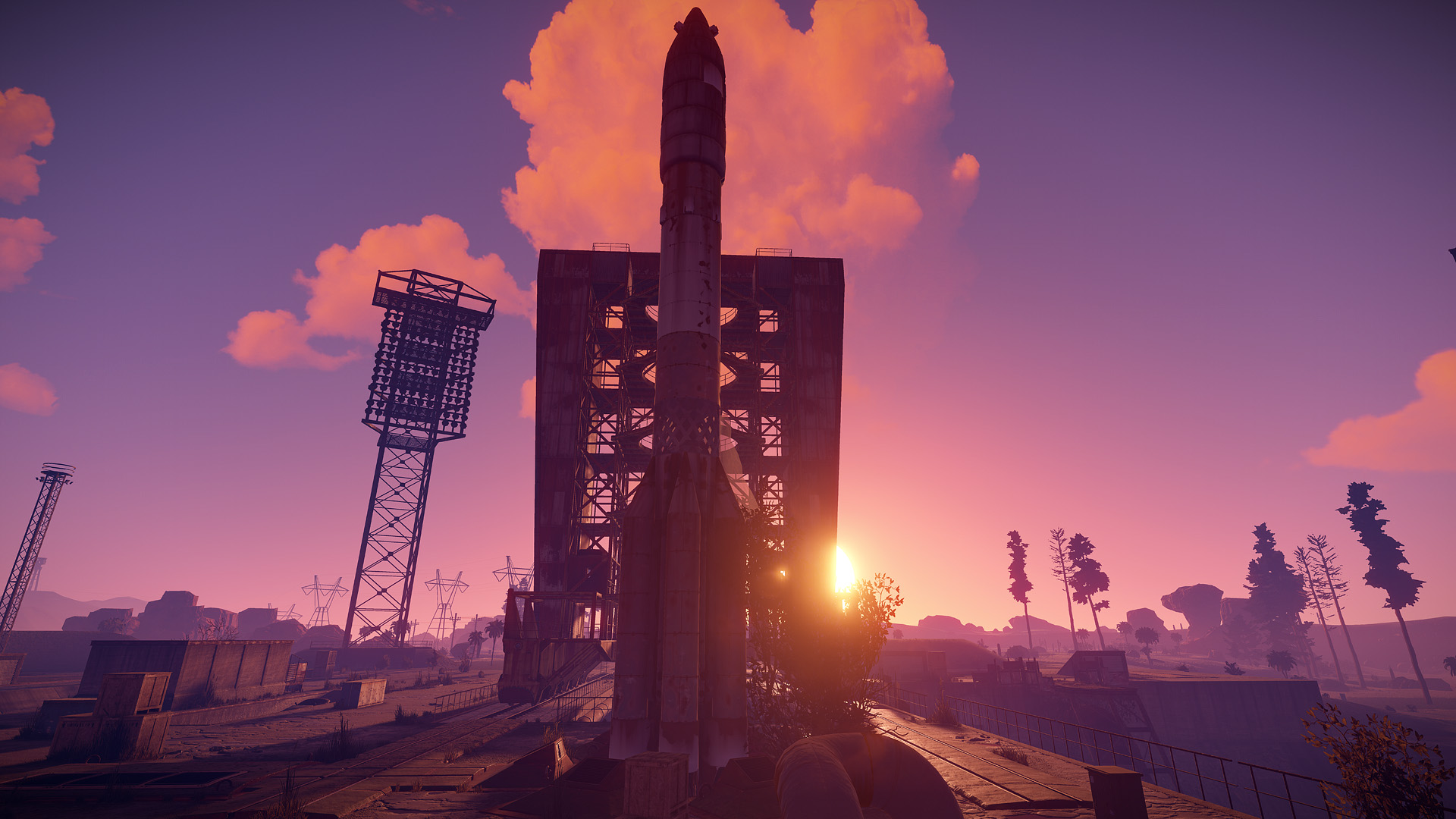
Vincent spent the week on the rocket itself at the Launch Site. It was still missing branding and decals, and it needed to be split into stages for the parts kept in the factory. Damian made significant progress across the Rocket Factory over two weeks, polishing exterior and interior sections and finishing the walkways and staircases that wrap the whole area, with an art polish pass, dressing pass and additional paths queued next.
Pilgrim showed Dropbox V2 - the deposit box first shown in Devblog 150, where a player can drop items in for the owner. The original model was small enough that depositing 1000 wood into it made no sense, so it was beefed up considerably, leaving only LODs, gibs and Unity prefab setup. Taylor finished skinning the reworked Roadsign Armour, with LODs nearly done and the first in-game shots shown.
Animation and audio
Alex Webster cleaned up some older animations and set up a test world with current gesture ideas bound to buttons to see how they trigger. Several implementation approaches were on the table: key bindings, context-sensitive sets that change with your situation or position, or a dedicated UI similar to the building menu. Longer term the idea was categories of gestures - greetings, raid-specific, emotions - with an open invitation for player suggestions.
Alex R had a slow week after his OS drive failed, costing him a day of recovery attempts and a day of reformatting and reinstalling, though backups meant nothing was lost. He still got all existing songs ported to the new playback system and spent significant time tuning fade and transition settings, plus added smaller playback and editor features he needed along the way, like alt click-drag to duplicate clips on the timeline and dragging multiple clips in from the project browser at once. He also walked back a previous change: dangerous NPC footstep audible distance had been cut too far, making bears and wolves more ninja than intended, so it was brought back up.
The changelist also includes the flamethrower now damaging AI, a fix for occasional rubber banding when jumping up objects, a new skipqueue admin console command, the last violation type being added to anti-hack kick messages and server logs, the removal of the hammer's admin demolish option in favour of binding ent kill to a hotkey, and the removal of the antihack.enabled convar in favour of toggling protections individually.