
What's New in Rust's "Devblog 158" Update
May 2017's Devblog 158 is one of the most consequential patches in Rust's history: it introduced Scrap as a universal currency, rebuilt the Research Table around it, and blew open the raiding meta by letting twig and ladders be placed inside enemy cupboard radius.
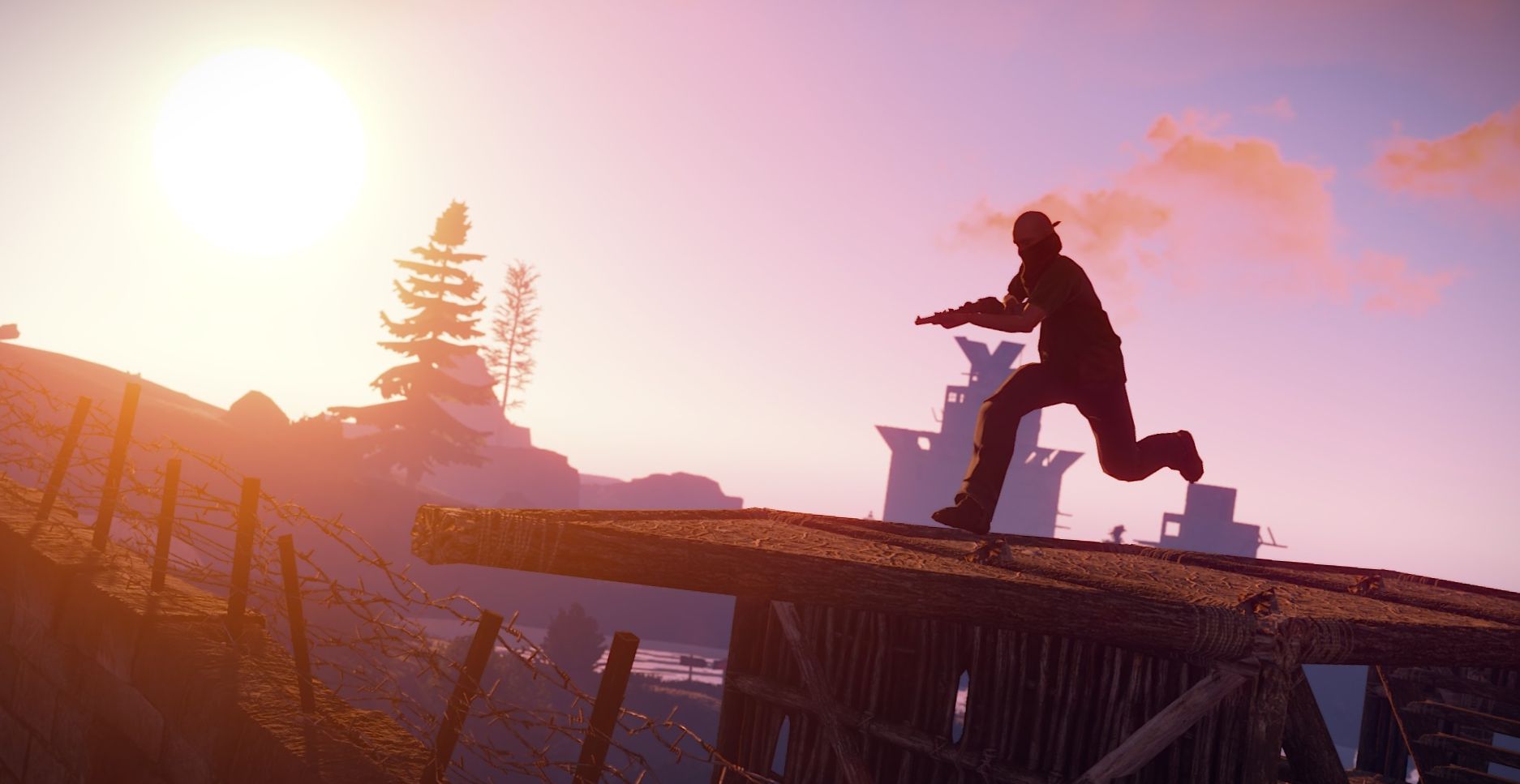
Devblog 158 went live on 4 May 2017 with a full wipe, and looking back it is one of the genuinely pivotal Rust updates. Two things happened in the same week: Scrap arrived as a new resource with the Research Table rebuilt around it, and Facepunch tore the lid off raiding by letting twig building blocks and ladders be placed inside another player's cupboard radius. Either one alone would have reshaped a wipe. Together they changed how the game was played.
Scrap and the Research Table
Helk described this as skipping ahead in his plans. Scrap drops from destroyed barrels at one per barrel, and from looted boxes at 5-10 per box depending on the type. The framing was "sweat equity" - you know exactly how much effort a given pile of scrap represents, which is the whole reason it works as a currency.
The Research Table came back as a deployable costing 1000 Metal Fragments, 25 High Quality Metal and 5 Sheet Metal. Feed it scrap and it turns that scrap into components. Each piece of scrap added raises the probability of successfully producing the target item, and each component type has its own scrap amount required to reach a 100% success rate. The catch is that success or failure both destroy all scrap in the table, so you are choosing how much risk to take. You also must already have at least one of the component you are trying to find - you cannot conjure components from nothing.
Recycling was adjusted to feed the loop: recycling components now yields 10% of their scrap requirement in scrap, on top of their traditional parts.
The design goals were spelled out clearly. Scrap has a measurable value, because you know how hard it was to farm. It has intrinsic value, because it makes components. And it is accessible to everyone, which makes it a strong candidate for a common in-game currency - Helk explicitly hoped to see people selling scrap through vending machines. It also lets you buy your way past the RNG: if you have been unlucky and you really want a specific item, you can go hit X barrels and get there deterministically. Balance changes were expected, with a request that players give it a few weeks before judging.
On the map side, a recycler was added to both harbors and a research table was added to the satellite dish, so the new economy had somewhere to run outside of your own base.
Raiding: towers, ladders and turrets
Andre opened his section by admitting raiding had been in a bad state for a long time and that the team had been arguing about solutions instead of shipping them. This update was the correction.
The headline change: all building blocks of the twig tier can now be placed inside another player's cupboard radius without authorisation. That makes raid towers a first-class part of the game and, as Andre predicted, it was a drastic enough step that plenty of people declared the game ruined on the spot.
The reasoning behind it is worth reading as design philosophy. Raiding should not run along the exact path the base's architect planned for. It should not be a fixed equation of sulfur and explosives to reach loot. It should not be binary - either the base is entirely destroyed and all loot stolen, or the raid fails completely with nothing lost. Instead it should involve planning, risk and reward. Attackers should be vulnerable during a raid even when the base owner is offline. Spotting that one loot room is exposed and can be hit cheaply by a small group or a single player should be rewarded. Defenders should build multiple loot rooms with different defenses, maybe even a fallback base. Raiding should not require farming enormous resource stockpiles first - but a successful raid also should not mean the total destruction of someone's progress. It should be a setback whose severity depends on base layout and attacker creativity.
Ladders got the same treatment: wooden ladders can now be placed inside the cupboard radius, intended either as an alternative to boosting or as part of a raid tower. Their placement rules were loosened so they can attach to the edge of floors, their trigger thickness was tweaked so they can be climbed from both sides, and the trigger width was widened so you can traverse around them to switch sides. The intent is that ladder-climbing a building carries risk but stays a cheap way to exploit weaknesses in a base's design.
Turrets were buffed to compensate: they can now see and fire through twig building blocks, with auto turret projectiles penetrating twig. That directly counteracts twig being placeable inside the cupboard radius, and pushes turrets toward a more central role in base defense now that defenders face a wider range of approaches.
To stop the map filling with abandoned scaffolding, twig decay was made six times faster. Twig now has a one hour delay before decay starts, then decays completely within another hour - two hours total - which cleans up raid towers shortly after a raid succeeds or fails.
Building tweaks and what came next
Two smaller building changes came along for the ride. Low walls had their health reduced by 50%, and wall sockets were added to the top and bottom ends of foundation steps, making both less effective at blocking raid tower construction. Barricade building prevention volumes were also tweaked.
Looking forward, Andre wanted to spend the month opening up more base design options, and floated half height snapping of foundations and half height walls as things the team was discussing. He was upfront that none of this was a final answer to raiding - just a big step meant to shift the game onto a better path, with the explicit reminder that this is early access.
Animal AI
Helk kept chipping away at animal AI. The main win is that animals no longer get randomly stuck, which turned out to be a bug in the flee logic. Flee behaviour is also considerably smarter: rather than picking one position and running to it, animals now continuously re-evaluate the best place to flee to. Flank left while chasing one and it will turn right to increase the distance. They also weigh up dangers, so chasing an animal toward a wolf pack will often make it turn around and treat you as the lesser threat.
A long-standing bug where some of the new animals were completely invisible on the client while still dealing damage was tracked down to the network group update routines and fixed. Culled ragdolls remaining invisible with culling disabled was fixed too.
Skin cache and performance
Andre implemented a caching system for workshop skins that substantially improves load times, memory usage and performance. Unity handles real-time texture loading and processing badly, so skins caused noticeable stuttering whenever they loaded in - and texture compression could not be enabled because it would have made the stuttering worse, which in turn hurt memory usage and performance. The cache is now built once, after a skin is downloaded. That initial build has some overhead, but every load after it is near-instant, eliminating skin-related stutter entirely.
Art, monuments and audio
Pilgrim finished the Mailbox from Paul's concept, adding some support beams where they were needed. Vincent reported steady progress on the Launch Site, with half the monument complete and most of the remaining work sitting in the factory and office building interiors.
Taylor is nearly done with the Roadsign Armour rework. The old textures were in poor enough shape that they were scrapped and redone from scratch, so the set should read as more realistic and less blown-out. The high poly leg pieces were being baked, with skinning and LODs queued for the following week. Alex Webster ran more R&D, mocking up an admire animation so you can look at your weapon skins up close.
On audio, the fade-in points and control clips from the previous devblog are finished, with all playback system changes working. What remained was final editor UI polish and a code cleanup pass. In the editor, control clips appear as small green clips in the top section and cut intensity at specific points instead of the old slow gradual drop, which lets intensity fall at musically relevant moments and feel far more cohesive. The bottom section handles fade-in points: vertical green lines mark where a fade completes, with the overhang to the left showing fade length. On a drum clip, that means the track only ever fades in just before a drum hit and is always fully faded in by the time the hit lands.
Alongside the tooling, existing songs were being tweaked and moved onto the new system, including a finished remake of the classic Rust theme, with a new song possibly sneaking in. The goal with the tweaks was to slim the in-game music so it sits more like ambience out of combat and the drums stop dominating in combat.
Smaller items in the changelist include the miner hat model becoming emissive when switched on, a fix for research table lens refraction, new find_radius and find_self admin console commands with extra info added to the existing find commands, and a batch of clothing cost changes: cheaper bandana, cap, balaclava, boonie hat and burlap headwrap, plus a snow jacket that got both more protection and a lower cost.