
What's New in Rust's "Devblog 156" Update
April 2017's Devblog 156 was the week Facepunch finally reined in Heavy Plate Armour, handing it view obstruction, no ADS and a flat movement penalty. Alongside it came stabler shadows, sky-based ambient lighting, much stricter movement verification and the first look at the Launch Site crane.
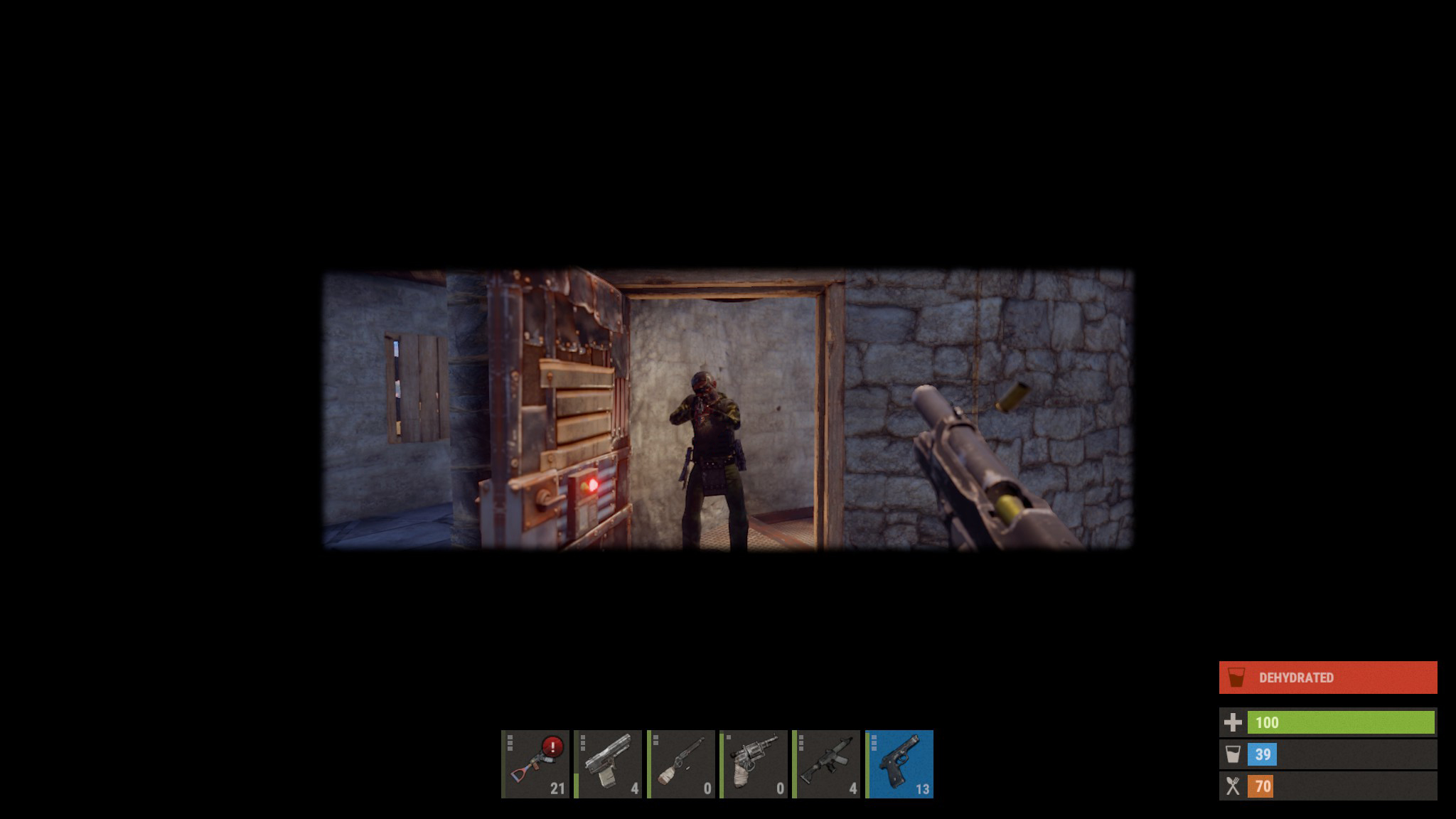
Devblog 156 landed on 20 April 2017, and it is best remembered as the patch that made Heavy Plate Armour a genuine trade-off instead of a straight upgrade. Helk's argument was that the armour had never been fully implemented in the first place, so rather than lowering its protection he bolted on the downsides it was always meant to have. Around that, the week was a solid mix of rendering work, anti-cheat tuning, exploit cleanup and monument progress on the Launch Site.
Heavy Armour finally gets its downsides
Players had been complaining that Heavy Armour protected too much. Helk disagreed with the premise but agreed with the outcome, and pushed the set closer to its original concept with three changes:
- Wearing the Heavy Plate Helmet now seriously obstructs your view - you are looking out through the slit, not at a clean screen.
- Wearing the Heavy Plate Jacket prevents you from aiming down sights at all. It is too bulky, so you hip-fire, bolt on a laser sight, or lean on shotguns and flamethrowers instead.
- Any single piece of the set - jacket or leggings - now applies the full 40% movement penalty rather than each piece chipping in a small slice.
Helk was explicit that this was an experiment. If the nerfs proved too harsh he wanted to push the armour's protection value even higher; if they were not enough, further restrictions like being unable to swim were on the table. The view occlusion in particular was flagged as unfinished - the plan was to eventually make it a mesh that bounces as you walk, and it was known to eat too much of the screen on ultrawide and multi-monitor setups.
Shadows and ambient lighting
Diogo spent the week on the renderer. The long-standing annoyance of shadow resolution shifting as you turned the camera was replaced with a more stable solution, so resolution is now predictable rather than distracting. To get the most out of that resolution, Two Cascades gained a hard 200 metre maximum distance regardless of what you set in graphics options, matching the existing 50 metre cap (and minimum) on No Cascades. Only Four Cascades gives you the full range now.
The hard seam between cascade regions also got blending to soften the transition, and water caustics are now shadowed properly by the sun and moon.
On the ambient side, Rust's fully dynamic scenes had always fought Unity's lighting limitations, and the stopgap had been a flat dark ambient colour. This patch swapped that for spherical sky-based ambient lighting - not correct in every case, and explicitly not final, but a clear improvement while a proper global illumination solution is still out of reach. Ambient occlusion was also widened in radius and pushed up in intensity for more depth.
Movement verification and smoother players
Andre cut the false positive rate on server-side flying detection and trimmed overhead from the water checks, freeing up budget for more advanced verification. The net result was better detection with fewer false flags, which let the team crank the strictness up considerably. The plan from here was to experiment with the parameters on high-population servers to find out how far the system could be pushed.
The other movement change is the one everyone felt immediately. Players at a distance used to animate at half your framerate - the result of an ancient optimisation that no longer made sense - which quietly made every long-range gunfight feel awful. It was removed, and distant players now move smoothly.
Exploits and fixes
The previous week's furnace placement changes had opened up Large Furnace exploits, and those were closed. The assorted Water Catcher exploits, which had been hanging around far longer than anyone was comfortable with, were finally addressed too.
Two other fixes worth noting: helicopters had been randomly firing explosive rockets instead of napalm, traced to the heli being forced into a strafe pattern while the napalm cooldown was still running, so explosive rockets were considered available. Credit for pointing at the cause went to a player, arodax. On the AI side, all ore nodes now carve the navmesh properly, which stops animals getting wedged between them, and the bear's walk animation was retimed to match its actual move speed.
Performance-wise, a batch of per-frame memory allocations was removed to cut garbage collection frequency, and viewmodel transform updates were optimised by a factor of two.
Launch Site and the rocket factory
Vincent spent the week building the crane at the rocket launch site. It is designed with two lifts running in the columns either side of the crane, and deliberately not every floor is reachable by lift - some will require jumping, with the better loot placed where it is hardest to get to. The rocket itself was queued up as the next job.
Damian worked across the rocket factory site, getting all the buildings textured and doing a quick dressing pass to preview the finished area. The fuel silos were polished, pavements and curbs were added alongside the buildings, and the layout was tweaked for more open space. Next on his list was bringing the rocket factory interior up to a presentable state.
Art and animation
Taylor started a rework of Roadsign Armour. It is a tricky piece to touch - iconic, but also genuinely just a few signs dangling off your neck, and it already carries a pile of community skins whose textures all have to keep lining up. Fortunately the old texture had spare space, leaving room to add straps, buckles and rivets so the set reads as something actually constructed, with the plates cut up while keeping a clean edge bevel.
The Water Jug had its animations and states set up, ready for whenever there is time to get it into the game. Player animations got a detail pass - the crouch walk no longer has the spine jutting out awkwardly, jump animations were polished, and the multi-directional jump animations were re-added so sideways and backwards jumps look natural again. The sweep through every viewmodel to fix awkward wrists and clipping animations was also finished. The Tier 2 Workbench had its props grounded onto the main model and its textures finished, leaving only LODs and prefab setup.
Audio
Alex R had a busy week. Newer footsteps were polished after notes taken from playing the previous patch - barefoot concrete and wood sound considerably better, and most grass footsteps are softer. Animal sounds that had stopped playing after the AI update were fixed, with sleeping sounds singled out as the worst offenders, pending a full pass once the animal animation work is done.
The bigger change was a high-level mix pass. The gap between Rust's quietest and loudest sounds was so wide that players cranked their volume to hear the quiet details and then got their ears blown out by the next explosion. Quiet material came up, loud material came down, plus some EQ adjustments and a few ambient sounds swapped for better versions. It was a rough first pass, but the core sounds sit in a much saner range.
He also spent time recording chunky scrap metal - historically hard to capture well because thin metal lacks the tone and texture needed - with the results earmarked for weapon sounds and UI/physics sounds. Meanwhile the music system rework continued: the back end is largely settled and the week went into editor UI. The old system split songs into sections (time) and layers (instruments), and the strict section division was proving restrictive, so it now works more like traditional audio software - layers remain, but clips can sit anywhere on the timeline. That allows drum stings dropped straight into place and clips with lead-ins rather than everything starting on a section boundary. Randomised playback was the next ambition: random clip selection first, then looping a timeline section a random number of times or jumping to one of several playback positions.
The changelist itself is short by Rust standards - roughly a thousand characters of improvements and fixes, including the chain link gate becoming pickup-able, foliage shadows animating again, and a fix for players culling over low walls. The real story of the week was Heavy Armour, and Helk promised more on the view occlusion in the following devblog.