
What's New in Rust's "Devblog 143" Update
Devblog 143 fleshed out Farming 1.5 with watering and double yields, ran a loot experiment with a new purple crate full of ready-made tools and weapons, automated item store pricing over a 7-week cycle, and delivered a heavy round of optimisation work.
Devblog 143 landed in mid-January 2017, billed as "nicer junk, further optimisation, loot table fixes, and more." It was one of those quietly substantial patches: farming got its most interesting mechanics yet, a controversial new loot crate started spawning full items at junk piles, the item store's pricing went fully automatic, and nearly every developer on the team spent the week hunting performance gains.
Farming 1.5: Water Your Plants
Helk continued his mission to get "old forgotten features ship-shape." Nothing was forced on anyone - you could still spam lines of hemp and pumpkins outside and they'd grow like they always did - but green thumbs gained real levers to pull:
- Plants in a Planter Box grow at 2x speed.
- Round-the-clock light from a Ceiling Light adds another 2x growth speed - and plants now grow slowly in shade but much quicker in sunlight.
- Pouring fresh water into a planter darkens the soil, plants consume it as they grow, and with enough water over its lifetime a plant's yield can double. Salt water, on the other hand, dries them out completely.
Helk called it "a good enough start," with more artwork, shader features, and a genetics system - cloning good plants or extracting high-quality seeds - on the wishlist. Server owners worried about the light calculation could disable it with plantlightdetection = false, falling back to time-of-day light exposure. Supporting changes rounded it out: ceiling lights got 50% brighter (with a known light-bleed trade-off, since shadows on them were too expensive), ceiling lights stopped being turned off by water, and water buckets became drastically cheaper to craft - you'd be needing them.
The Purple Loot Crate Experiment
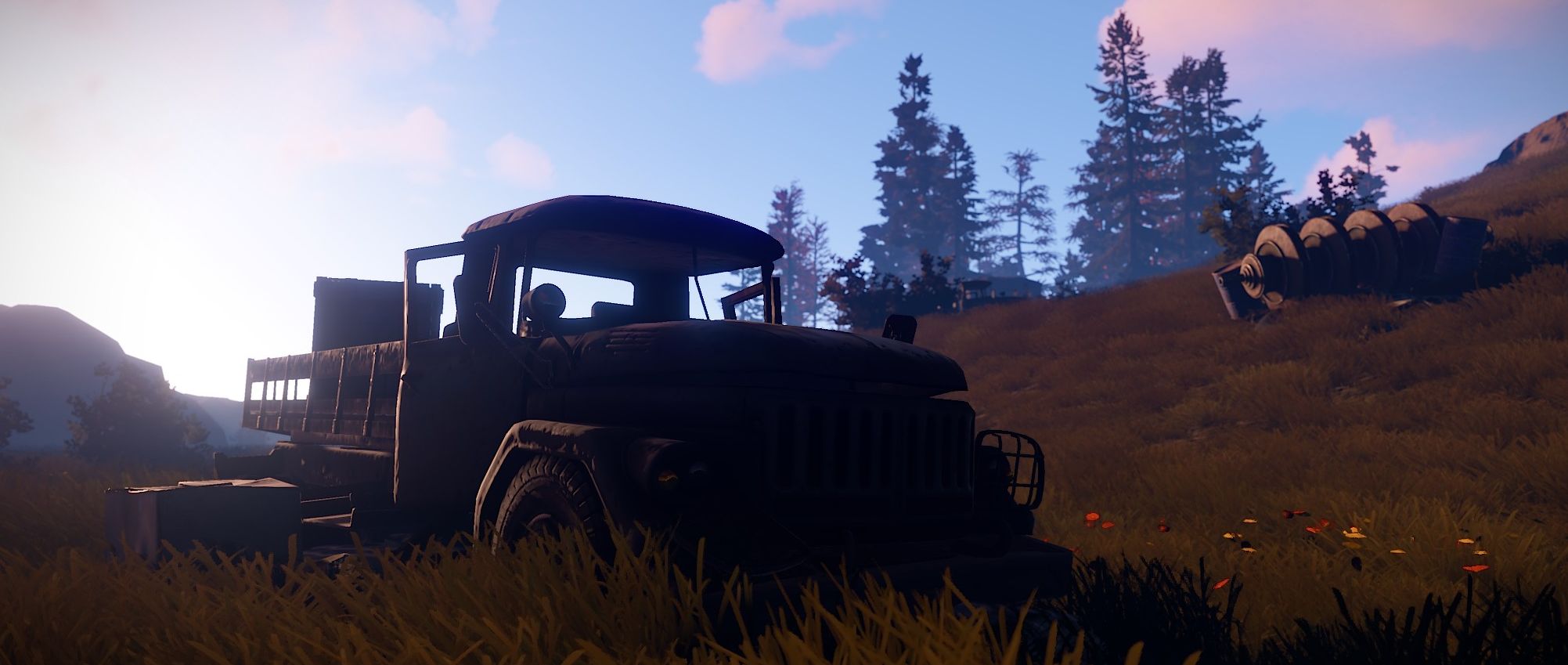
Helk had long resisted spawning full items in the world, feeling it bypassed the component system - but enough people internally and externally wanted it that he agreed to an experiment. A new purple loot crate (temporary art) began spawning at junk piles, containing hatchets, pickaxes, starter weapons and some armor. Crate probabilities were also reshuffled across junk pile types: purple crates cluster near cars and trucks, smaller junk piles lean toward food and oil, and machinery-style piles favour tier 2 components. Vincent supported the theme by remodelling two vehicles into wrecks and building several new junk pile variants, while oil barrels started yielding more per barrel but spawning less often.
Item Store: Automatic Pricing
Building on the previous week's cheap-skins experiment, Garry restructured the item store around two new categories - New Items (added within the last cycle, usually a week) and Leaving Soon (gone next cycle). Prices are now set automatically: cheapest on arrival, rising each cycle across a 7-cycle (roughly 7-week) lifespan, after which the item leaves sale for the Steam market to take over. Some previously retired skins even returned to the store under the new rules. That week's crop of workshop items included the Uprising Hide Poncho, the Polymer BAR, the Where Eagles Dare AK and the Bloody Tooth Pickaxe.
Optimisation Everywhere
The performance war declared in Devblog 142 continued on every front. Garry rewrote the RPC system with a code generator so network calls are "as fast as they could possibly be, and totally allocation free," replaced a reflection-based HUD variable-watching script to save about 0.2ms every frame, converted the look-at menu system to the same flat generated code, and fixed a consistent allocation bug in the player tick - leaving the main client loop entirely allocation free. Andre eliminated 70% of client-side rigidbodies, made all effects compatible with prefab pooling (a big win during heavy gunfights), and cleaned up prefabs that were visible from absurd distances - cutting around 100,000 vertices and close to 500 draw calls on average. Alex Ramsey found that disabled reverb zones were still costing performance, and removing them until you actually enter one saved around 1ms per frame on procedural maps, with immediate sound recycling adding a little more. He also fixed a long-standing annoyance along the way - Garry discovered ragdolls had always been jerky because interpolation breaks when rigidbodies are children of other rigidbodies; moving them all to the object root made death cams and kills visibly smoother.
Smaller Changes and Fixes
- Wood armor no longer requires cloth (a leftover from before the rope item existed), making it easier to craft.
- Corpse flies stopped glowing in the dark - they'd been using an unlit shader, visible even on pitch-black nights.
- Unity was updated to 5.4.4f1, fixing the
-window-mode exclusivecommand line option for exclusive fullscreen - which anecdotally improves framerate. - Fixed player movement issues (especially jumping), impact particle effects not playing, a bunker-room building exploit, and code lock lights showing the wrong colour in some cases.
In the Pipeline
Andre began a world serialization system aimed at cutting loading times to "only a couple of seconds," with a side goal of giving modders control over world generation later. The Magnum Revolver's viewmodel animations and sounds were finished, with the world model underway and hand-off to Helk expected the following week. New truck variants shipped, Pilgrim pushed on replacing generic burlap-sack world models with real models for resources like animal fat, coal, HQ metal and gunpowder, and wolf sounds got a second pass while the bear's audio waited on its new model. A dense little patch, all told - and if you fancy tracking down those Uprising-era skins today, they're all catalogued on our skin tracker.