
What's New in Rust's "Devblog 123" Update
Devblog 123 brought researching back via the Research Bench and stackable one-use blueprints, buffed base damage across rifles and pistols, made the holosight actually usable, and saw Helk openly question whether the XP system should survive at all.
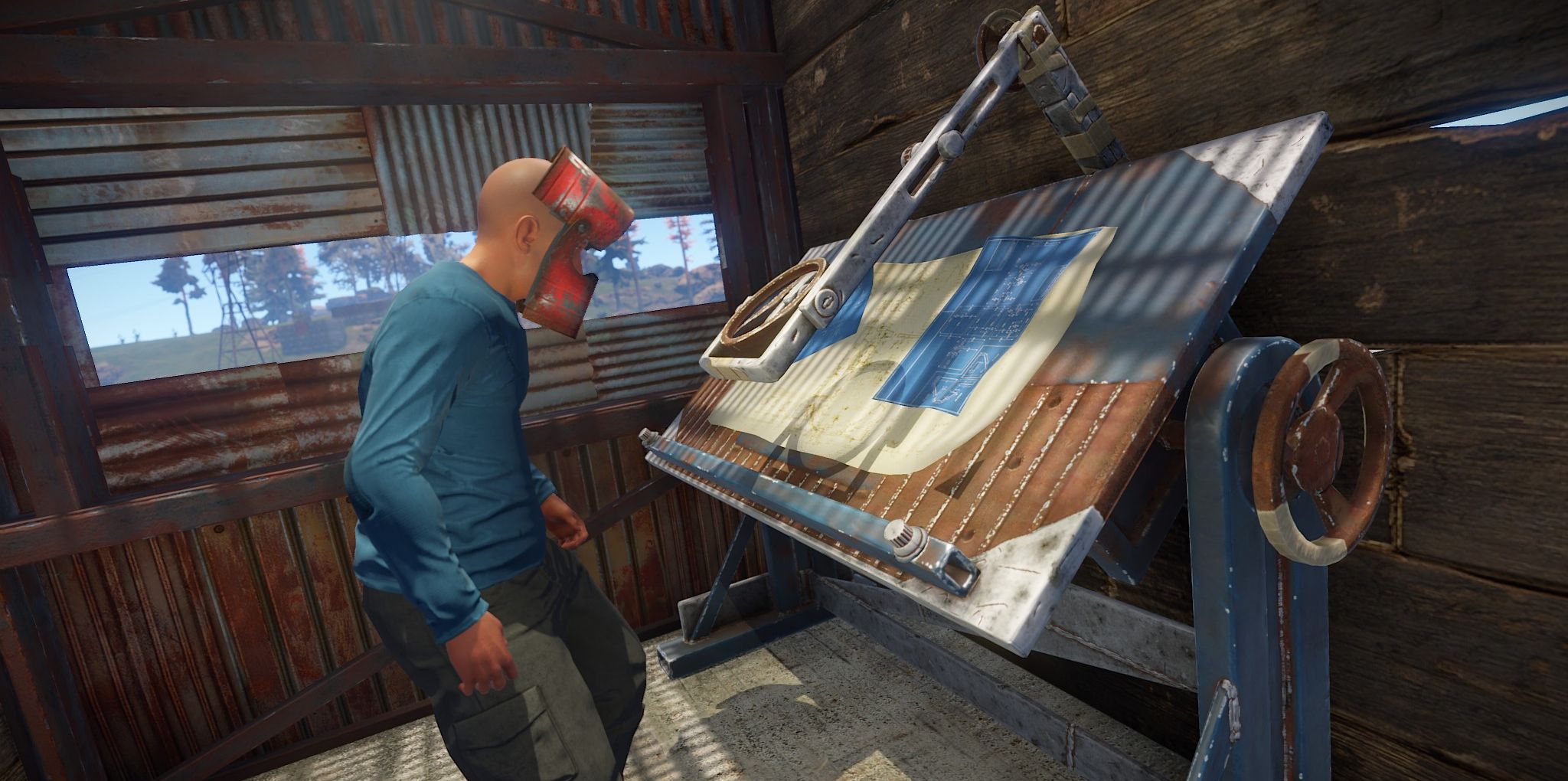
Devblog 123 arrived on August 19th, 2016 carrying the update players had demanded since the XP launch: researching was back. Alongside it came a substantial weapon damage rebalance, a gloriously simple holosight fix, entity pooling to fight building-load stutter — and, at the bottom of the blog, a remarkably honest essay from Helk admitting that ditching the XP system entirely was now on the table.
Researching Returns
A reddit thread digging into XP-system hatred surfaced two core complaints: the forced linear progression, and the loss of researching — which meant a higher-tier player's loot was mostly useless to you, too precious to ever take out of your base. The answer was a reworked research system:
- You need a Research Bench — found at various monuments, or craftable at level 10 and above (moved down from level 17).
- You need Research Paper — rare in barrels, more common in loot crates.
- Throw the target item in the bench: based on its durability you get a base 0-30% success chance, boosted by adding more Research Paper. Low-end items need one or two papers to max the odds; high-end items can need up to 10.
- Success destroys the source item and grants a stack of Blueprints — dozens for things like ammo, upwards of 5 for an Assault Rifle.
Crucially, each blueprint was a single craft session — stackable and tradable, but not a permanent unlock. Find a Semi Auto Pistol, break it down, and you've got several crafts of it (spend paper to improve the odds, "or none if you're a degenerate gambler"). One warning: items crafted from blueprints had limited durability and were less likely to research successfully again. Helk called it an imperfect stop-gap — but one that fast-tracked progression for those who wanted it, made high-tier loot worth taking, and bought the team breathing room to rethink the bigger picture.
Weapon Damage Rebalance
Andre ran the PvP numbers and raised the base damage of rifle and pistol bullets across the board (from 40 to 50 base for the ammo types). The new per-shot figures — double them for headshots:
- Bolt Action Rifle: 75
- AK: 50
- Semi Auto Pistol: 50
- Semi Auto Rifle: 40
- Thompson: 37.5
- Revolver: 37.5
- SMG: 30
Relative ratios between guns stayed the same — except the Bolt Action, deliberately buffed less so a Coffee Can Helmet let you barely survive its headshot. AK and Semi Auto Pistol headshots could one-shot at close range, but even basic headgear forced a second hit. Rifles also got a longer maximum-damage distance to widen their range advantage over pistols, and shotgun buckshot's projectile radius was doubled again to smooth out pellet-spread damage variance and make shotguns feel good.
Holosight, Fixed the Easy Way
The Holosight's dim, grey glass had made aiming through it a chore. Helk's solution was elegant: delete the glass. Completely transparent, just a reticle — "like every other game. Maybe it'll be useful now?" He also fixed a self-inflicted bug from the previous week's performance work: the player-model rebuild optimization had eaten candle hat and miner hat light toggling, "so everyone can continue to never unlock or use either of these items!"
Netcode and Combat Transparency
Server-side projectile verification got another pass, drastically reducing attacks rejected due to client delay or desync — the source of rare unregistered hits. A rare bug where a player's view direction wasn't networked to others was tracked to two root causes and fixed. And the combat log grew more useful: it now included every attack the server rejected, with the reason — both a debugging tool for the team and transparency for players dissecting a fight. Attack verification was extended to launcher weapons too, and additional interaction checks on nearly all RPC calls made basic scripting harder.
Entity Pooling and Server Customization
Attacking the infamous stutter when huge buildings stream in, Andre shipped entity pooling — disabled by default, testable via pool.entities — which greatly reduced the lag's intensity, with more entity types beyond building blocks and external walls to come before default-on. Server owners also got a full set of gameplay tuning knobs: meleedamage, arrowdamage, bulletdamage and bleedingdamage to scale damage types, with matching armor-scaling convars. The team planned to use them for rapid balance experiments on staging servers — and to watch what values community servers chose as a crowd-sourced read on balance opinion.
Dungeons, Guns and Skulls
The Old Mines tunnel set took shape — twisted, timber-era remnants of an older industrial age, destined to be secondary paths into military complexes and natural caves, with the reworked Military Tunnels dungeon set to become the largest underground space in Rust so far. The Lighthouse detailing continued, its tower exterior mostly done and its bunker heading for an abandoned, deteriorated look. The LR-300 got viewmodel animations, sound effects, world-model LODs and third-person rigging with attachments. Taylor integrated the Deer Skull Helmet into the bone armour set (a makeshift cowl standing in for fur, still intimidating), with the human skull version staying and a bear skull tempting him as "the ultimate in bad-ass head attire". The Vending Machine high-poly progressed, with plans to borrow an old-arcade CRT shader for its pixelated screen.
Sound Polish
Alex R's cleanup week hit a long list: hurricane-level wind on windy days tamed (a "fun gameplay thing" that was really just annoying), birds and crickets rebalanced with the worst stings and loops deleted, footsteps EQed and made cohesive, bush rustles starting the moment you enter the bush, tree impacts gaining woody knock and losing excess tearing, and brand-new bullet ricochets and fly-bys with more variation and more low end "to make them feel scarier". Shotgun blasts also stopped triggering a million impact sounds, and music gained longer gaps between songs.
The Future of XP: An Honest Reckoning
The blog closed with Helk thinking out loud. The XP system, praised universally before launch and hated by many after, was "in some ways the antithesis of what Rust was all about" — forcing an order onto a sandbox. The old blueprint grind had been the complaint that birthed it, but he'd neglected how randomness forced players to work with what they had, creating interesting situations. A component-only system where anything could be crafted from parts was one suggestion — but with no persistent progression, a raid would mean total loss ("Ragequit probability = high") unless paired with ideas like a difficulty gradient moving high-tier content inland, away from fresh spawns. His conclusion was unusually frank: ditching XP was an option not because people were bitching, but because something about it "just 'feels' wrong" — great at the start, but ending in the perception of a finished game rather than an endless sandbox. "We might just be polishing a turd." The Research Table, he hoped, would give everyone breathing room while the team figured it out.