
What's New in Rust's "Devblog 122" Update
Devblog 122 was the performance patch: player culling delivered 20-30% FPS gains, the armor-condition microstutter died, and Rust became GPU-bound again. Plus a Double-Barrelled Shotgun buff, supply drop randomness, and a first look at player vending machines.
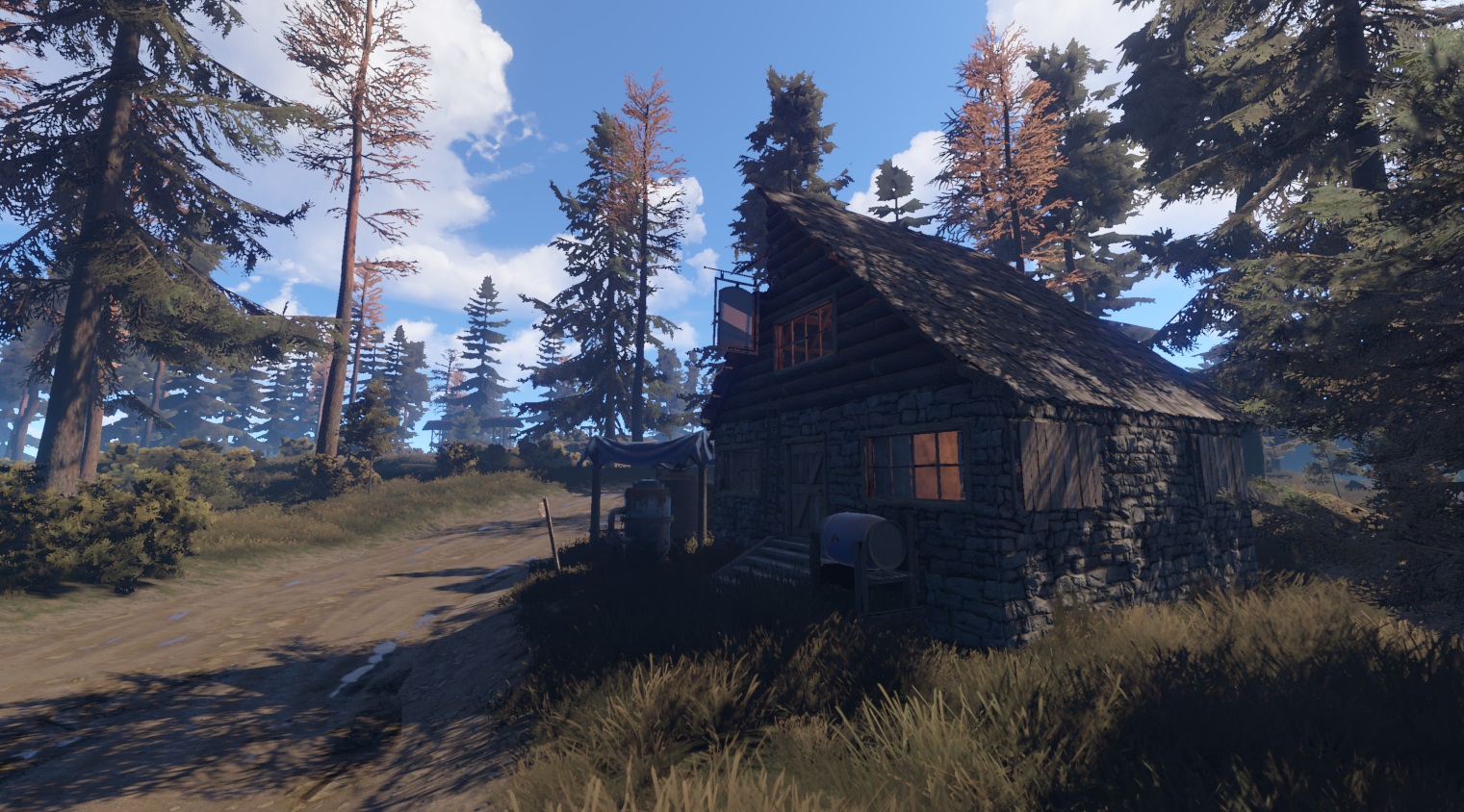
Devblog 122, published August 11th, 2016, was the week Rust's frame rate finally got some justice. A pair of CPU investigations by Helk and Diogo uncovered why populated servers tanked performance — invisible players burning your CPU — and the resulting player culling system delivered average gains of 20-30%. Add the death of the infamous gunfight microstutter, a Double-Barrelled Shotgun buff, supply drop shakeups, and concept art for player vending machines, and this was a quietly huge patch.
Player Culling: The Big FPS Win
Helk's mystery: why was FPS great on an empty server but 30 on a populated one? His assumption — more people means more buildings to render — was wrong. The real culprit was other players themselves: alive or sleeping, visible or not, every player on the server was "Thinking, Rendering, Skinning, and doing a whole bunch of unnecessary garbage" on your machine. Players were by far the most CPU-intensive entity on the client — even ten of them had a significant frame-rate impact.
The fix: draw a ray between each player and your camera, and if you can't see them, switch them off. What started as a test produced impressive improvements — around 20-30% on average for most people he'd talked to, most noticeable in crowded areas or on wipe day when everyone's on the beach. Edge cases were handled to prevent players popping in and out mid-battle: sleepers beyond playercull.maxSleeperDist and players beyond playercull.maxPlayerDist get disabled, anyone closer than playercull.minCulldist is force-enabled, aiming in someone's general direction (or them aiming in yours) force-enables them, and players behind you are disabled. Type find playercull in the F1 console to see all the options, or playercull.enabled false to turn it off entirely if it misbehaves.
The Microstutter, Solved
Helk also found the source of the notorious gunfight "microstutters". Whenever a player's wearables inventory changed, it networked to everyone who could see them, and those clients rebuilt the whole player model. The catch: armor condition counted as a change — so every time you shot someone wearing armor, your client rebuilt their entire model and froze for a fraction of a second. Mid-firefight. The fix compared clothing before and after each update and only rebuilt when something had truly changed; the same lag when harvesting player corpses was fixed too.
Diogo attacked the visible-player half of the problem: on busy servers, LOD selection, animators, state machines and skinning for player models alone cost upwards of 10ms of CPU time. With his optimizations plus Helk's culling, Rust was "finally GPU bound again" — good news, because graphics scale well in both quality and performance. One known issue remained on the list: the multi-second FPS drops while player bases stream in, still being worked on.
Double-Barrelled Shotgun Buff
After hands-on time, Helk concluded the new gun didn't pack its intended punch. The damage multiplier rose from 0.75 to 1.0 — matching the Waterpipe per shot — while spread increased (shrinking effective range) and the re-fire rate dropped from 1.0 to 0.5 so both barrels could be emptied quicker. A close-range monster with real tradeoffs.
Supply Drops Worth Fighting Over
Two changes rebalanced the airdrop game. Supply signals no longer guaranteed a pinpoint landing — previously players would throw one onto their 1x1 rooftop tower and collect with zero risk. Now the drop landed within a +/- 20m radius of the marker: still close, no longer a private delivery service. Signal drop rates in crates were lowered too. And continuing the loot-table cleansing from the previous week, the Supply Drop itself was purged of garbage — no more apples or torches, with ammo now the "worst" possible pull.
Server Weapon Verification, Unified
Andre went deep down a rabbit hole: weapon interaction checks on the server had been written by about three different people across the Rust reboot's lifetime, and the oldest ones silently rejected player actions with no logging at all — surfacing only later as cryptic "fired invalid projectile: Missing ID" messages. He combed the codebase, unified every check, and added warnings whenever an action was rejected. Staging-server log watching then revealed a fair number of real bugs — melee attacks incorrectly rejected, projectiles lost server-side — which now appeared to all be fixed. And if any remained, the new detailed logs would catch them the moment they happened.
He also fixed a small bug with an outsized quality-of-life payoff: code locks on external gates could finally be interacted with from both sides of the gate. "Getting it fixed made me feel nice and cozy inside."
Monuments: Lighthouse and Tunnels
A new environment artist introduced themselves with a finished greybox for a revamped Lighthouse monument — much larger than the old one, pairing the tower with a bunker-like structure for a more interesting explore, and with the lighthouse itself shaping up as a proper sniping spot. A second, tower-only variant was agreed on for variety. The Military Tunnels revamp also progressed, with new tunnel pieces (like slopes connecting levels) enabling more compelling layouts — plus an intriguing idea for old timber-braced mining tunnels as a smaller-scale alternative that could blend into sewers and natural cave networks.
Player Vending Machines
Concept art appeared for a craftable vending machine — an old soda machine modified with a crude keypad and screen, sitting in a wall frame, letting players offer item trades from the safety of their base via a large exchange tray. The team was openly curious what kind of economy would emerge, and how players would price weapons against stacks of resources. Paired with the recently teased shop front, Rust's trading future was clearly taking shape.
Everything Else
The Beancan Grenade viewmodel got fixed deploy poses and proper loop animations to match the F1 Grenade, the bone armour low-poly bake wrapped (with a human skull helmet in progress and a deer skull variant planned), and the LR-300 Assault Rifle finished its high-poly with deliberate color variety instead of all-black boredom. The Double-Barrelled Shotgun got a first sound pass preserving its beloved deep, cannon-like placeholder character, and Alex R composed toward a calm "harvesting trees in a sunny field" vibe for zero-intensity music. Researching's return slipped a week, having taken a back seat to the performance work — a trade most players were probably happy to accept. More FPS for everyone, and an economy on the horizon.