
What's New in Rust's "CCTV Update" Update
March 2020 turned the CCTV camera from a mere turret ingredient into a real surveillance system viewable from the new Computer Station, added trumpet-playing auto turrets, experimented with Valve netcode, and purged a mountain of exploits.
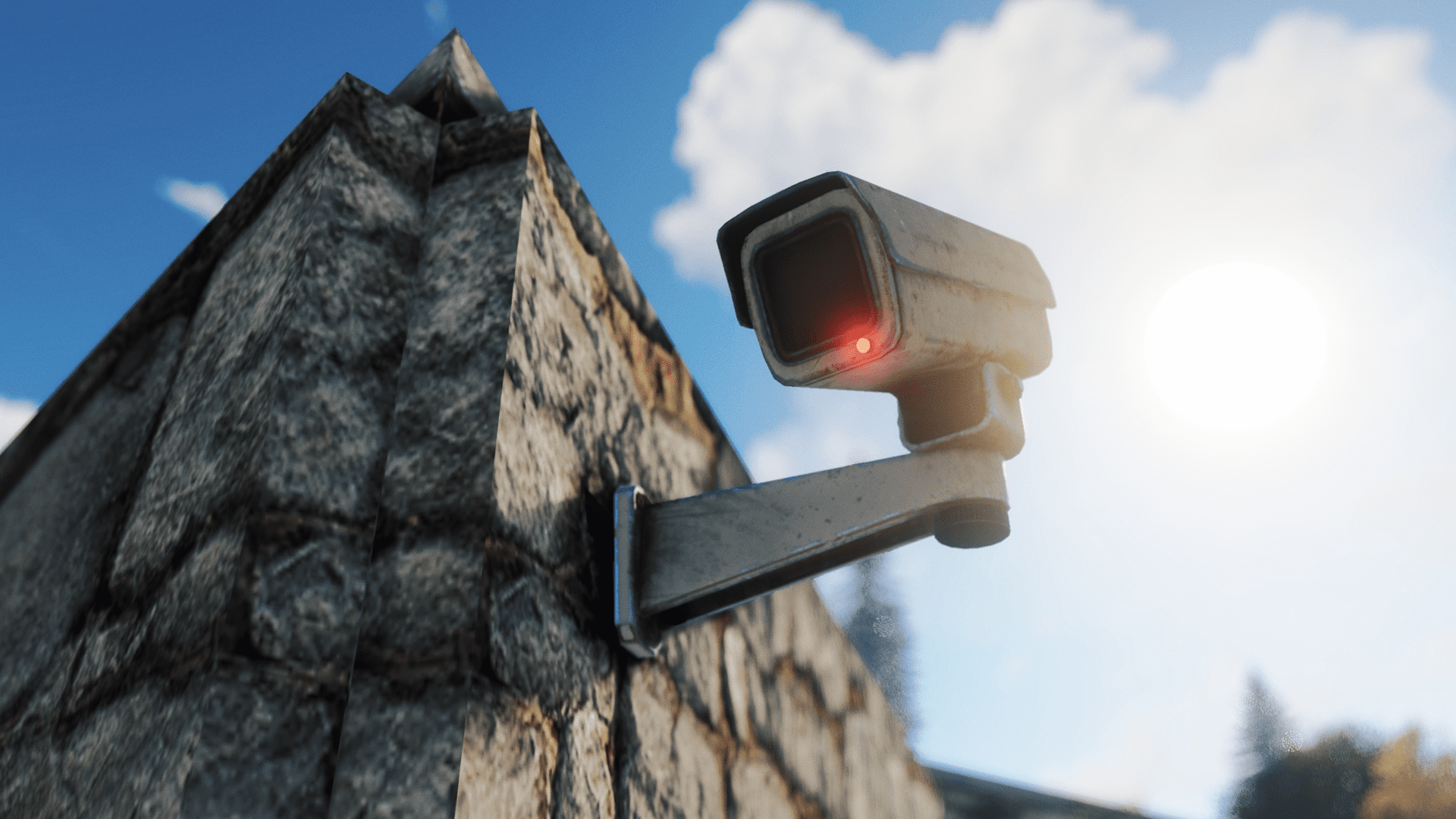
The CCTV Update shipped in March 2020 and gave paranoid base owners exactly what they'd always wanted: eyes everywhere. The CCTV camera - until then just a crafting ingredient for auto turrets - became a fully functional surveillance device, and the update wrapped it in a mix of playful extras, serious exploit fixes and some forward-looking netcode experiments.
CCTV Cameras and the Computer Station
Deploy a CCTV Camera in or around your base, then equip a hammer to configure it. Each camera needs an identifier - a unique name of up to 32 characters that grants access to anyone who knows it, from anywhere (Facepunch's advice: be creative, and don't use "lootroom"). Holding E offers a "Set Direction" option that rotates the camera to face you.
Viewing happens at the new Computer Station, available at the compound and researchable. Take a seat, add identifiers, and click a name to view that camera's feed - with no range restrictions at all. The devblog also dropped a delicious Easter egg: "a recent incursion at a Cobalt security station lead to the discovery of a set of encoded identifiers" propagating around the island - the in-lore introduction of the static monument camera codes the community soon began collecting.
The Fun Stuff
In classic Rust fashion, the surveillance patch also let you equip a trumpet in an Auto Turret, which plays random notes whenever a hostile player is detected - equal parts alarm system and psychological warfare. Server admins got a new toy too: env.oceanlevel instantly raises the server's ocean level for everyone (one meter with a value of 1), pitched mostly at custom map and modded servers, with Facepunch expecting "interesting ideas" to come of it.
Console power users made out well. You can now bind key combinations - for example bind [leftshift+x] kill to make accidental suicide harder - and the new meta.add command adjusts any convar by adding a value to it, enabling binds like raising the ocean 0.1 meters per keypress. Content creators got commands to adjust weather, change cloud rotation and disable underwater effects.
Exploit Fixes and World Improvements
Andre spent serious time debugging recent gameplay elements, fixing horse leaning exploits, sleeper parenting exploits, "a seemingly endless amount" of scrap transport helicopter exploits, more explosive ammo, fire arrow and incendiary rocket exploits, various projectile trajectory exploits, and exploits that created tool cupboards belonging to external or faraway bases. Some were abusable without hacks; others were far worse with them.
The recently added ring road also got housekeeping: road meshes now use several LODs for performance, roadside monuments can spawn next to both main and side roads and are placed after larger monuments so they don't steal space, the ring road was removed from maps smaller than 4k, and the default world size grew from 4000 to 4250 to give monuments breathing room. A bug where the cargo ship sometimes spawned out of world bounds - immediately killing its scientists - was fixed too.
Steam Netcode Experiment
Garry modularised Rust's netcode so multiple systems can coexist. Raknet remains the default, but adding -swnet to a dedicated server launch switches it to Valve's ISteamNetworkingSockets system, with clients adapting automatically. The motivation was twofold: Raknet - once excellent paid middleware, later open-sourced by Facebook - hadn't been updated in 5 years and had 63 open, unanswered issues; and Steam's networking offers a relay mode that connects via SteamId with no visible IP addresses at all, meaning servers can't be DDoSed and traffic rides Valve's worldwide backbone for better pings. Not enabled yet, but a tantalising direction.
Quality of Life and Cinematic Tools
Electrical items now show their power requirements and generation right in the inventory - a small change that made circuit planning far saner. Localization got attention too, fixing CJK player names in the team dock and item names in the inventory, plus newly localized options screens and achievement lists.
For machinima makers, a proper cinematic toolkit emerged: debug camera parenting (press F to parent the camera to an entity, TAB to cycle target bones, scrollwheel to dolly in and out), debugcamera_guide overlays offering Rule of Thirds, Golden Ratio Spiral, custom aspect ratio and crosshair guides, a demo.hud playback overlay with timecode and timescale, and a full demo browser on the main menu for playing, deleting and sorting your demo files. All of it was being documented on the then-new Rust Wiki's cinematics section.
One last behind-the-scenes note: a build server hardware upgrade plus process optimizations halved build times from 60 minutes to under 30 - unsung work that directly reduces late updates. The CCTV theme naturally leaked into cosmetics as well, with community skins like the CCTV Garage Door and CCTV Storage capturing the surveillance-state aesthetic - both trackable, along with the rest of the market, on our skin tracker.