
What's New in Rust's "Farming 2.0 Update" Update
April 2020 turned Rust farming from a background chore into a system with real depth. Plants now care about light, water, ground and temperature, seeds carry genes you can breed and clone, and a whole new Fluid IO plumbing system exists to water it all.
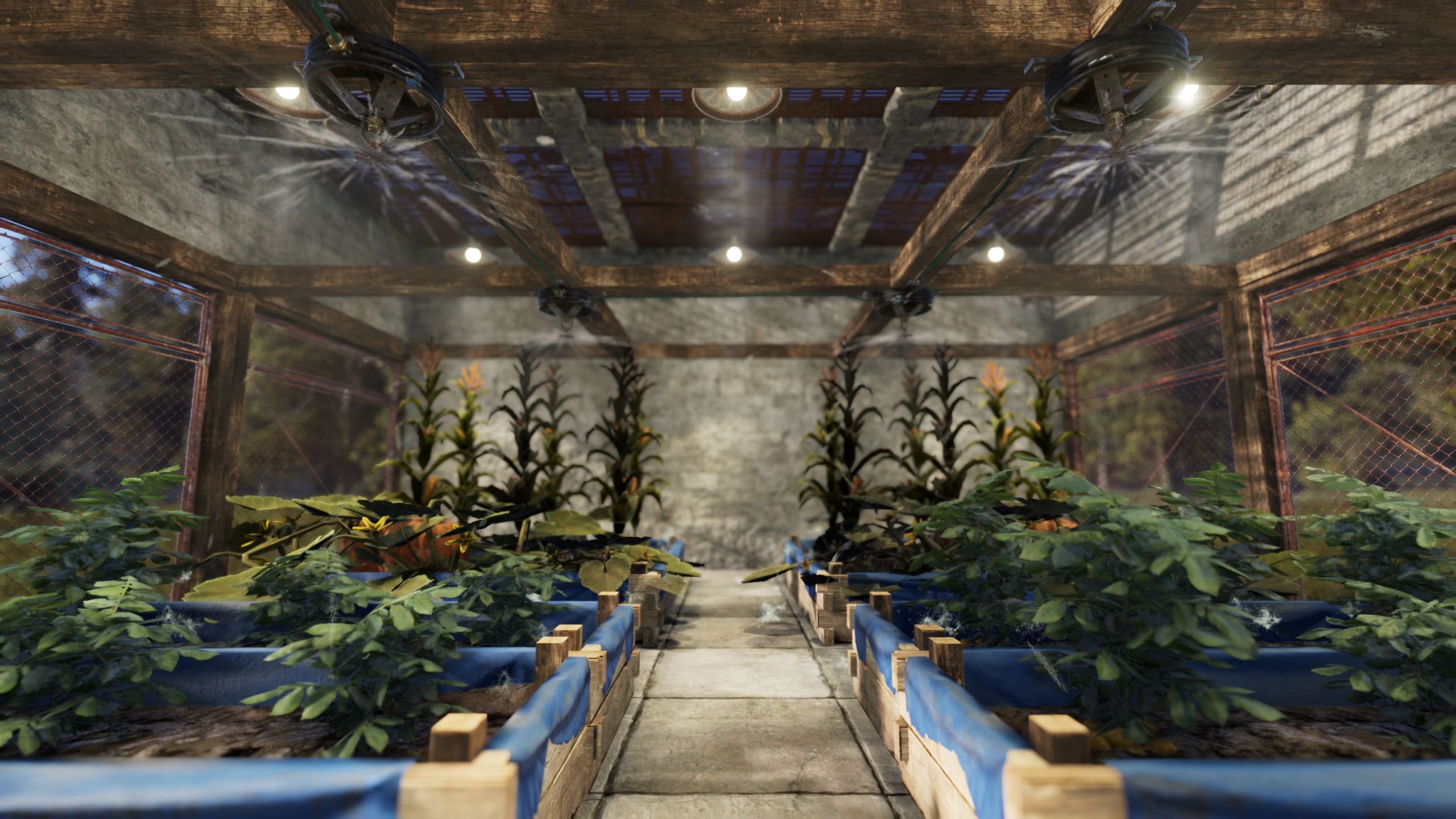
Farming 2.0 arrived in April 2020 and it is one of the largest single-system overhauls Rust has ever received. Before it, planting was mostly a matter of dropping seeds and waiting. After it, plants have conditions, resiliences, six gene slots each, and a full crossbreeding mechanic - plus an entirely new Fluid IO system with hoses, sprinklers, splitters and pumps so you can actually keep a farm irrigated. It's dense, and it rewarded players who were willing to sit down and learn it.
The new farming basics
Plant growth was rebuilt around four conditions, and all of them matter:
- Light
- Water saturation
- Ground condition
- Temperature
Aiming at a plant now brings up an info panel that updates in real time as you change things - turning on lights, adding fertilizer, and so on. The value to watch is Overall, which is the plant's current growth rate. The higher it is, the faster the plant grows and the more yield it produces. Crucially, Overall is calculated by taking the lowest of the four condition values, so one neglected condition caps everything else. A perfectly lit, perfectly fertilized plant with no water is still a bad plant.
Each plant type also has different resiliences to those conditions, meaning some species grow more easily in certain areas than others. You can check a plant's resilience values on the seed information panel before committing a whole planter to it.
Composter, fertilizer and horse dung
The Composter is a new deployable with a pleasantly simple loop: put stuff in, wait, get fertilizer out. Fertilizer added to a planter box pushes ground condition to 100%. Only items you'd sensibly expect to be compostable can go in, and it ticks every 15 minutes by default. Some things compost better than others and contribute more fertilizer.
Which leads directly to the update's most quoted line: horses now poo. Horse Dung drops every 20-25 minutes, and putting it in the composter gives a very healthy amount of fertilizer. Server admins can tune the rate with the dungTimeScale command.
Potatoes
A new plant type joined the roster - the Potato. It has strong resiliences and grows in most environments, making it far easier to keep happy than the other plants. The trade-off is that potatoes heal for less than the alternatives, so it's the low-effort, low-reward option.
Plant genetics
This is where Farming 2.0 gets deep. The second panel of the plant UI shows genetics: every plant has six gene slots, with green genes being good and red genes being bad. The gene types are:
- G - increased growth rate
- Y - increased yield gain rate
- H - increased hardiness, so it survives worse ground conditions
- W - increased water intake
- X - empty
When you pick a wild plant you get a seed of that type, but its genes are unknown until you actually plant it. That uncertainty is the entire engine of the farming metagame - you're gambling planter space on unrevealed genetics.
Cloning and crossbreeding
You can take a clone of a plant, and the clone inherits its genetics exactly. Plant the clone and you grow another plant with the same genes, which is how you lock in a good strain once you've found one. Clone genetics are visible on the clone information panel.
Crossbreeding is how you build a strain in the first place. When a plant enters its crossbreeding stage it compares its genes against surrounding plants on a per-slot basis. If enough neighbouring plants share a matching gene type in the same slot, that gene overwrites the plant's existing gene in that slot. For example, if a plant's first gene is a W and two surrounding plants have a G in that slot, the W is replaced with a G.
The plant info shows what changed - new genes appear at the bottom, and the previous genes are greyed out and removed from the chain. Two rules keep it from being trivial: negative genes have a stronger crossbreeding weight than positive ones, so you need to surround a bad gene with more good plants to displace it, and crossbreeding only happens inside a planter box between plants of the same type.
Fluid IO
Watering all this by hand would have been miserable, so the update shipped Fluid IO - a new variant of the electrical system built for transporting and using water. The one rule that shapes every design is gravity: water flows horizontally or downward on its own, and can only go up with a Fluid Switch.
The Hose Tool connects water sockets on compatible props and works almost exactly like the wire tool - left click a socket to start, left click surfaces to add points, left click the target socket to finish. Hose sockets are on water purifiers, water barrels and the new fluid deployables.
The Sprinkler can be placed on walls, floors and ceilings. Connected to a valid water source, it sprays in a radius and fills any plants or planter boxes in range, draining the source barrel or catcher while it's active. It has a passthrough water socket so sprinklers can be chained.
The Fluid Splitter does what it says: splits one incoming water source into three outputs, which is how you feed several sprinklers from one supply.
The Fluid Switch toggles flow to sprinklers, letting you kill a whole irrigation network from one point. It has water in/out plus three electrical inputs - Pump, Power On and Power Off. Powered, the pump pushes water up to higher floors of your base, and the Power On/Off inputs let you wire the switch into your existing electrical network.
Water Barrels and Water Catchers were updated to fit in, gaining Water In and Water Out sockets so they can act as sprinkler sources. Water Catchers automatically push water through their output socket into any connected water storage, so a Catcher wired to a Barrel fills it over time, and Catchers can be daisy-chained to pour several of them into a single Barrel.
Unity 2019.3
The engine upgrade got a genuinely interesting write-up. The initial move to 2019.3 caused a significant performance drop and higher memory usage, traced to a new flag in the mesh collider cooking options - prefabs created on 2019.2 had to be explicitly updated or they'd run much slower.
The obvious fix was to set the bit mask to all 1s so it included every current and future flag. That helped, but was still slower than 2019.2, which is why 2019.3 was held back from the previous month's update. Further digging turned up an old bug from the 2018.3 beta: something inside the engine checks for the exact default flags, and any other bit mask - even one that includes the defaults - is dramatically slower. The eventual solution was forcing the new default flags onto all mesh colliders, going from the old default value of 14 to the new default of 30.
With that in place, 2019.3 showed a significant performance increase, and Unity indicated the underlying problem was fixed in the 2020.1 beta with a backport to 2019.3 planned. The HDRP branch was still slower than the legacy render pipeline, so more work remained on both sides, but the upgrade was described as a major step in the right direction.
DOS attacks and navmesh
March had brought a number of DOS attacks. Facepunch stayed deliberately vague on specifics, but reported that all known issues plus a number of previously unknown ones were tracked down and fixed, along with preventative measures added for the future.
Separately, navmesh generation at server startup - painfully slow on large maps - was made at least 4x faster on the default map size, with bigger gains on bigger maps. That was flagged as the last known blocker for maps supporting vehicles, which tells you exactly where the roadmap was heading.
The rest of the changelist
Smaller items worth knowing: horses now trigger landmines, new farming-related vendors were added at Bandit Camp and Outpost, keylocks stack to 10, planters are stackable, and the water purifier both processes water twice as fast and stores twice as much. The airfield CCTV camera was moved so it no longer overlooks the recycler. Fixes covered mounting ladders through windows, large water catcher and large floor spike placement on terrain, the distorted water mesh in the water bucket, and windmill vane culling.
Store skins
The store leaned all the way into the theme with a full farm wardrobe and set of deployables - the Farmer Overalls Top and Farmer Straw Hat, the Red Barn Double Door, and the aptly named GMO Free Seed Box. You can check what any of them are worth now in our skin tracker.