
What's New in Rust's "Devblog 77" Update
Devblog 77 was a no-patch week in September 2015, with Facepunch moving to a two-week release cadence. Instead of a build, the team showed off holosights, a rewritten ironsights system, three greyboxed monuments and a serious hunt for frame-time stutter.
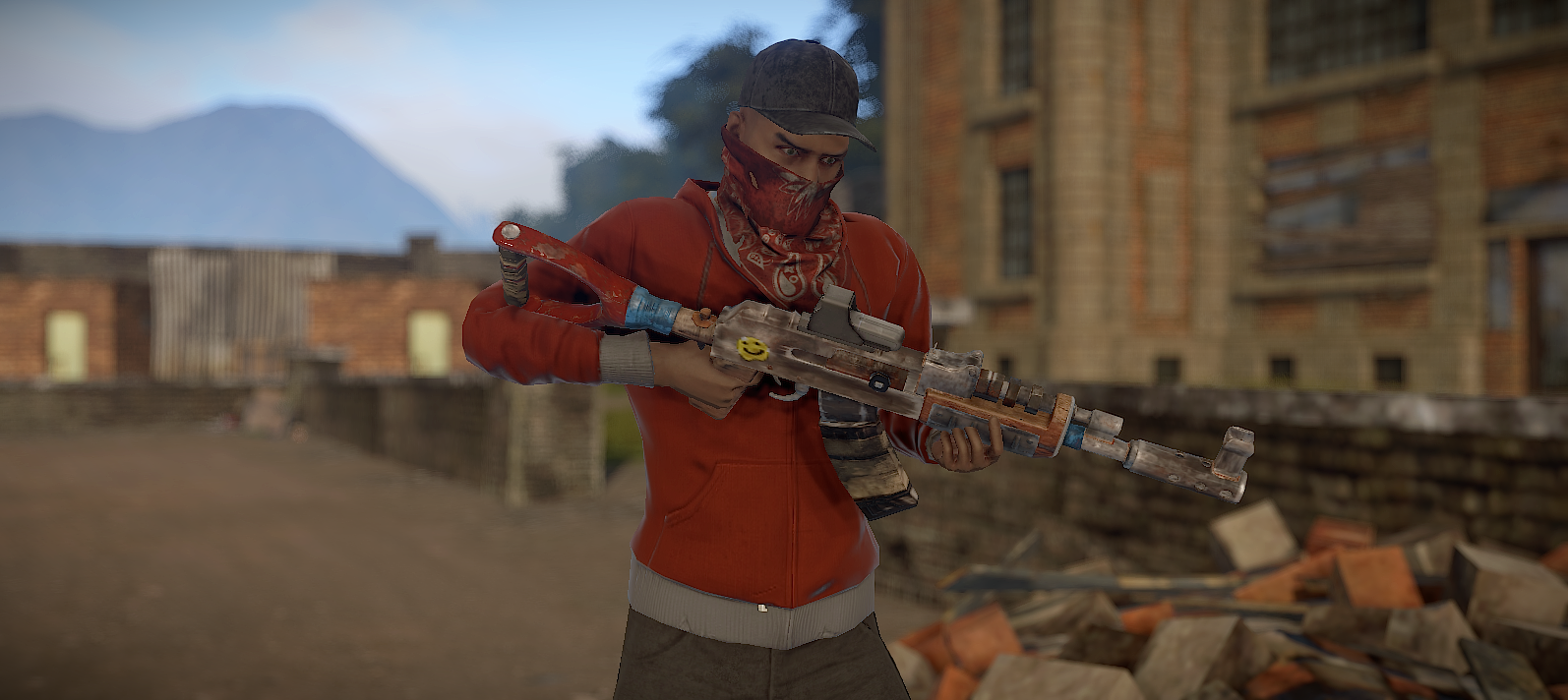
Devblog 77 landed in September 2015 and, unusually, came with nothing to download. Facepunch had just shifted to a two-week patch schedule, so this was a pure progress report rather than a release. It's still one of the more interesting reads from that era, because it's the week the weapon attachment system, the rewritten ironsights and the first greyboxed versions of monuments we now take for granted all showed up in the same post.
Holosights and a Rewritten Ironsights System
Garry spent the week on the holosight, which meant the deeply unglamorous work of setting up attachment points on every weapon, in both view model and world model, and then fixing the ones that came out wrong. The upside is that it's a one-time cost per weapon - the same attachment points get reused for scopes and any other optic added later. Attachments also got general polish: attachment sounds, and the ability to drop a mod directly onto a weapon to fit it.
Optics also broke the old ironsights code. The previous system involved manually typing eye position and rotation numbers per weapon, which was never going to be accurate enough once you needed to actually look through a sight. Garry wrote a replacement, found it was subtly off on weapons whose models were slightly rotated, and then rewrote it a second time. The final version defines two points per weapon - an eye point and an aim point - and derives everything from those. The stated result: ironsights that are far more accurate going forward. Garry also made the point that on the old weekly schedule he'd probably have shipped the first, flawed version and called it close enough.
Market Balancing
The other Garry topic was the skin market rebalance he'd done earlier that week, which had generated a lot of noise. The reasoning was straightforward: if 2,000 copies of an item are listed at the lowest possible price, there are too many of them in the economy, so the fix is to stop dropping them and buy some back out of circulation. The goal was that items should hold value rather than clog inventories, and that a player selling something should be able to ask a decent price for it. He framed it explicitly as a temporary measure that becomes less necessary as more items exist to drop. The long-term plan floated here was a TF2-style crafting system - break clothing items down into cloth, then use that cloth to craft something new.
Next on his list was the weapon slot system, with an idea of letting you upgrade a blueprint to add more attachment slots to weapons you craft - an early sketch of a levelled blueprint system.
Monuments: Powerplant, Trainyard and Water Treatment
Vince had first-pass greybox layouts for three dungeons: the Powerplant, the Trainyard and the Water Treatment Plant, all assembled from the modular pieces he'd built in August without much repetition. Keeping to the grid meant buildings combined cleanly and doors lined up by themselves, which also kept the eventual final-art workload in check.
Water Treatment was designed specifically to push terrain elevation, giving a space you can move through from underground to ground level and well above it. Surrounding hills form a natural overpass leading up to a water tower - explicitly flagged as sniper bait - and the sewer network beneath it is more complex than the previous two dungeons, sitting across multiple levels. The Pigeon Nest monument was tucked into one corner, with more loot on top of the reservoir than anywhere else around the plant as a reward for climbing it. Players only interested in that loot could shortcut the whole plant by entering under the overpass.
The Stutter Hunt
Andre's week was almost entirely about frame-time consistency. The complaint at the time wasn't average framerate, it was the hitching whenever new content had to be loaded or cleaned up.
- Building blocks and deployables were being loaded from disk the first time each type appeared, sometimes dozens of meshes and textures in a single frame. The fix was to preload all assets into RAM on first joining a server - disabled by default on 32-bit operating systems because of the memory cost, with a recommendation to move to 64-bit.
- Even with assets in memory, instantiating large numbers of objects like building skins was slow, so spawns got load balancing - at most 1ms per frame, with anything over that deferred to the next frame.
- Network entity spawns were harder, since deferring a spawn means handling messages that arrive for an entity that doesn't exist yet. The interim workaround was delaying client messages once a per-frame network processing budget is exceeded.
- Dynamic memory allocations got a pass too. Sound update routines alone were responsible for more than half of the per-frame allocations, and eliminating those cuts garbage collection frequency considerably.
Alongside that, the new particle effects from the previous week had caused real framerate problems, so Andre added distance-based particle count reduction and culling for far-away particles - shipped as a weekend hotfix. He also wrote a new screen overlay shader with normal mapping and dynamic lighting support, and used the Unity 5.2 move to fix the deferred decal system, adding reflection probe support, ambient light on albedo decals and emission map support. Fog 2.0 work started as well, aiming at directional light occlusion and better height-based density.
A grab bag of smaller changes rounded it out: dungeons now support terrain offsets and underground loot spawns, improved client-side projectile prediction, a fix for projectile tracers ending one frame early, new flags for client-side effects and attacks on projectiles, small furnace smoke disabled for looking odd, and memory usage plus garbage collection counts added to perf 2 and perf 3.
Rendering and the Unity 5.2 Prep
Diogo spent the week getting shaders current ahead of the Unity 5.2 upgrade, and fixed a run of PVT bugs: tiling artifacts in certain quality settings, low-res quality modes looking too blurry, missing resolution adjustment when switching quality level, and ground looking blurry closest to the camera while sharper further out. Page caching got a small optimisation. Water work resumed after the 5.2 updates, with local reflections and river improvements queued for the following week. An attempt to hack particles into receiving shadows went nowhere.
Effects, Sound and Art
Scott applied Andre's particle optimisations to the biggest offenders - furnaces, campfires and similar. Since you can't really make out most effects from around 50 metres, the LODding can be aggressive. He also started a new pickup effect for rocks, mushrooms and logs to make harvesting feel more grounded, and began switching first-person impact effects to mesh particles, which hold up better when they fill the screen, can be directionally lit, and let him drop a couple of large textures. Damage overlays gained normal map support so they react to lighting, with bleeding mapped first and cold, poison and radiation to follow. Footstep particles were being stripped back to water, sand and snow on most characters, with decal footprints - and the possibility of tracking players and animals - flagged as the follow-up once 5.2 landed. Smoke signals became more purple than pink, and large furnace smoke got lighter with updated motion.
On audio, Alex Rehberg made other players' reload sounds audible, which is exactly the kind of information that rewards pushing an enemy mid-reload. He spent most of the week on alternate gunshot sounds, including silenced ones, added slight left/right panning to your own footsteps, and did ambient electric buzzing for Petur's monuments.
Gooseman finished high-poly models for the holosight, flashlight and silencer, with the red dot and laser sight next. Tom's female character sculpt was nearing completion ahead of the low-poly pass, and Alex Webster fixed bow and crossbow bugs plus updated the crossbow reload view model animation. Xavier had been at a wedding and had nothing to show, and Maurino was still being coy about "the secret".
Savas Island Rework
Petur's Savas Island had been thoroughly broken by the last hot patch, but not before he got useful feedback on how it actually played. The rework queued for the next patch included loot tables rebuilt from scratch, a small buildable hill in the middle with static spotlights for defenders, a C4 spawn shack at the back of the island, Savas-specific loot crate textures with clearly marked loot tiers, Food Town converted into an ammo farm as the only source of special ammo, a large public furnace, several public campfires, slightly more frequent airdrops, better lighting in key areas and hemp spawns.
As progress reports go this one was unusually load-bearing: the attachment framework, the ironsights rewrite and the first playable shapes of Powerplant, Trainyard and Water Treatment all trace back to it. The payoff arrived the following week, when Devblog 78 shipped the holosight and the Unity 5.2 upgrade for real.