
What's New in Rust's "Devblog 69" Update
July 2015's Devblog 69 is a landmark patch: Steam Inventory integration arrived with the first playtime-awarded cosmetics, the female model went live for admins, wood and bone armour sets shipped, and ALT freelook replaced the old look-back key.
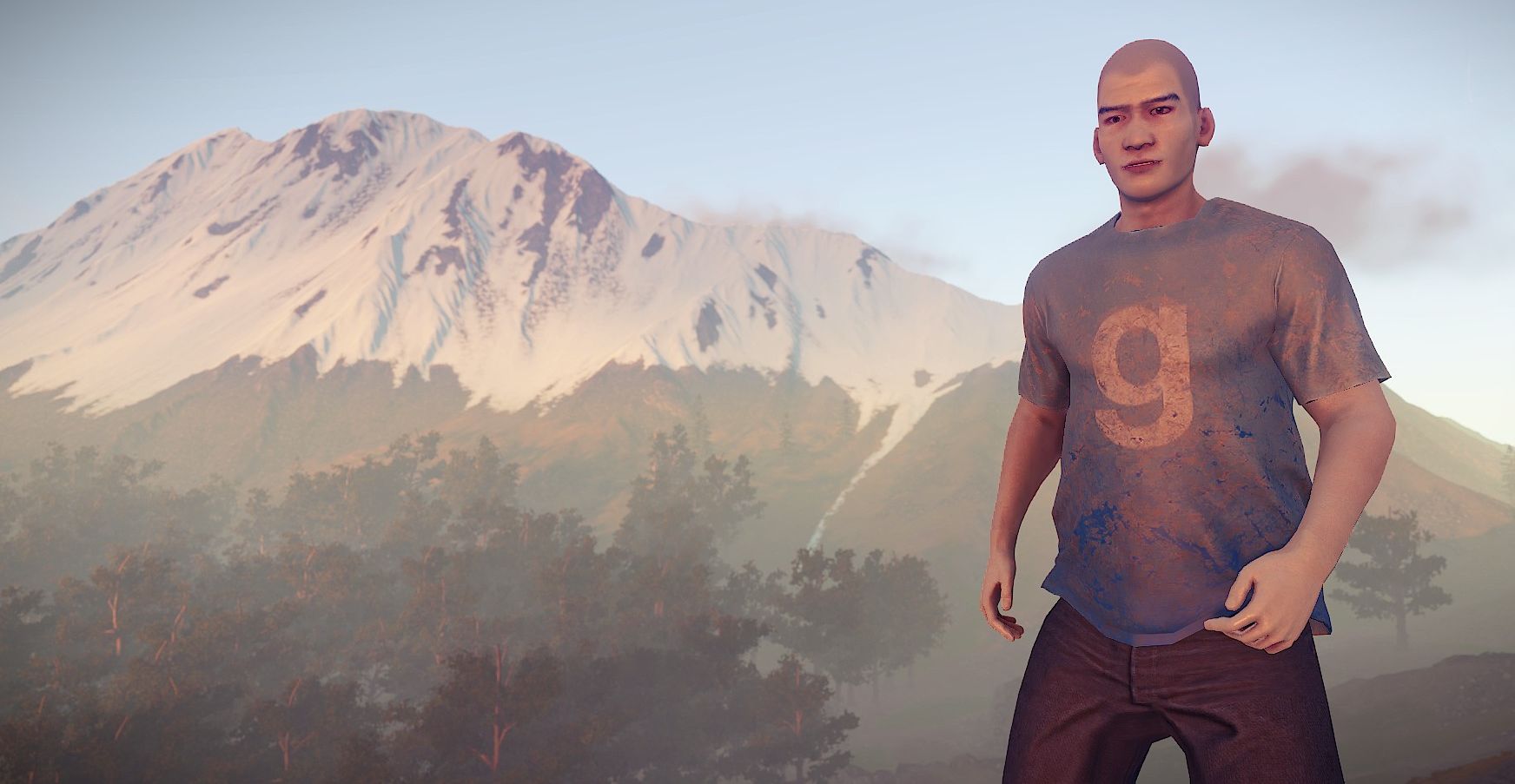
Devblog 69 went out in July 2015 and is one of the more historically significant patches in Rust's early access run - it's the update that introduced Steam Inventory integration and the first cosmetic clothing drops, the foundation everything in the Rust skin economy is built on today. It also put the female model into the game for admins, added wood and bone armour, and fixed a long list of player movement annoyances.
Steam Inventory and Cosmetic Drops
Garry laid out the reasoning at length, because he expected the reaction. Facepunch had always intended to use the Steam Workshop the way TF2 and CS:GO do, tying into an original vision of Rust as something closer to an MMO with one connected universe rather than a multi-server game where your progress resets per server.
The mechanics are simple: you join a server and play for a few hours, you're randomly awarded an item - a red t-shirt, say - into your Steam inventory, and you can then craft that shirt globally on any server. It applies only to select clothing items, not all blueprints.
The direct answers to the obvious questions were worth reading. Pay to win? No - the items are cosmetic and not sold, they're awarded on playtime. Selling blueprints? No, though never ruled out; the only routes are random timed drops, trading, or buying from other players. Garry compared it to a card collecting game where duplicates get traded for what you don't have, or sold to "lazy rich people", and pointed at the common Steam marketplace as the endgame - trade your Rust blueprints, some CS:GO guns and a few TF2 hats for a copy of Bad Rats.
Armour was the deliberate line they didn't cross. It could be read as pay to win since money unlocks something with a gameplay advantage - but you'd still need to gather resources to craft it, the blueprint might drop in your first hour anyway, and anyone who kills you takes the armour. No decision was made either way, and feedback was explicitly requested.
The launch set was small: a couple of t-shirts including the Black Tshirt, four long sleeved t-shirts such as the Black Longsleeve T-Shirt, a pair of Blue Jeans, and eight jackets - the Snowcamo Jacket and Hunting Jacket among them. Garry expected a moderate player to be awarded most of them within a month. Establishing the system early mattered more than the item count, since the plan was to trickle in more every week and have the plumbing ready for player-submitted Workshop skins.
On the question of whether the game would end up full of gimmick clothes, the answer was a shrug plus a plan: community contributions would likely be categorised into "fun" and "serious", with serious servers refusing fun clothes. And on the inevitable "you have time for this so the game must be finished" jab - Rust was still in early access, and that was exactly the window in which game-changing experiments were possible.
The Female Model
The female model is in the game, but not really live yet - alternate clothing models still needed doing, so for now you get it only if you're a server admin.
Garry also pre-empted the confusion: when it does go live there'll be no choice between male and female, and that isn't taking a choice away, because there never was one. His comparison was that a man's voice coming out of a woman's body is no stranger than an eight year old boy's voice coming out of a man's body, which is a fair summary of how Rust voice chat sounds on any given evening.
Armour Sets
The roadsign jacket became an "over" type of armour, worn on top of shirts like the metal chestplate, and gained a matching pants version.
Wood armour and bone armour both went in on the same layering principle, and both are default blueprints. Wood gives good protection against melee and explosions. Bone gives very good protection against most melee but is vulnerable to blunt and stabbing attacks. Maurino noted that once armour damage is implemented he intends to make both block much more damage but fall off after absorbing a few hits. Some pieces hovered slightly over the player and some icons - bone especially - were still work in progress.
Maurino was candid that he'd spent the whole week on the mining system and new event again without finishing either, and switched to implementing the artists' completed items rather than shipping nothing.
Player Movement
Andre worked through a batch of movement problems. Not perfect yet, but significantly less annoying:
- Improved landing, fall damage, grounded and sliding detection.
- Jump and sprint blocking after landing feels more natural.
- Fixed various situations causing jumping weirdness.
- Added a climbing state between grounded and sliding, where you can hold position and move sideways but not upwards.
- Slope speed adjustment now mostly affects sprinting speed.
- Fixed the wobbly, bouncy feel when trying to move up a step that's slightly too high.
- Improved ground normal detection.
Freelook and Head Tracking
Holding ALT no longer snaps your view backwards - instead you hold ALT and move the mouse to look around freely. Head rotation wasn't networked to other clients yet, since Andre didn't want to touch networking on patch day, with that planned for the following week.
The more interesting part is where it's heading. He added a first implementation of TrackIR-style head tracking, rotating your character's head on two axes the same way ALT freelook does - you turn your head slightly and the in-game head moves by an amplified amount, so you can look around without losing sight of your actual monitor. He described it as a limited prototype, with ambitions toward full six degrees of freedom plus body leaning via keyboard or pedals. The same groundwork could support VR, along with rendering your whole body rather than floating arms, though he was clear that's a much bigger job and not to wait around for it.
PVT Performance and Intel HD 3000 Crashes
Diogo spent two days setting up an older Macbook Air with Intel HD 3000 graphics to reproduce crashes, testing across OSX, Windows under Parallels - which ruled out driver issues - and finally Windows 7 x64, which was the crash target. He traced it to Intel GPU driver issues and was preparing a minimal reproducible project for both Intel and Unity, while also possibly having found a workaround.
Separately, PVT was performing terribly on high-end hardware - drops from 100 FPS to 25 - which he reproduced and pinned mostly to NVIDIA GPUs, likely due to their cache architecture. He shared terrain-only benchmark numbers at 2326x909 with maxed anisotropy and parallax on a GT 750M: roughly 34 FPS without PVT, about 104 FPS with the current implementation plus some improvements, and around 238 FPS with the new compressed cache. That compression also cuts VRAM footprint by around 65%. The option was re-added but disabled by default, with advice to leave it off unless it demonstrably helps your framerate.
He also started revamping the standard Rust shaders to support masked tinting and microfiber-based fuzz for cloth and fabric materials, and fixed a Water2 bug on NVIDIA cards in DX9 that showed random lines instead of an opaque water layer.
Art and Audio
Gooseman finished view-model and third-person animations for the two-handed sword in time for the patch, and fixed a third-person bug where the player's eyes closed shut whenever he deployed, reloaded or attacked. Three of Dan's melee weapons remained - a hacksaw, a two-handed cleaver, and a two-handed baseball-mace thing.
Xavier finished the armour sets, noting they took more planning than expected but that the extra work pays off: the bones, boards, ropes and other pieces are modular, so unique variants and mixed-material armour become possible from the same parts. His next stretch was retrofitting clothing to fit the new female model.
Tom made good progress on the crossbow, with LODs and a Unity check still to do, and had female character skinning seam issues to chase plus heads and skins to finalise. Vince put finishing touches on the sphere monument update, held in its own branch until a wipe.
Howie finished the large fractioning tower - flames shooting out the top, suitably intimidating - and returned to cars. His modular concept: start with a default chassis (several sizes eventually), which carries a two column grid for placing parts. His current parts each occupy 2x2 grid spaces, with larger chassis potentially supporting 2x4 flat beds. Even three or four pieces produce visible variety, and with a fuller part library he expects everyone's vehicle to feel like their own.
Alex Rehberg finished the first real pass at weather-influenced ambience: rain hitting tree leaves in the forest, some days windier than others, with volume levels and switching thresholds still needing tuning. Most ambient sounds were cleaned up, and all of them now stream from disk rather than loading into RAM, cutting memory use - close to a necessity given how many there now are. The ambience manager itself was next on the list for a refactor, having been designed back when there were only a few variations.
Megan got a reminder of the concept artist's occupational hazard: about 11 stackable hat and headgear designs, polished over a week, scrapped outright. She could still show more beaten-up satellites and a large batch of icons, mostly variants of existing ones, and planned to look at new beds next - not replacing sleeping bags, and not quite a retooling of the Legacy beds.
Other Fixes
- Fixed a network issue where corpses and dropped items showed at their spawn positions on the client.
- Thrown spears return to the belt bar when picked up.
- Anti-cheat bans are now livetweeted to @rusthackreport.
- Removed deprecated and very limiting foundation placement checks, now handled by the newer placement systems.
- Fixed the decal shader on DX9.
This is the week the Rust cosmetic economy started - a handful of shirts and jackets awarded by playtime, which grew into the marketplace players still trade in today. If you want to see how far that catalogue has come from those first sixteen items, our skin tracker covers the modern version of it.