
What's New in Rust's "Devblog 60" Update
May 2015's Devblog 60 brought back the supply signal and headshot sound from Legacy, added a hold-R menu for swapping ammo types mid-fight, and built out six tiered radtowns on Hapis Island. Also: players discovered they could sleep-talk across servers.
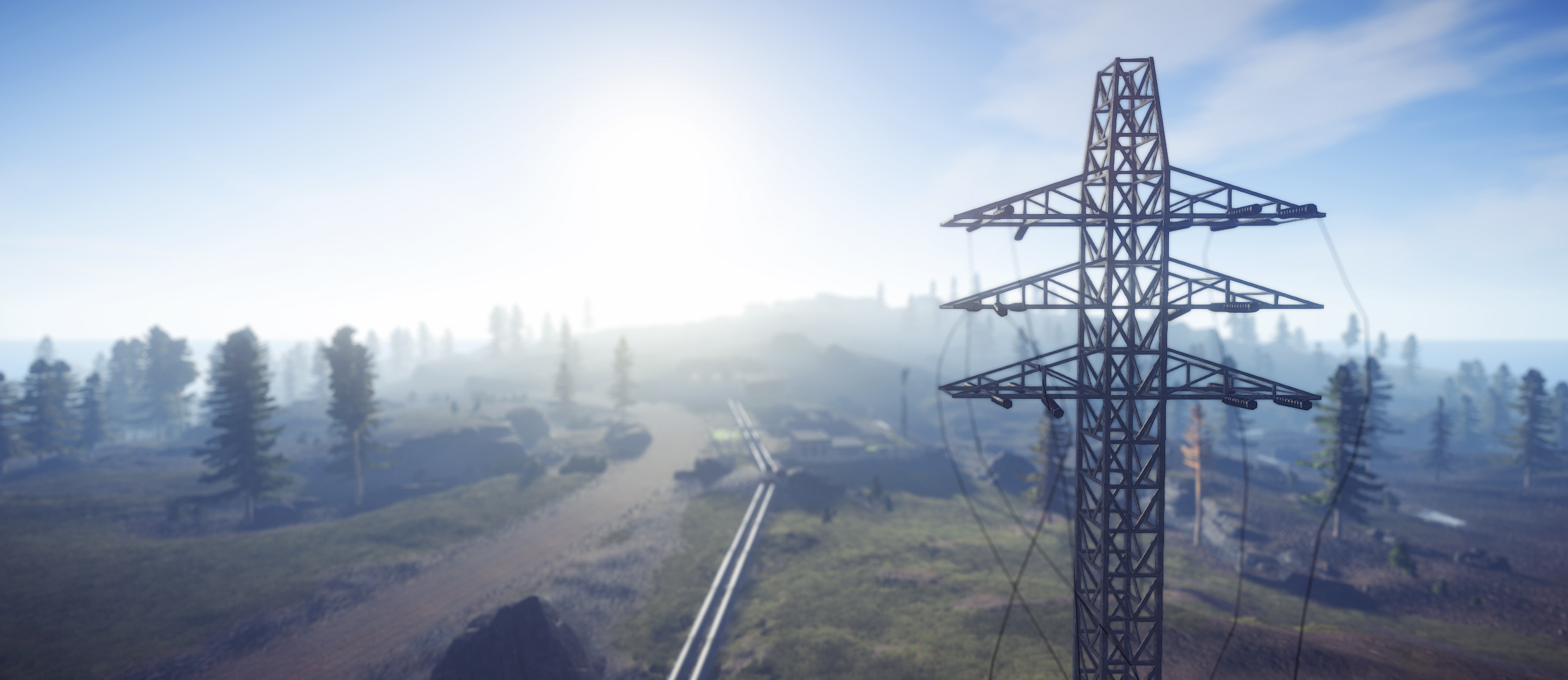
Devblog 60 landed in mid-May 2015 and is a genuinely dense one. The supply signal returned from Legacy, a new multi-ammo system let you hot-swap ammunition types from a hold-R menu, Hapis Island got six radtowns in three tiers, and Facepunch overhauled their build pipeline with asset bundles. It also contains the single funniest bug report in Rust's devblog history.
Supply signals and headshot sounds
The supply signal is back, working exactly as it did in Legacy but looking better. Throw it to mark the target and then, in all likelihood, watch the entire server converge on your position.
The Legacy headshot sound returned too. Land a headshot and you hear it at full volume locally; witness one and you hear it within 30 metres.
Ammo types
The big mechanical addition: hold R to open a menu and select your weapon's ammo type. Maurino also restructured a lot of code so ammo items govern their own behaviour rather than the weapons dictating it, which opens the door to far more ammo variety later. The immediate additions were:
- The Eoka can fire any shotgun, rifle or pistol ammunition
- High Velocity Rocket — less damage, more accurate, faster
- High Velocity Pistol and Rifle ammo — moves much faster with bonus damage
- Shotguns accept either shotgun shells or handmade shells
The plan for the following week was more ammo types and rockets plus supporting detail — different ammo sounding slightly different when fired, dealing more or less condition damage to the weapon, and modified impact effects.
Bean can grenade rebalance
The bean can grenade had been too unpredictable, so its randomness was made event-based instead:
- 70% chance it behaves predictably with a 3.5-4 second fuse
- 15% chance it explodes very shortly after throwing
- 15% chance of an extra long fuse
- 25% chance of a dud
- 50% chance a dud re-ignites when picked up
Elsewhere in weapon handling, firearms lose half as much condition per shot as before, view model positions were adjusted to reduce clipping, and the revolver no longer puts quite so much palm in your face.
Asset bundles
Facepunch had a build pipeline problem. Changing a 100-byte material file triggered the build server to build and upload OS X, Linux, win32, win64, server and debug versions of each — ten builds, roughly 2GB per client. A trivial change could mean uploading over 10GB to Steam.
Asset bundles give control over file layout, splitting content into logical groups so a material change uploads some materials rather than the whole project. Legacy used them and it became a serious burden — the implementation made development so painful it was easier to commit code untested, let the build server run, and download from Steam to test.
Unity 5's asset bundle system is much improved. It's incremental, rebuilding a bundle only when it might have changed, and it works well: build times for four platforms dropped from 10 minutes to one. The ideal scenario is building bundles once and sharing the data across platforms, which wasn't working because shaders appear incompatible between OS X and Windows — worth chasing with Unity, since it would cut the Steam footprint from around 10GB to nearer 3GB. Facepunch flagged that this was not a small change and asked for patience with any fallout.
Candle hat and emissive fire
The candle hat is divisive, but everyone agrees it's annoying when your torch light vanishes because you swapped weapons. Implementing it wasn't trivial — Rust had no systems for functional clothing at all — and now that the groundwork exists, more functional wearables can follow. Some bugs with lights in the sea were known, with Diogo due to investigate.
Building the candle hat exposed that fire was wrong. It wasn't emissive, just additive sprites, and it wasn't emitting light the way the sun does — so it never got bloomed, tone-mapped or otherwise processed correctly. Any particles that should emit light are now emissive, which in practice means fire, embers and muzzle flash.
Barricades, spikes and Legacy
Vince's barricades from a few weeks earlier went in — sandbag, concrete and stone — giving bases a proper insurgency look. They do nothing special beyond looking good and stopping bullets. His floor spikes landed too, and are best walked around.
A language selector was added to the main menu, with community-provided translations and a frank acknowledgement that some entries would be wrong and possibly include a racial slur or two.
Legacy stopped being installed side-by-side with the current game, so launching no longer asks which version you want. It remains playable by switching to the Legacy branch in Steam properties.
Cross-server sleep talking
The bug of the week. Rust's voice chat uses Steam's peer-to-peer system to send audio directly to nearby players — but it wasn't careful about who it sent to, and tried sending voice chat to sleeping players.
Normally that does nothing, since sleeping players aren't connected. But if a sleeping player was actually playing on a different server, they'd receive the voice data, fail to find the player it came from, and ignore it — unless it found that player's sleeping body on the server they were connected to. At which point the sleeping body would talk, relaying voice from another server entirely. Players could effectively use their sleeping bodies as cross-server radios.
Hapis Island radtowns
Petur rolled a large number of changes into Hapis, enough that they hadn't been properly tested. The island now has radtowns split into three tiers:
- Beginner — lighthouses and beached cargo containers, non-radioactive with small amounts of loot
- Standard — three full-size radtowns, radioactive, with roughly the loot volume you'd expect from procedural maps
- High tier — a single high-yield, zero-radiation facility in the middle of the island, where you'll need warm clothing to survive the night
The island also has fewer empty and flat areas — not final by any measure, but progress. Sweeping biome-specific visual changes to both Hapis and procedural maps were floated for the following week.
LOD grid and rendering
André replaced Unity's LOD groups with a custom solution, and his reasoning is worth reading. LOD groups look great at first: easy to use, nicely visualised, quick to set up, and probably ideal for average projects. Rust is not an average project, and they caused real trouble:
- They check camera distance every frame for every object, so their cost scales linearly with count
- Every LOD group switches at a slightly different distance from its neighbours, so objects pop in and out constantly as you approach a cluster — countered only by lumping objects into shared groups, at which point they lose their appeal
- Each individual LOD owns a game object, mesh filter and mesh renderer — pure memory overhead
- At around 35,000 LOD groups, Unity starts spamming a cryptic
group < 0x7ffferror
His custom grid-based LOD system has constant runtime, switches LODs for entire clusters rather than per object, uses one game object, mesh filter and mesh renderer per object, and has no practical count limit. It can also toggle whole objects including their scripts, which replaces a separate cull grid — so a fair chunk of its runtime cost is offset by removing that system. The migration wasn't finished, with analysis ongoing about which parts of the world benefit and LOD distances still to tune.
Biome material blending — the smooth material parameter blending previously exclusive to procedural map rocks — can now be used by any object with any shader and material, currently applied to rock tinting and terrain blending on Hapis and procedural maps. And Petur's SMAA implementation was enabled, which should reduce blurriness even with sharpen disabled; anyone having trouble can disable anti-aliasing in the F2 menu.
Art and concepts
Gooseman rigged and animated the smoke signal grenade with all its world models, built a spreading fire-bomb particle effect suitable for a fire grenade or rocket, added a large blood spray when hitting fleshy targets so long-range hits register visually, improved third-person SMG and Thompson hold animations with better supporting hand placement, and scripted the rocket launcher view model to swap between rocket types easily.
Paul designed a crafted handgun as a spiritual successor to Legacy's P250, bridging the revolver and SMG — junky and thrown-together but brutal, envisioned as behaving like a Deagle with heavy kick. He also concepted bone weaponry, with a chunky leg bone club as the team favourite plus a spiked mace.
Tom finished the new RPG ammo type and the smoke signal grenade, and started on Paul's bone club in ZBrush. Xavier began a miner's hat with headlamp, cheerfully noting it solves the problem of a head-mounted candle blowing out. Vince spent three days on the quarry asset, deliberately reusing existing building skin tier textures with blend layer materials for colour and dirt variation, tied together by metal edge and weld decals to make the silhouette pop — a technique that costs more polygons but pays back in production time and memory.
Howie focused on the pump jack for extracting oil and fuel from the ground, exploring several 3D sketches before settling on design F for its iconic shape, with the windmill next so the game can finally generate electricity. Megan made icons for the candle hat, more rocket launcher ammo types, three barricade flavours and the floor spikes, and continued on electric lights, power outlets and rough ideas for arranging wires on walls — with a floodlight and basic ceiling light chosen for an in-game test.
Diogo had a rough week on the water remake, discovering mid-migration into the Rust project that his LOD transitions weren't as watertight as he'd thought — small problems that take time.
Sound
Alex spent most of the week on gunshots, which are now snappier with far more detail. The part he was most pleased with is the reverb tails. Unity lets you control a sound's spread, fanning it across your speakers — turning spread up makes a sound feel enveloping, but costs directionality, which is bad for something as important as a gunshot. His solution: no spread during the initial bang, then fading spread up around half a second in so the reverb fans out and surrounds you. The result genuinely feels like sound echoing off the environment.
He also merged the new animal footsteps from the previous week and began revising them to distinguish them further from player footsteps, made a hitmarker sound for Maurino, and played with music ideas between gunshot sessions.
Anti-cheat and fixes
Cheating had increased over the preceding weeks, with EAC blocking and banning steadily and having just started blocking the method the newest cheats relied on. Facepunch set up @rusthackreport as a temporary reporting channel — tweet with as much information as possible (server, SteamID, what they're doing) and it gets read, though the bot won't reply. Proper in-game reporting was planned, covering not just cheating but general antisocial behaviour like chat spam.
- Fixed melee attack exploits and missing pickup icon
- Fixed the map being all blue on lower graphics settings
- Fixed weapon models at feet, and dropped items falling through rocks (potentially)
- Crafting can be cancelled in progress; cancelled on death with resources returned to your corpse, and on disconnect with resources returned to your sleeper
- Fixed clicking invisible crafting buttons while looting
- Tweaked building components to prevent building in rocks
- Updated Steam SDK; fixed player stats not uploading
Garry's list for the following week: ladders, mining work, stats, server browser improvements, throwing mechanics and streamer mode. André was aiming to land as much of his TODO list into procgen8 as possible ahead of a wiping update potentially only 2-3 weeks away, with dynamic weather a long-standing want he might finally get to.