
What's New in Rust's "Devblog 59" Update
May 2015's Devblog 59 finally gave Rust an in-game map - craftable, lootable, drawable and with persistent fog of war. It also added the research bench and bean can grenade, and cut tree counts in half after profiling showed trees were eating most of every frame.
Devblog 59 arrived in early May 2015 with the feature players had been asking for longest: an in-game map. True to Rust's design instincts, it isn't a UI overlay you always have — it's a craftable item you can lose, loot and draw on. Alongside it came the first research bench, the bean can grenade, a second SMG, and the discovery that trees were responsible for most of the game's frame time.
The map
Garry's reasoning was straightforward: an in-game map beats using a web page and console commands, a craftable map beats a free one, and a map with persistent fog of war that you can draw on and that can be looted off your body beats all of it.
The usage is simple. Craft it, then put it in your belt bar — it has to be in your belt to be active. While it's active and you're moving around, it updates visibility automatically. Hold the map key (default G) to open it, and press right mouse button to unlock the cursor for drawing. Facepunch had further plans depending on how it played out, though Garry was audibly done with it by the time it shipped, having fought Unity's RectTransform coordinate translation the whole way.
Trees are the performance problem
Garry added a render timings tool to the F2 menu that renders the camera in various scenarios, and the results were stark. An average frame takes around 11.5ms. With no terrain, about 11ms. With no trees, 4ms. Trees were consuming the majority of every frame.
Legacy had far more trees than this and handled them fine, because Unity had settings that made it work — settings that mostly don't function anymore. If they worked properly, exposing them in the tweak menu would resolve most of Rust's tree performance problems outright. Worse, Unity's internal tree handling and culling appeared to have got slower at high counts, since the framerate drop occurred even when nowhere near trees, not looking at any, and with shadows off.
Unity's support advised getting the issue voted to the top of their tracker so developers would notice; it was sitting third with 64 votes and had been for a while. In the meantime the blunt fix went in: tree spawn counts were more than halved, which should give everyone a meaningful framerate boost.
A UI speedup landed too. Unity UI has a "pixel perfect" setting, which Rust doesn't need since its UI scales with screen size. Turning it off made the UI dramatically faster — the consistent 50ms+ times seen while scrolling the map vanished entirely, and opening the inventory feels notably snappier.
Research bench
Maurino shipped the first iteration of the long-awaited research bench. You put an item in, pay the required resources — the item cost plus 10 paper — and get a 30% chance at a blueprint for it. The catch is significant: that 30% is scaled by the item's condition and max condition, and a failed research either destroys the item or reduces its quality to 0. Maurino acknowledged this was unsatisfying and said he had a much better idea lined up for the following week or two, with this serving as a placeholder. The art was temporary too, with Vince already producing the proper bench from Paul's concept.
Bean can grenade and weapon balance
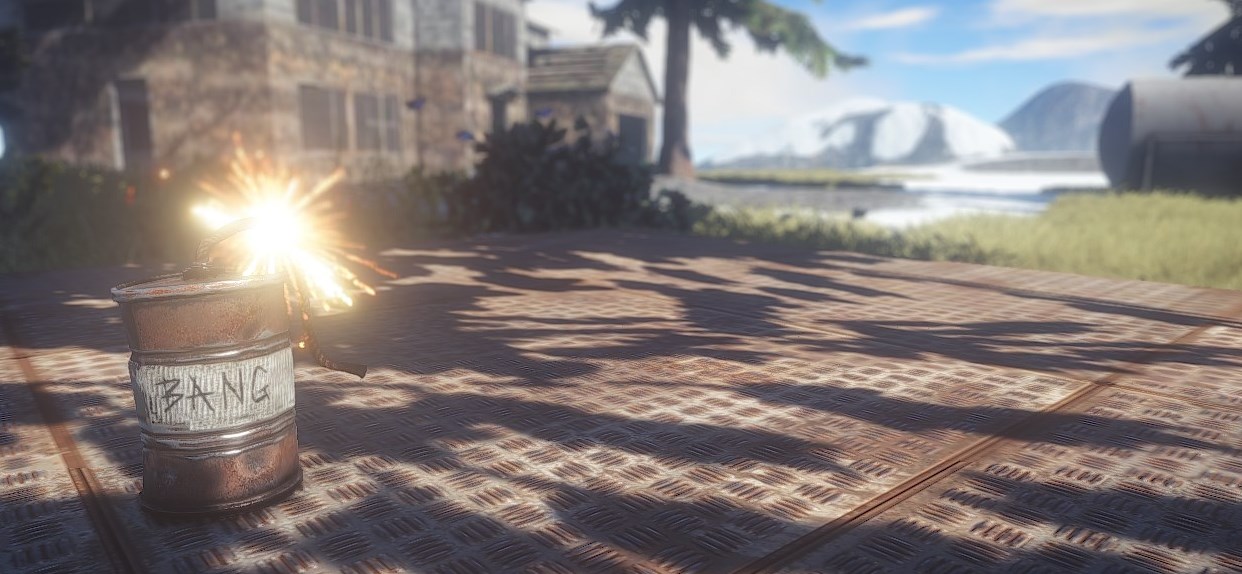
The bean can grenade is deliberately unreliable — sometimes it goes off, sometimes it doesn't — which was the point. You can pick up duds, though whether that's wise is another matter.
Arrows got nerfed. They had been travelling as fast as pistol bullets while dealing three times the damage, which meant the bow simply outclassed the revolver. Speed came down so you now need to lead targets and arc long-distance shots, and damage was slightly reduced. Still deadly, just no longer trivially accurate.
The second SMG was implemented, built from concepts shown earlier. It fires faster than the Thompson with weaker rounds, deliberately bridging the gap between the revolver and the Thompson.
Fixes and anti-exploit work
- ShaderLOD is now clamped — it was being used to see through walls
- Ban command also bans the family share owner ID where applicable; the status command shows the family share owner and accepts a player filter string
- Fake servers banned
- Fixed missing feet in the player shadow, and shadow jitter when dead, wounded or sleeping
- Fixed accidentally dropping items between inventory cells
- Fixed collision scaling on the blue shirt (100x), metal plate (0.3x) and hazmat helmet (100x)
- Fixed clearing a texture generating garbage collection that caused performance spikes
- Player animation performance improved; console history is less terrible
Hapis Island
Petur described it as one of those weeks — three new issues appeared for every one he closed. Hapis had problems that made it barely playable, including barrels not respawning on top of the obvious absence of radtowns. Fixes were expected the following week at the earliest.
The plan he outlined: far fewer empty-looking areas, and a set of six radtowns. The biggest and best of those would sit right in the middle of the island up in the freezing mountains, holding the most loot — and he was toying with giving it no radioactivity at all, which would let gangs camp inside it king-of-the-hill style. He also warned not to read too much into the radtown lighting, which probably wasn't staying.
Procedural generation and checksums
André had to walk back the checksum kicks introduced the previous week, which left some players unable to connect to any procedural map server. He got good data from affected players and, while unable to reproduce it himself, formed a decent idea of the underlying problem. Since nothing in that data pointed to serious game-breaking differences between client and server, checksum mismatch kicks were disabled again, with a plan to fix the identified issues and retry the following month.
Water checks were reworked as promised, so rivers and lakes are now correctly detected as water and affect the character. The system also got considerably faster and more scalable — the time a water check takes no longer depends on how many water bodies exist in the world.
Procedural components became fully supported on custom maps, with Petur experimenting with them on Hapis. There was a possibility custom maps would end up partially modulated by the server seed through them.
Other fixes: mushrooms no longer disappear with the decor quality slider (they have colliders, so they must be identical for everyone) and no longer bleed when hit; clutter decor no longer spawns in disallowed places; the black sun behind clouds with bloom disabled is fixed; and cargo planes stopped dropping loot into lakes, now actively avoiding unreachable locations.
Procgen8 in progress
André also started the next iteration of procedural world generation, with the caveat that none of it would go public for at least three weeks as part of the next wiping update — he chose to document it weekly rather than try to summarise a month of work in one go.
Procedural maps combine artist-created mountain prefabs fitted into the world with procedurally generated mountain lines that subdivide it and add randomisation beyond what prefabs alone provide. Those on-the-fly mountain lines are naturally lower quality, so he added back the procedural pseudo-erosion from the early days of Rust experimental to compensate.
Because generation has to run identically on every client, including very old hardware, it must be fast — which means a highly optimised noise back-end that trades some noise quality for speed. That noise source tends to produce unnaturally regular shapes, so he added proper noise distortion to height-map generation, making everything look more natural and mountain ranges especially so.
Prefab mountain blending was improved as well. The previous method was basic enough to leave visible discontinuities between prefab and generated terrain; the new approach maintains detail through transitional areas and also benefits monuments and all other procedurally generated terrain features. Rounding it out: monument placement order is now randomised and modulated by map seed, so tiny maps no longer always spawn the same radtown, underwater bridges are genuinely fixed, and lighthouses no longer interrupt bridges.
Art, animation and sound
Gooseman optimised all the animal LOD models down to 50% fewer polygons, and worked on the new SMG. Tom fixed the revolver bullet texture, finished the flammable RPG ammo type and made another whose type he kept secret. Megan continued concepting electric lights, deliberately moving away from orange, with player-paintable glass and bulb colours proving popular, and made the bean can grenade icon.
Dan reworked the water tanks after discovering both on one texture map looked poor in game — each now has its own texture sheet, with re-UVing, re-baking, and LOD and gib passes to follow. Xavier fixed skinning issues on a jacket, remodelled some lower LOD models for performance, continued on folded clothing world models, and kept cleaning up folder structure and removing unnecessary textures and materials.
Scott continued on the bridges, being deliberately efficient with textures by leaning on high-quality tileable textures and floating decals for detail. His honest assessment was that apart from the Satellite Dish, Rust's big environment assets hadn't turned out as well as hoped — they lack a sense of scale and feel plonked down — and the new bridges were meant to fix that and set a benchmark.
Diogo focused on water simulation and geometry management, chasing a high-performance but decent-looking solution with very flexible level-of-detail control that can be set aggressively on low-end machines. Dev-branch integration was scheduled for that weekend, with the optics still to be nailed down.
Alex implemented animal footstep sounds appropriate to the surface being stepped on, matching how player footsteps work, which also means Gooseman's footstep effects now apply to animals. He fixed wolves being silent, and fixed important sounds like bush rustles and wolf growls getting cut off early by the per-object voice limiting. A proper second pass on gunshots and a first pass on reload sounds were queued next.
Garry closed by admitting the map had burned him out, with plans to spend the following week on backlogged features, revisiting asset bundles to speed up a build-and-upload process then taking an hour per Steam upload, and helping with stage two of the research system.