
What's New in Rust's "Devblog 186" Update
November 2017's Devblog 186 added a hit-marker mini-game to tree harvesting and made trees actually fall over. It also detailed Building 3.0's shift away from tool cupboard radius privilege, and fixed the EAC bug behind that month's influx of undetected hackers.
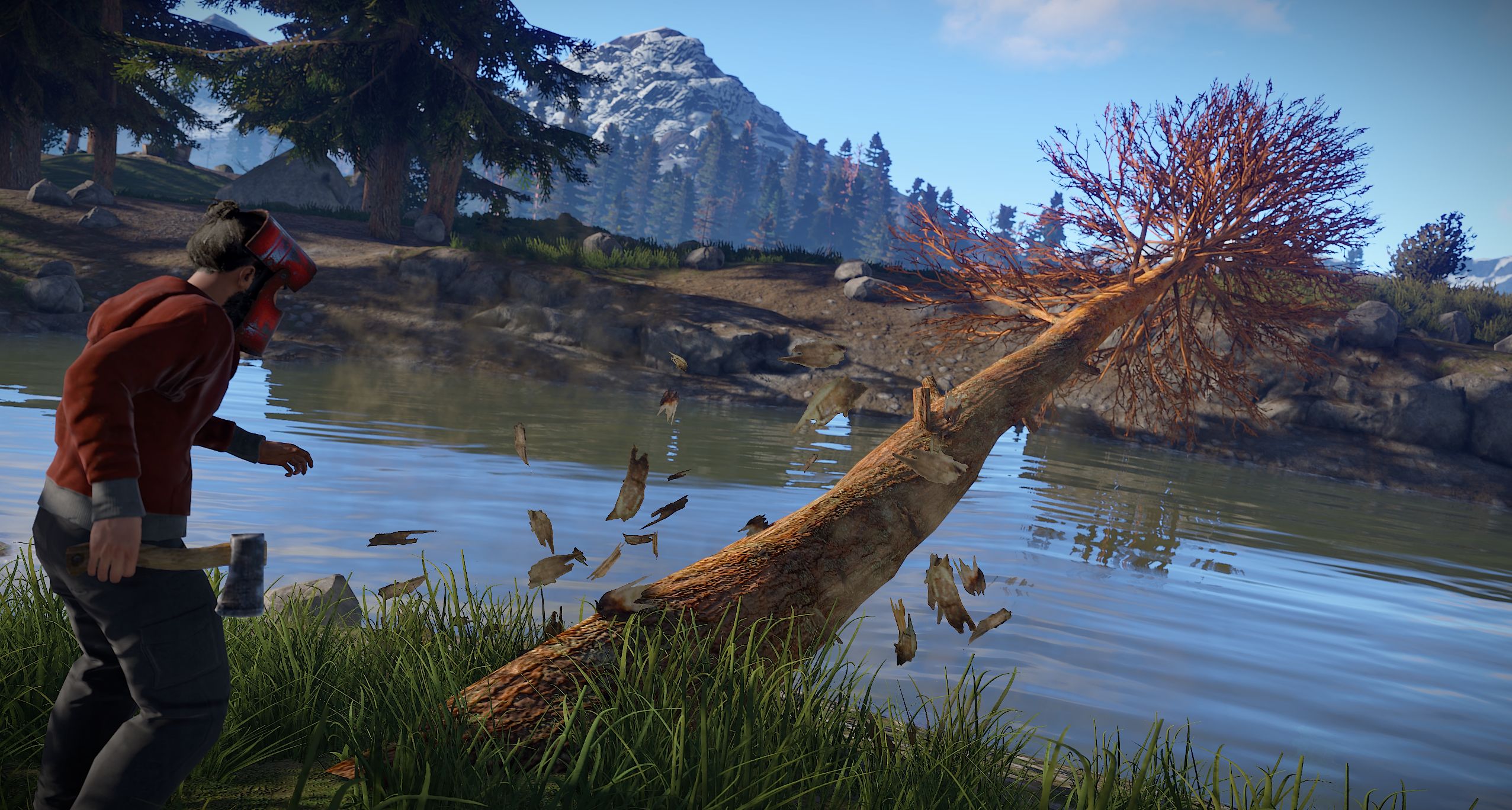
Devblog 186 arrived on 16 November 2017 and it's the patch that made trees fall over. Helk added a hit-marker mini-game to tree harvesting, mirroring the ore node hotspots, and gave you a proper visual payoff when a tree finally comes down. The rest of the week was about stability: Diogo cleaning up after shipping too much at once, Andre grinding on Building 3.0, and an EAC bug that explained the month's hacker influx finally getting fixed.
Tree redux
Harvesting trees got a mini-game similar to ore nodes. You hit the tree, a spraypainted mark appears showing where to hit next, and every time you connect with a mark your gathering multiplier increases, harvesting the tree faster.
You'll notice fewer resources coming out per swing with the same tools, and that's intentional: tree resource distribution changed so you now receive half while harvesting and half as a finishing bonus. You'll know you're done because the tree actually falls over. That's a clientside effect with no server impact — Helk noted that making falling trees part of real gameplay might come far in the future, but for now there was no reason to add server stress.
He anticipated the "why work on this" reaction, recalling the abuse he got for adding "stupid sparkling nodes", and argued that in retrospect these touches break up the monotony of farming and make it feel considerably more interactive. Some trees have the mini-game disabled — the small bare trees and a few oddly shaped palm trees — because you'd effectively be hitting the same spot anyway and they don't yield much.
Remaining work was tuning how fast larger trees fall for realism, and replacing placeholder sounds. Otherwise Helk ticked it as complete on the roadmap. As a bonus, trees can also be knocked down by grenades and rockets.
Building 3.0 progress
Andre kept grinding on the new building system, and this week's work reshapes something fundamental. He optimized building ID refreshes when placing and removing blocks so large buildings don't hit performance problems, then started on the building privilege changes.
Building privilege will no longer be emitted in a radius around the tool cupboard. Instead, any building blocks connected to a tool cupboard emit privilege for the cupboard they belong to — which means you no longer need more than one tool cupboard per building.
He also extended the building API that tracks all entities belonging to a given cupboard, accessible on both client and server so placement guides can update accordingly. Entities like campfires, boxes and furnaces now connect to the building when placed on building blocks, which becomes very useful for calculating building upkeep costs.
The entity link and socket code was extended to allow new and improved ways to counteract honeycombing and wall stacking, with those prevention methods nearly finished across the building blocks. Next on his list were half height walls and half height foundation snapping so artists could start on the required art, after which only the upkeep frontend stood between the new building system and release.
EAC troubles explained
If you'd noticed an influx of undetected hackers that month, there was a concrete reason. A bug in EAC's server code could trap the runtime in a zombie state, at which point it stopped processing kicks for banned players and even failed to enable network encryption on new connections. Alistair worked with EAC to track it down — it took longer than it should have — and a new SDK version shipping with this update removed the vulnerability.
AI: back to startup navmesh baking
ptrefall moved the game back to baking the full navmesh on server startup, porting the most important upgrades from the navmesh grid across. NPCs are rendered dormant beyond a certain distance from players, and Andre's terrain technology came over to this system too. The reasoning is that navigation is less complex for NPCs on this system, so behaviour should improve — and navmesh loading happens at startup rather than during play.
Server owners need to know one thing: Unity's navmesh baking demands 100% CPU for the duration of the bake. The workaround to stop it freezing other processes is reducing the Processor Affinity. The nav_wait convar is recommended on (it's on by default), since baking will still freeze the game itself while consuming all available resources. Facepunch were reaching out to Unity about the issue.
Navmesh Grid remains available as an option — add +nav_grid 1 to the startup or bat script — and is the recommended choice for hosts where adjusting Processor Affinity won't prevent other processes freezing. ptrefall also added the ability to change how much navmesh carving servers perform, which should get faster once Unity 2017.2 lands. He also started collaborating with Alex on animal locomotion, with no timeline yet.
Stability pass
Diogo admitted to pushing too many changes at once the previous week and spent days on stability, with the more critical fixes going in earlier in the week and the rest arriving here.
Hair was the worst offender, hurting both visuals and performance: fixes landed for beards sometimes not showing, a hair-related memory leak, and hair motion vectors used in motion blur and temporal anti-aliasing.
TSSAA had shown black sludge artifacts around particles, fixed right before launch — but other issues then caused the same symptom and needed a different approach. The fixes cover TSSAA-related black sludge, water shoreline flickering, and TSSAA on the inventory player preview. Performance also improved substantially, with GPU memory usage dropping from around 150 MB to roughly 25 MB at 1920x1080.
Motion blur had been bothering him for a long time and ate an entire day. Unity doesn't zero motion blur vectors when swapping LODs, so he had to find a workaround to stop them blowing up — fixing player motion blur popping on LOD swaps.
A few older items got attention too: textures downscaled to save around 100 MB of GPU memory, a few small recurrent memory allocations eliminated, projected decals no longer sometimes failing to show (bullet impacts among them), and basic projected decal draw ordering added for the new tree mini-game.
Art and audio
Damian's Launch Site changes from the previous week are finished and ready to merge, but they wouldn't appear in game until the next wipe — the removal of the elevators requires a server wipe, so to avoid compatibility issues they were held back until December's wipe.
Taylor started the low poly and bake for the craftable hazmat suit, with an improved baking workflow giving him flexibility to keep revising the high poly while adding wear and tear. He was keeping the suit split into sections — head, torso, hands, legs — to make swapping pieces less painful and potentially allow rag-tag combinations later.
Alex Webster continued on admire animations and answered the recurring question about when they'd ship: as with throwable weapons, once the code starts calling the feature it breaks in game unless every weapon has the animation. So the plan is to work through the complete weapon set, then set up the animators with the appropriate trigger and hand it to Helk for code implementation.
Pilgrim was handed concepts for a series of tiered boxes and built the lower, more primitive tier, with tier 2 expected the following week.
Alex R spent the week on sound bugfixing and polish. Physics sounds no longer spam when an object gets stuck inside something, song shuffling now kicks in before the first song plays so the menu isn't identical every time, a rare bug where a music clip tried to unload before finishing loading is fixed, and a rare stuck bush rustle sound got failsafes (he couldn't reproduce it and was still hunting the real cause). Cave reverb was softened slightly to blend more naturally. He'd also started on sounds for the tree harvesting update, having wanted to do falling tree sounds for ages, aiming for something crunchy and satisfying alongside a pass over weapon and tree impacts.
The rest of the changelist
The beanie hat now deforms hair when worn, and workbenches can no longer be locked. It's a tighter, more focused patch than the previous few weeks — one genuinely fun addition on top of a lot of cleanup, with Building 3.0 and the December wipe looming.