
What's New in Rust's "Devblog 176" Update
September 2017's Devblog 176 wiped servers to ship the long-teased gas station and supermarket monuments, added item information panels to the crafting menu, restored the 16km2 default map, and moved Rust onto Unity 2017.1 - finally killing the crash-on-exit bug.
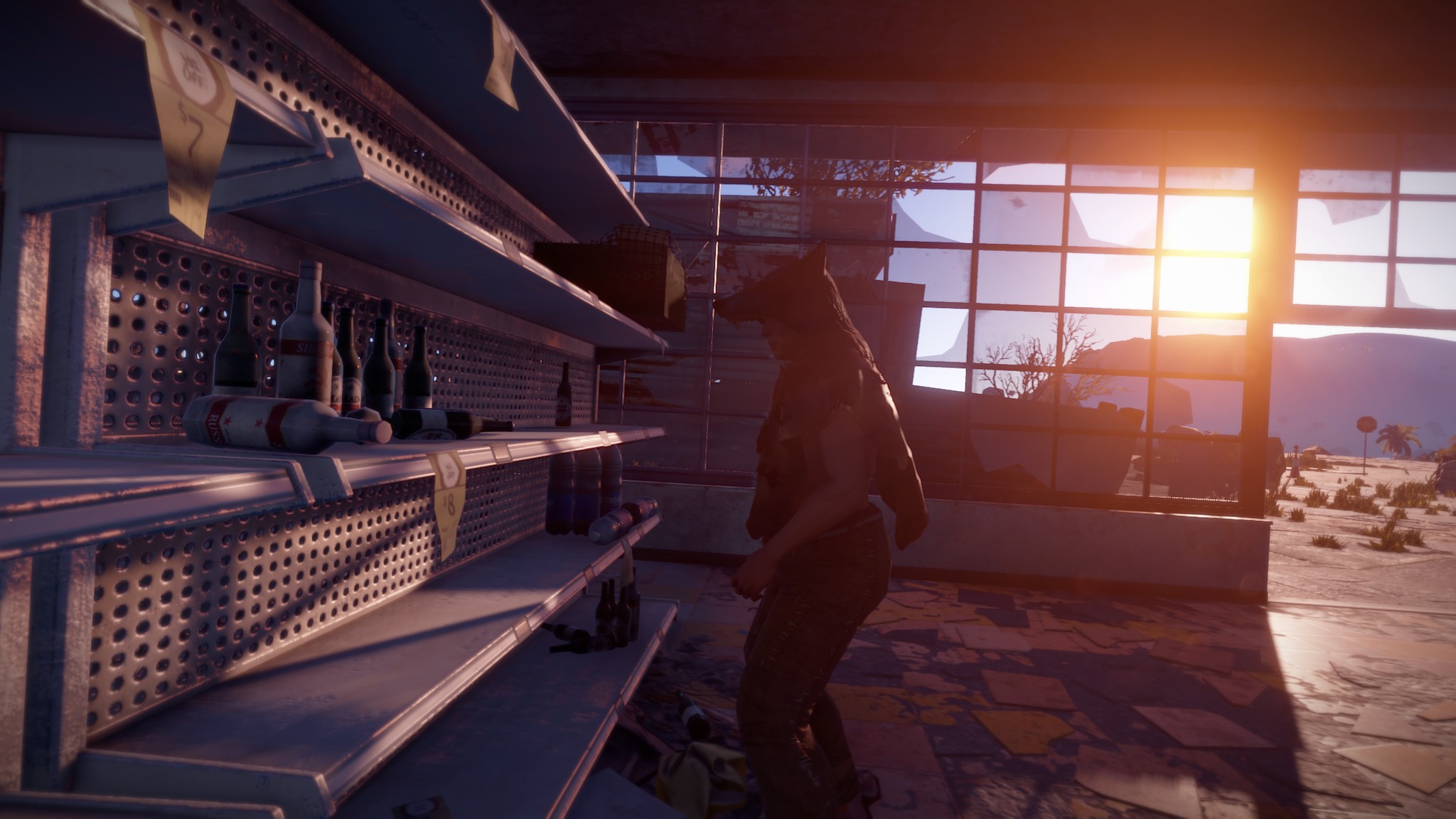
Devblog 176 arrived on 7 September 2017 and it wiped the servers, which was the point — after weeks of greybox screenshots, the gas station and supermarket finally went live as roadside monuments. The same patch brought item information panels to the crafting menu, bumped the default map back up to 16km², and moved the whole project onto Unity 2017.1.
Supermarket and gas station go in
Damian spent the week polishing the supermarket for release. The shelves looked too empty, so he built a batch of clutter — rotten food, old bottles, newspapers — scattered around to give the place a properly post-apocalyptic feel, with the intention of reusing those props to improve other monuments. With that, both the supermarket and the gas station were finished and shipped in this patch.
His next target was returning to the snow biome, with the goal of making it feel genuinely distinct from the other environments rather than a white version of them.
Item information panels
Helk started on another roadmap item that had been sorely missing: item information panels. Select an item and the menu populates with stats relevant to that item type. Firing weapons show rate of fire and damage; melee weapons show how good they are at gathering different resources, plus attack radius and range. The panels appear in the crafting window, so you can evaluate an item before committing resources to it.
He was upfront that the first version looked rough — the goal was getting functionality in place, with tooltips, sizing and placement to follow, and some values needing better calculation since a few sat suspiciously close together. The gathering display is the part worth understanding: the value indicates gathering speed, and the red portion indicates how much is destroyed in the process. So harvesting a tree worth 1,000 wood with a tool whose Tree Gathering bar is half red yields 500 wood. Helk admitted it was convoluted and promised tooltips to explain it. The main audience for all of this is new players, who previously had no way to know how anything performed.
Map size back to 16km²
With this wipe the default map size went back up to 16km² from 12km² (a size value of 4000). Andre was careful to explain this wasn't the team randomly oscillating between two numbers: the reasons for the original reduction had changed. A lot of content had been added since, and most of it — caves and new monuments — massively cut the space available for building bases. Community servers can still run smaller maps, but officials use the bigger one.
Related, he added a monument prioritization system so certain monuments can be guaranteed on every seed. For now the only one it applies to is the launch site, which has the highest priority.
Unity 2017.1
Most of Andre's week went into upgrading the project to Unity 2017.1. It came with problems that had to be addressed, but he rated it one of the more stable major Unity releases. There's little front-facing change beyond some shadow mapping improvements — the real motivation was under the hood: Unity finally shipped a new version of the .NET scripting runtime with major optimizations. It was still experimental so Rust couldn't ship on it yet, but Unity expected most issues ironed out in the next release, and internal testing could start immediately.
The upgrade paid an unexpected dividend. Unity's improved crash logging helped track down the notorious crash-on-exit bug, which is now fixed — so, as Andre put it, you can rage quit faster and harder than ever before.
He also wrote a tool for finding incorrect profiler samples, which are normally painful to track down because Unity logs almost nothing about them. It tracks all profiler calls, detects mismatches automatically and outputs a call stack with exact details. It immediately found two sample mismatches that had gone unnoticed for months — which matters, since profiling is the primary weapon against bad performance.
Other fixes from Andre: a memory leak from UI images loaded over the web, and cliff terrain texturing, which had looked out of place for a very long time and got noticeably worse when cliffs were changed back to a bright gray. He rewrote the systems that made it hard to address and updated the affected cliff prefabs.
Bradley, briefly
The Bradley loot table was modified to drop 10-12 tech trash. It still needs more weapons implemented plus weak spots, expected over the following weeks, but Helk considered it stable enough to divert attention to other roadmap items first. A fix also landed for the Bradley shooting players through the rocket factory roof.
Particle collision optimizations
Diogo spent most of the week rushing the Unity 2017.1 upgrade, but had previously noticed with Alistair that some explosions — the survey charge being the worst offender — lagged the game for everyone anywhere near the blast. The cause was particle collisions on the debris ejected by the explosion, which also applies to ore mining and other effects where rocks bounce off the ground or buildings. These are purely visual and shouldn't be costing that much.
His answer was an experimental collision LOD component: collisions are disabled entirely for explosions beyond 50m, and quality scales with distance. Only the survey charge explosion was converted for this patch, with a plan to roll it out to other effects in a client patch before the weekend peak.
AI and assets
ptrefall merged the new navmesh grid to main after another round of cleanup, though performance kinks remain at high entity counts. Because navmesh generation is continuous rather than a one-off at server startup, the performance bar is higher than under the old approach — it was being tested on a few selected servers. Navmesh links now use position samples and raycasts to avoid generating links that make NPCs fly or ghost through geometry, and traversal between grid cells is smoother. Scientist populations were turned off until the grid is ready.
The Geiger Counter model Tom Butters created was set up in-game — it's for NPC scientists to hold while surveying an area for radioactivity.
Pilgrim started on a Nail Gun from a Paul concept, then Paul reworked the concept mid-build into something better. The idea is a visually chunkier "small" gun, with details like the chunky welding making it through to the final product.
Alex R made strong progress on tank sounds: another fine tuning pass over all weapon sounds, finished fly-bys and explosions for the main shells, turret rotation and tread sounds implemented, and chassis lurching started. The Unity upgrade cost him time, so it missed the patch. Left to do were chassis lurches, distant gunshot variations, the main explosion when the tank dies, and final testing. He also tracked down and fixed a sound-related performance issue around bases with lots of auto turrets.
The rest of the changelist
Food items that had missing consumption sounds were fixed, item descriptions got another pass, scope and helmet overlays no longer show in third person, and the "crappy gather ability" was removed from swords and similar weapons. It's a wipe patch with two new monuments, a bigger map and a UI feature aimed squarely at new players — a good week to start fresh.