
What's New in Rust's "Devblog 167" Update
July 2017's Devblog 167 was a wipe-day map patch: the Launch Site monument finally shipped after three months of work, the Airfield got its tunnel network, grass was replaced wholesale, and junkpiles were pushed back onto the roads.
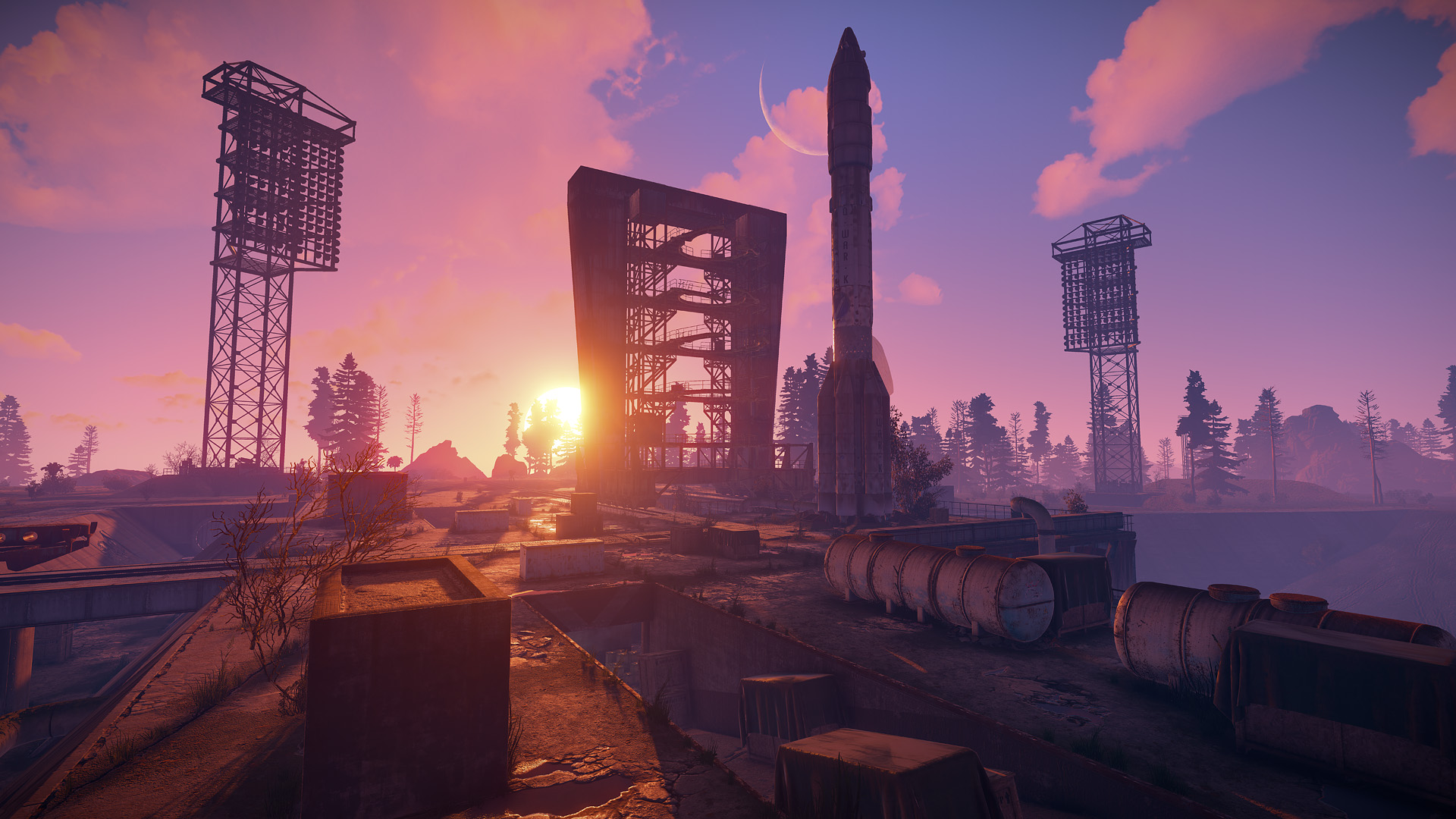
Devblog 167 landed on 6 July 2017 with a full wipe, and it is a map patch through and through. After roughly three months of work the Launch Site monument finally went live, the updated Airfield came with it, Rust's dated terrain grass was replaced wholesale, and junkpiles were pulled off the open world and put back along the roads. Hapis Island got another substantial pass on top.
Launch Site monument
Vincent and Damian released the Launch Site, made up of the largest man-made structures in Rust. There is a lot to explore, with the caveat that the office interiors were still mostly empty and due to be finished in the following weeks. As with any release of this size, some kinks were expected to remain, with fixes targeted at the next forced wipe.
Two things spawn there specifically. A new Elite loot crate - the model borrowed from the non-procedural deathmatch maps - yields a large amount of supplies and scrap for anyone who finds one. And Hobo Barrels were added to both the Launch Site and the Lighthouse: empty barrels that function as campfires near monuments. Fill them with wood, ignite them, cook food, stay warm, and get 100% comfort. Helk noted they would be particularly useful after a nighttime swim to the Lighthouse, and warned that if Legacy was any guide they will attract a crowd.
Airfield and caves
Vincent also shipped the updated Airfield layout he had originally built back in March. Like the Trainyard, it now has an underground tunnel network including bunker rooms, sewers and a short natural cave segment. That gives players a way to cross under the surface of the Airfield through dark passages and resurface at the far end. The loot follows the same thematic logic used elsewhere: the natural cave segment spawns ore nodes, and the bridges between cave and bunker space carry mining crates.
Caves also became more buildable. The full surface of the 2x2x2 and 3x3x3 rooms is now unlocked, so you can use the whole room. The larger 4x4x3 room was left as it was, pending feedback on the smaller rooms.
New terrain grass
Andre and Vincent replaced the dated grass models. Density and height are now controlled by procedural noise and gradients, which gives far more natural coverage than the old one-dimensional system. Terrain grass colours were slightly adjusted, though the overall game palette should feel unchanged. Grass LOD also now falls off with 3D distance rather than 2D distance.
World generation improvements
Andre finally implemented a set of long-planned world generation changes. The most significant is that monuments can now use a detailed terrain blending map rather than a basic radial falloff, so they blend with the terrain far more naturally and avoid unnecessarily flattening the ground around them.
Not every monument has a blending map yet, so things remain somewhat circular overall. To compensate, terrain anchoring tests were updated to choose the placement height with the lowest possible error for a given position, which means even monuments without detailed blending maps should no longer look like they sit on a circular plateau. Andre was clear all of this would need tweaking over the coming months.
Making roads great again
Roads used to be hotspots of player interaction, and that died completely once junkpile loot spawns were scattered across the whole map. To bring the action back, junkpiles now only spawn along roads and around powerlines. The side benefit is a clearly identifiable place to go when you want junkpiles, rather than wandering the world at random. Ore spawn rules were also adjusted so ores really only spawn near rock formations, and the temperate biome's ore distribution was rebalanced toward more stone.
In the same spirit of making world interactions intuitive, driftwood can now be harvested with any tool that chops trees - if something looks like it gives resources, it should give resources. Barren gained roads and CraggyIsland got some roadside.
Ore fixes
The previous week's ore rework had gaps. Cave ores were never updated when yields changed, which handed cave-dwellers an unfair advantage - now fixed, and Helk raised the question of whether caves should offer something different rather than just duplicating surface ores. A bug preventing half-completed ores from awarding the completion bonus after a server restart was fixed, and Metal Ores in the desert and arctic biomes now correctly yield 2 HQM instead of 1.
Barrels and pickup feel
Helk was blunt about barrels: they suck, they were always meant to be a placeholder, and several years later Facepunch still is not ready to drop them. So he made them more satisfying to break instead - a particle effect, reworked gibs so they actually fly apart, and beefier impact and death sounds replacing the old hollow ones. Those sounds were acknowledged as semi-placeholder pending a proper polish pass.
He also changed item pickups so they play their physics impact sound when you actually grab them. It adds to the game feel of looting barrels, but it has real gameplay weight too, because other players nearby can hear that pickup sound.
Vending machines and the helicopter
Two long-standing frustrations got fixed. Running to a vending machine to find it out of stock, or discovering it was selling a rock for 1000 tech trash, are both over: the map tooltip on player-created vending machines now shows exactly what is for sale and how many remain. Helk conceded it is deeply unrealistic and did not care, on the grounds that it should produce more honest transactions with fewer traps. A related bug where a machine would list itself as in stock while holding less than the sale quantity - 9 wood in a machine selling 10 wood for 1 stone - was fixed too.
The helicopter had a long-standing exploit where if you were its only target and disconnected after being killed, it would hang in mid-air as an easy target and hurt server FPS. That is fixed, and an eye bone was added to the helicopter optics so admins spectating it get a clear view of what it is aggroing on.
AI handover
Helk announced he had handed off NPC, navmesh and AI work to an AI specialist, Pål Trefall, who works on Before. He was on vacation at the time, with an introduction expected in the next devblog. Helk's assessment was that Pål knows roughly 100 times more than he does about the subject, with the hope that he can improve the existing base as well as finish the humanoid NPCs.
Hapis Island and lighting
Petur delivered another Hapis update: a completely revamped valley with a large canyon, and a good chunk of the southern coast morphed into a desert area likely to expand further over time. There is over a kilometre of new roads, plus new mines, caves and slight radtown and loot tweaks and additions. He also rolled out an experiment with slightly softer lighting.
Still queued for Hapis: new trees, radtown refinement, a swampy area, a launch site, and map names for essentially everything. Separately, global lighting reflectivity was tweaked slightly, so surfaces should read as a little less matte - not perfect yet, but improving.
Character art and viewmodels
Taylor continued the skin texture work and all but finished the male body textures, adding a separate texture set for dark skin variants. The skin shader multiplies your chosen skin colour over a pre-defined coloured texture, which works in theory but breaks down in practice for two reasons: colour variation across skin changes depending on skin colour, and it is impossible to lighten something by multiplying it by another RGB colour. The result was very flat skin tones, with darker tones especially hard to balance and often ending up too red. The new approach fixes that while also improving the lighter tones.
He also ported over the texturing and remodelling of the viewmodel hands, rebaked a slightly more realistic normal map, and added loops to the chest area that were not holding up under deformation. The plan was to land the texture changes at the same time as the viewmodel update so skin appearance stays consistent across the whole game.
Alex Webster started reorganising the viewmodel files, which do not currently share a consistent hierarchy. That has no in-game effect since they load independently, but a matching hierarchy across all animations and assets is a hard requirement for ever showing clothing on viewmodels - and with Taylor's updated arm mesh needing to be added, it was a natural moment to do it. The first phase covers updating and organising source files and re-exporting all viewmodel files with a matching rig, no mesh data and bloated nodes removed. The intended outcome is that players see no visual change at all.
Pilgrim started a new backpack model. With corpses now leaving a bag rather than a body, Rust was using the old Legacy bag, which needed replacing. The high poly base was in progress, with plans to roughen it up, make it more Rusty and add details for personality.
Console, animation and audio
Andre fixed the weird player spine rotation visible at a distance, and cleaned up two irritations in the F1 console: pressing tab now quickly autocompletes the current command, and the autocomplete popup no longer blocks you from stepping back more than one entry in your command history.
Alex R finished the dynamic music clip loading and unloading work. Only currently playing clips and clips due within about the next 8 bars are kept in memory, and moving away from streaming clips resolved the last of the sync issues. After optimisation and further fine tuning, this was the first week he could listen through all of Rust's music seven or eight times in a row without hearing anything wrong beyond minor musical tweaks - implementation was done and the system was ready to ship. He held it back a week purely because he was out of town and would not be around to fix anything that broke.
With most of his non-holiday time going to music, he still found room to experiment with sounds for the scientist NPCs and to start on chunkier impact sounds for the loot barrels, building on Helk's quick placeholder versions.
The rest of the changelist covers small fixes: a dozen invisible barrels near dome, a static repair bench NRE, cave ores using old loot tables, sand and snow ores giving 1 HQM instead of 2, and forest dead branch prop colliders no longer blocking movement above themselves.