
What's New in Rust's "Devblog 166" Update
June 2017's Devblog 166 rewrote resource gathering: ore nodes now yield only their own resource, a 20% finishing bonus rewards clearing them, and HQM largely moved to quarries. It also overhauled dropped items, decay and explosion effects.
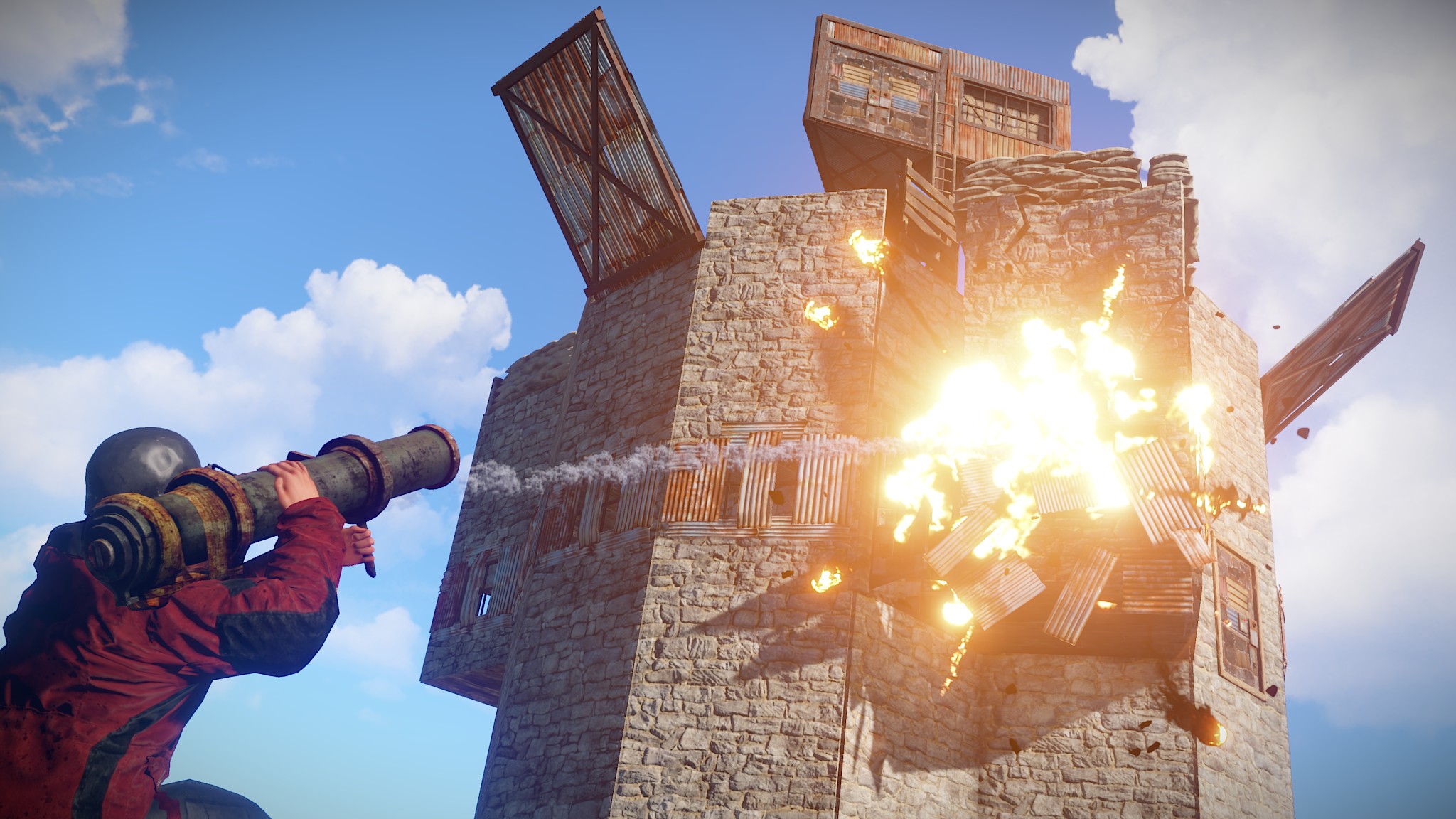
Devblog 166 arrived on 28 June 2017 and it is the patch where Helk stopped compromising on resource gathering. Ore nodes became type-specific, a finishing bonus rewarded actually clearing them, and High Quality Metal was largely pulled out of nodes and pushed toward quarries. Alongside that came a serious overhaul of dropped items and decay from Andre, and a complete replacement of Rust's explosion effects.
Ore changes
The core change: ore nodes now yield only their own resource. Stone nodes give stone, sulfur nodes give sulfur, metal nodes give metal. Previously every node gave a bit of everything, which Helk described as making players moths to a flame - you hit every node you saw because skipping one felt like a loss, and nothing felt like an achievement. The intent is that players make active decisions about what they need and travel to find it.
Nodes also got a finishing bonus: the final hit yields roughly 20% of the node's total. Beyond being satisfying, it discourages cherry-picking and abandoning half-finished nodes across the map. The bonus only triggers with a proper tool - bone clubs and stones do not count.
The controversial part was removing HQM from ore nodes entirely, apart from metal nodes, which give 2 HQM as part of their finishing bonus. If you want to mass-produce guns, you need a quarry. Helk's reasoning was that a lone wolf can get by through recycling or trading, and that nobody needs to be producing five AK47s a day, so 2 HQM for ten seconds of hitting a static object is a reasonable ceiling.
Visually, nodes got a much-needed particle effect and sound to mask the visual pop as a node changes stage.
Helk on listening to the community
The ore section carried an unusually candid passage. Helk described falling into the trap of reading the playrust subreddit, taking the criticism to heart, getting cold feet and making kneejerk last-minute changes to his own work to please what he later concluded was a small number of very loud people focused on the next five minutes of playtime.
He traced three specific compromises back to that pattern: junkpiles everywhere exist because people did not want to go to radtowns; HQM was in nodes because people did not want to do the work to get a quarry; and the north/south resource divide never happened because people disliked the idea of doing more than stepping outside their base for good items. The whole point of introducing HQM originally was to split resource requirements between new and high-end players, and to make different resources available in different areas of the map - which is exactly what the compromises undid.
The ask was for players to reserve judgement for a few weeks, with the standard caveat that nothing is set in stone and anything that sucks will get changed.
He also previewed a gathering minigame, not live yet and still in multiple iterations: hot spots on a node that are visible in certain light conditions or with the miner hat, granting a bonus when you finish the node, probably chaining together so that hitting them all well yields more overall.
Mining quarry changes
As a first step toward making quarries more common, their cost was cut to 5000 Wood, 1500 Metal Fragments, 6 Gears and 4 Sheet Metal. A larger pass on making quarries genuinely viable and interesting was planned for the following weeks, since reliance on them was about to rise sharply.
New explosions
While redoing the rock particle effects, Helk looked at Rust's explosion effects and was appalled they had survived that long. He bought an asset pack with much better explosions and swapped them in wholesale. They are not perfect - he listed longer-lasting smoke, more grey instead of black, and vertex lighting as outstanding work, with Gooseman likely to improve them later - but they are dramatically better for very little effort.
He also added a screen shake effect to explosions, with severity and falloff varying by explosive type, which does a lot to make them feel powerful.
Dropped items and corpses
Andre reworked how loot behaves on the ground, and it is a substantial set of changes:
- Debris and ragdolls no longer block picking up items behind them, so you can finally collect the loot from a destroyed barrel.
- Despawn times were raised to between 5 and 60 minutes depending on rarity. An AK stays in the world a full hour; hemp seeds vanish after 5 minutes. Burned meat also despawns much faster.
- Corpses and storage boxes now drop a single backpack or item pouch containing everything, instead of scattering dozens of individual items.
- The backpack and pouch despawn as slowly as the slowest-despawning item they contain.
- Dropped items now displace grass around them and use much higher friction, so they stop hiding in grass and sliding away down slopes.
The aims were to give players more time to retrieve dropped loot and to stop people despawning their own loot during a raid. The single-object approach also cuts performance cost significantly - a backpack is far cheaper to render than a ragdoll, and both backpack and pouch are one physics object rather than many, which is what makes keeping them around so much longer affordable. A corpsedespawn convar controls when corpses despawn and player corpses turn into backpacks.
That change also appears to have fixed a server crash. Physics items with an invalid NaN position were crashing servers, and it seems to have happened when boxes were destroyed or decayed and dumped all their items at once. Official servers were hit hardest because their long wipe cycles leave a lot of abandoned bases decaying. With boxes now dropping a single pouch, the crash stopped reproducing in testing, with live monitoring to confirm.
Decay changes
Two important decay adjustments. Deployables now only decay when they are outside - meaning nothing above them that would shelter them from rain, if Rust had rain. That means abandoned bases no longer have their boxes decay away, making them worthwhile raid targets again.
Second, storage containers no longer reset their decay timer when interacted with, so boxes left out in the wild decay properly even when random players keep opening them. Hidden stashes are exempt from this change.
Grenades and quality of life
Andre's assessment of grenades was that they felt horrible, and now feel slightly less horrible. Their friction was increased so they stop sliding around like an ice cube, their bounciness was reduced so landing looks less like throwing a tennis ball, their mass went up, and throw velocity came down slightly. Still not perfect, but he was at least hitting his targets.
Two small but beloved fixes: you no longer have to press a belt hotkey twice to consume an item from your hotbar, and holding down left mouse with the hammer now hits continuously.
Humanoid NPCs
No closer to shipping, but Helk gave a status report. Outstanding work includes performance issues with gathering paths, logic issues producing strange decisions, making the NPCs play nicely together, and balancing their loot - all straightforward, just time-consuming.
The real blocker is navmesh fidelity. He had optimised navmesh generation to run about 4x faster a few months earlier because servers were hanging for several minutes on startup after the new animals arrived. The cost of that is significant navmesh bugs and poor accuracy in and around radtowns. He planned to contact Unity about changing how the navmesh is generated internally so servers stop hanging and a higher resolution navmesh becomes viable. Until then, NPC AI will be poor around radtowns, so they would either be anchored to more open areas or spawned on terrain away from radtowns.
Texture packing results
Diogo finished most of the texture packing work and ran the numbers. Visually there is no discernible difference from the unpacked version in most cases unless you do a direct zoomed comparison, and the packed version uses up to 35% less memory in its current state - occasionally looking better, thanks to more accurate custom rescaling filters.
Packing in bulk also gives final-pass optimisation control over regular textures. In his example, the most important packed map containing albedo has a maximum anisotropic value of 16 while the second packed map, normals, is capped at 4 - a difference almost nobody can see, for a significant boost.
The headline numbers: up to 20% savings on both system and video memory by packing standard materials, with other material types varying. Performance-wise, texture bandwidth requirements drop meaningfully, which benefits low-end GPUs most. Measured on a GTX 960, improvement on those materials reaches up to 10% at the lowest anisotropic setting of 1, rising to 66% at the highest setting of 16. Most impressively, packing nearly halves the total number of textures used on supported materials, so the CPU does far less work binding materials during rendering.
The process was still manual and needed oversight, so a couple of packed materials would roll out for testing the following week, with dozens more the week after if all went well - incrementally and, ideally, invisibly.
Art, monuments and Hapis
Taylor started a pass over existing skin textures now that the new skin shader is in, since the shader uses features the current art does not support - so textures are being touched up and new maps like scatter amount created. He also wanted to add head variations, since the current selection is thin. The bottleneck is that each variation traditionally needs its own hand-sculpted high poly mesh, so he returned to an older idea: use low poly geometry to define larger shapes and let textures handle skin detail and small features. His example showed three heads sharing one material with variation only in the low poly mesh, with the plan to push much further by combining meshes, materials and skin tints.
Vincent finished the beautification pass on his section of the Launch Site, with the goal now being to release the level as stably as possible, and worked with Andre on implementing the new grass he had made back in January. He expected a heavy week of work and debugging, since merging the launch site and updated airfield to main is a sizeable update. Damian focused on LOD and collision models for the rocket factory and its surrounding assets - all major graphical tasks complete, leaving polish, playtesting, bugfixing and optimisation before the next forced wipe.
Petur confirmed the Hapis update was still on schedule for the following week's wipe, with new trees a maybe.
Audio
Alex R spent the week on the music sync issues. Unity offers exactly one way to play precisely timed audio, AudioSource.PlayScheduled, which works well for scheduling something in the future but simply starts playback immediately if given a time in the past, rather than offsetting the start position - unhelpful for a music system where clips sometimes need to fade in mid-clip. Setting playback position after starting a clip is possible and is what Rust had been doing, but it is not very accurate because those time changes have to be fed to the audio thread.
The discovery this week was that the problem is far worse for clips streamed from disk than for clips loaded in memory - and all of Rust's music had been set to stream. Since loading every music clip into memory at once is not an option, and audio loading and unloading already happens on a separate thread, he built a small system to load and unload music clips as needed. Initially it loads a whole song at a time, with plans to tighten it to just the current and upcoming sections. Occasional sync issues remain with in-memory clips because of how Unity propagates playback position changes to the audio thread, though it may now be tight enough not to notice. If playtesting proves otherwise, he had other approaches in mind that would give genuinely sample-accurate playback at the cost of more work and possible performance risk.
Beyond music he created the sounds for the new ore stage change effects, did another batch of polish and mix tweaks, and got more raw recordings cleaned up and library-ready.
The remaining changelist entries cover the usual small stuff: fixed grenade explosion rotation, fixed grass displacement choppiness, a fix for bootstrap not updating the loading screen text, a wood world model collider rotation offset, a rare false positive in server-side weapon cooldown verification, and you can no longer put items into loot containers.