
What's New in Rust's "Devblog 154" Update
Devblog 154 brought Rust's Simple Handmade Sight and the fuel-powered Searchlight, shipped the reworked Wooden Armour, re-enabled plant hydration colours, and rewrote Unity's invoke system for big server performance wins.
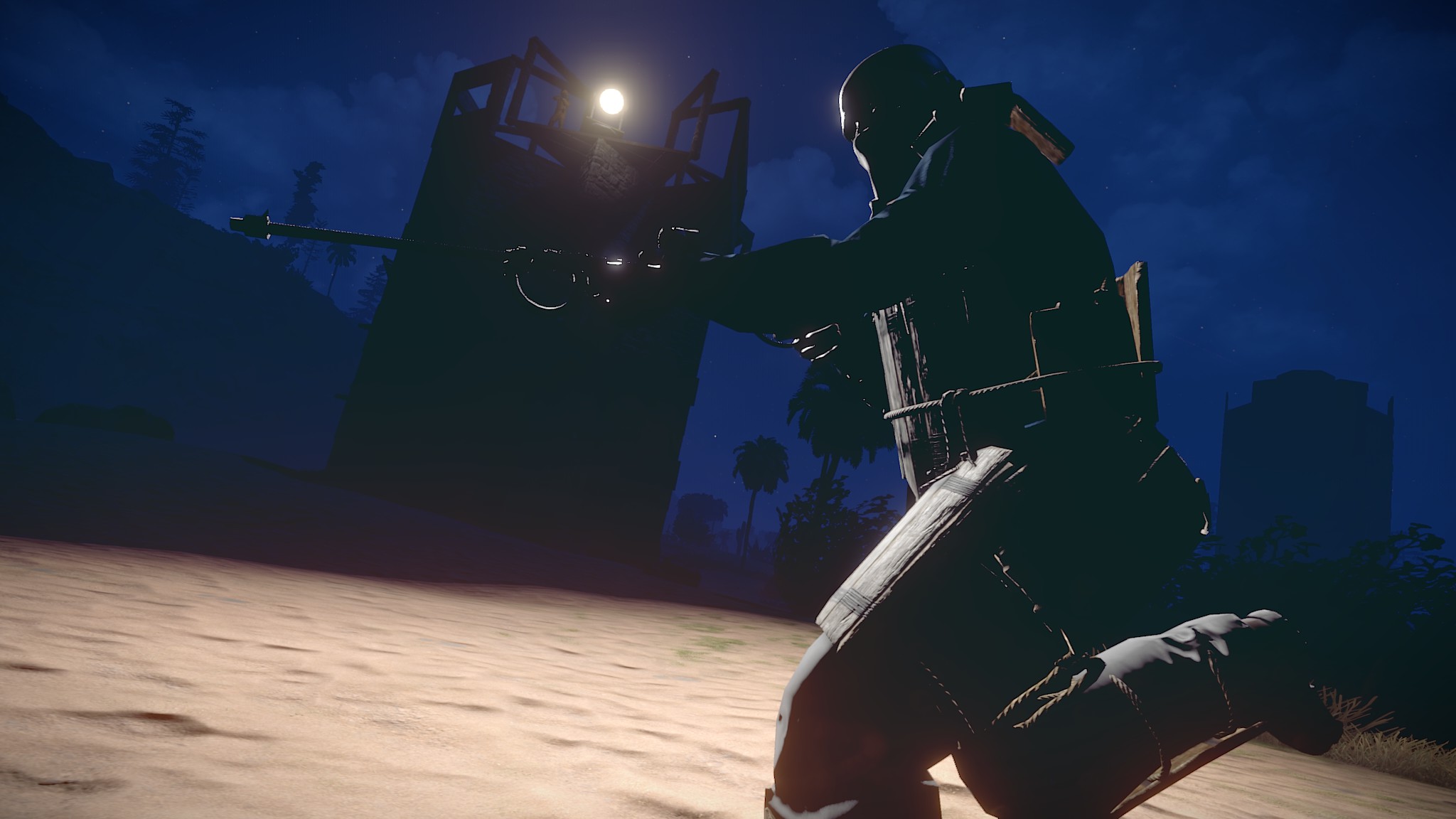
Devblog 154 arrived on March 30th, 2017, and it was a classic mid-cycle Rust patch: a couple of genuinely new toys in the Simple Handmade Sight and the Searchlight, the reworked Wooden Armour finally making it into the game, and a mountain of performance work behind the scenes. Facepunch also gave players their first proper look at the Launch Site monument, which was starting to take shape in greybox form.
Simple Handmade Sight
Helk finished up work on the Simple Handmade Sight, which became available in-game at a cost of 6 High Quality Metal. The sight slightly inhibits your zoom but gives you a clearer picture of your target. It also isn't emissive, so it wasn't much use during the nighttime - Facepunch pitched it as a middle ground between the iron sights and the Holo Sight, with a promise to watch feedback and adjust it the following week if it turned out too useless or too overpowered.
Searchlight
Rescued from what Helk called "Concept Limbo", the Searchlight was a model that felt like it had been sitting around for years before finally shipping. It's simple to use: walk up, press E, and it aims where you're aiming. You can turn it on or off, and it burns fuel while running. A polish pass was planned for after the patch, adding sound effects and extra features like being able to shoot the lights out.
Wooden Armour and farming fixes
The updated Wooden Armour was added to the game. Taylor Reynolds admitted the armour still floated above the skin when no other clothing was equipped - a surprisingly complicated problem to solve - but the set looked better overall, with a proper fix still being worked on behind the scenes.
Farming got some love too. The script that sets a plant's colour based on its hydration level had been disabled over performance problems; with those script issues fixed it was re-enabled, so plants once again showed dark brown when not hydrated. A bigger pass to make farming and watering "less convoluted and esoteric" didn't make it in time and was pushed to the following week.
Server performance: replacing Unity's invoke system
André spent the week on server performance and identified Unity's invoke system - used to initiate and cancel delayed method calls triggered by player interactions with items, traps and corpses - as one of the slowest things on the server. Cancelling a single call could take 5ms when a server had a lot of entities and players. His replacement made these calls nearly free, and as a bonus it references the actual method rather than a method name string, giving compile-time error checking. Initial results looked very promising, with more profiling planned on high-population servers.
Client rendering work
Diogo continued the culling crusade on the client side:
- Occluder meshes used in building construction were simplified to the bare minimum.
- Occluders were added to more construction pieces, such as floors and windowed walls.
- Sleeper culling detection spheres were shrunk.
- After a few weeks of the system running stable on DX11, culling support was switched on for DX9 and OpenGL as well.
He also found that some vegetation textures weren't set up optimally - they didn't smooth out with distance and ignored anisotropic filtering - which explained why Rust's foliage looked so aliased. With the fix, vegetation looked much smoother in motion and even saved a bit of texture bandwidth. Bloom got a smoothness improvement at both quality levels too, with minimal performance cost. Work on culling lights inside buildings had started but needed more testing time.
Launch Site takes shape
Vincent shared progress on the Launch Site monument, with the general layout mostly finished and greybox detailing underway. The monument was split into two sub-areas. The first is the pad itself, with an abandoned rocket as the focal point, a series of bunkers, and a maze of claustrophobic underground tunnels offering high-level loot and intense firefights. The second is the rocket factory: a large industrial complex filled with broken walkways, rocket parts and climbable beams, surrounded by fuel silos, warehouses and office buildings - most with accessible interiors - and rooftops connected by a network of fuel pipes and walkways. Plenty of cover and sniping points, in other words.
Viewmodels, music and footsteps
The previous week's viewmodel FOV changes - which stopped weapons looking squished at high FOV values - didn't go over well with the community, so they were reverted entirely. Work continued on giving viewmodel animations more weight with less bouncing, re-rigging wrists that bent badly in certain poses, and removing clipping regardless of FOV setting.
On the audio side, Alex Rehberg improved the music playback system with short one-off "stings" that play in time with the current track on a 16th-note grid, making intensity changes feel tighter - and confirmed the remake of the original Rust theme was being finished up as part of the work. He also recorded source material for the Spinning Wheel's sounds (mostly a frying pan lightly touched against a turntable platter, which unexpectedly produced some horror-movie bowed-metal tones destined for the soundtrack). A new footstep surface type mixing gravel and larger rocks was ready to go, though source control troubles threatened to delay it a week. Alex Webster rounded things out by optimising weapon mod world models.
All told, Devblog 154 was less about headline features and more about Rust quietly getting faster and prettier - with the Launch Site preview hinting at much bigger things on the horizon.