
What's New in Rust's "Devblog 147" Update
Devblog 147 introduced the player-crafted Vending Machine and its fully customizable sell orders, made armored door hatches actually open for shooting through, killed fall damage into deep water, and pushed dynamic occlusion culling to everyone.
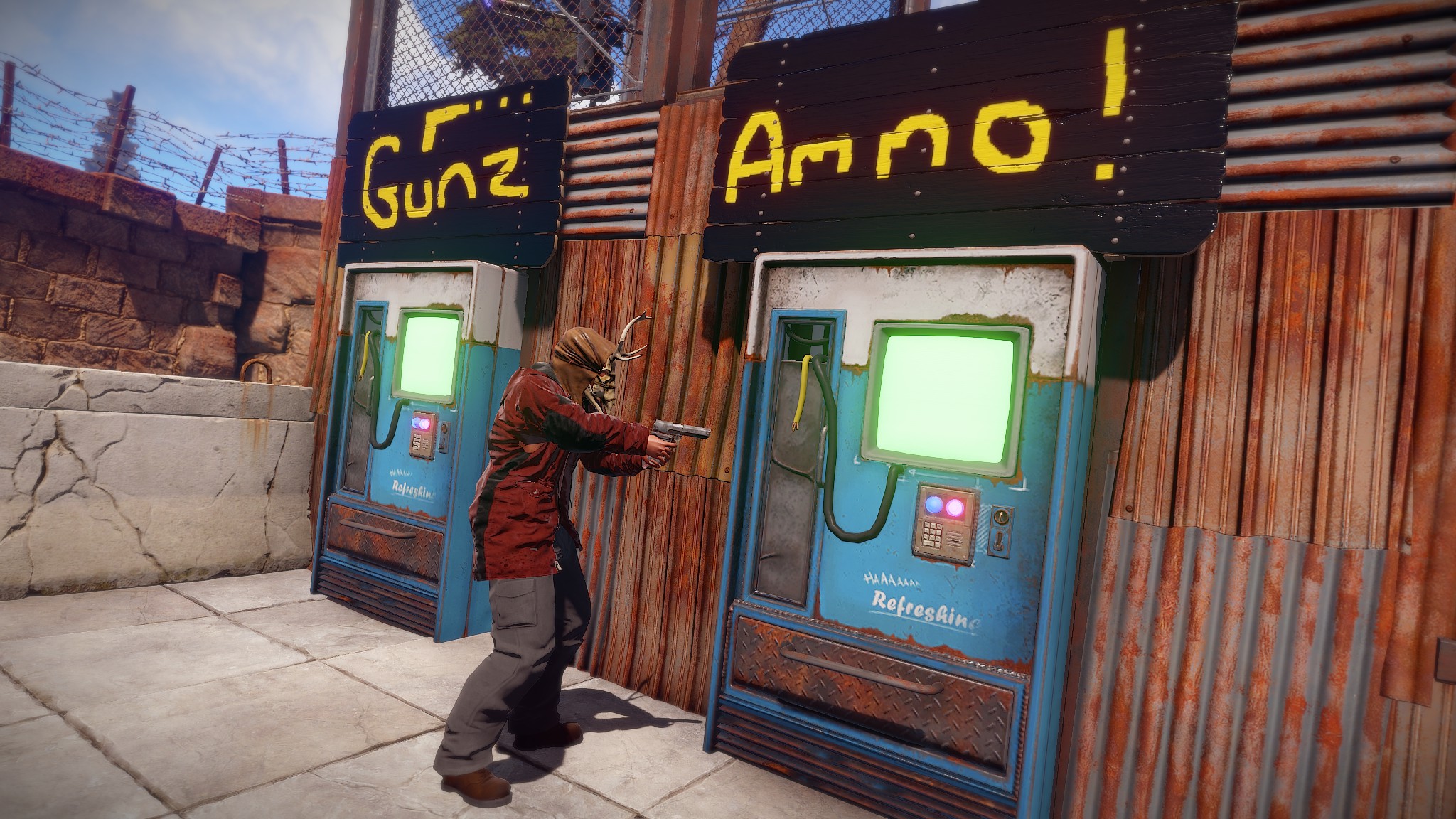
Devblog 147 arrived in early February 2017 and delivered one of Rust's most consequential additions ever, almost casually: the Vending Machine. Alongside player-run commerce, the patch made armored door hatches functional, fixed a genuinely infuriating water fall-damage bug, and shipped the dynamic occlusion culling system to everyone after weeks of testing.
The Vending Machine
Continuing his raid on Concept Limbo, Helk spent most of the week implementing the Vending Machine - "no easy task, but it's in-game and functional." Crucially, at launch this was a player-only deployable: none spawned in the world, so it was entirely up to players to craft and stock them. The system runs on Sell Orders - fully customizable exchange rates managed from an Administrator Panel accessible at the machine's rear (behind its lock, if fitted). Any item can be sold in any quantity for any other item in any quantity: hatchets for stone, components for metal fragments, whatever you like - though the machine only sells what's physically loaded into its inventory.
Helk's favourite wrinkle was the self-sustaining shop: sell Stone for Wood, add a second order selling Wood for Cloth, and the machine constantly replenishes and sells itself while you "simply extract the profits" - his example being a wood generator planted near a beach "for new spawns to take advantage of (or for you to take advantage of new spawns, as it were)." Two launch warnings came attached: floors under a vending machine couldn't be upgraded yet ("why would you place your vending machine on anything less than stone anyway?"), and the machine accepted broken items with no way to check condition - so taking condition-based items in trade was at your own risk. "There are probably a handful of exploits. Please test the hell out of these things."
Armored Door Hatches
Some low-hanging fruit got picked: the hatches on Armored Doors now genuinely open and close - not just visually. You can shoot out of them or lob grenades and projectiles through them. As Helk put it: "Be careful!" Base defense conversations changed immediately.
Quality of Life and Balance
- Water fall damage: after taking about 40 fall damage jumping into the harbor to escape "a group of geared guys" - "That is bullshit" - Helk removed fall damage entirely when landing in water at least shoulder deep, with altitude-aware handling promised eventually.
- Large Furnace: gained an on/off control on its loot panel, and can now only be accessed at its alcoves - no more using the chimney or any random surface.
- Paper now costs just 5 Wood, and the Code Lock's 'opened' colour was finally corrected from yellow to green after being wrong "a long time."
- In-Home Streaming and Steam Controllers started working: an EAC quirk had been eating mouse clicks on Steam Machines and streamed sessions, now resolved.
- Flame Turret fireballs slow damage even more, plus a network optimization for the turret itself.
Security: The "giveall ak47" Incident
The week's drama: someone discovered that running a console command while sitting in the connection queue got treated as if it came from rcon or the server console. It "didn't take long" before people were calling giveall ak47 and handing entire servers free weapons. A patch went out within an hour, some servers were wiped, and Garry spent the start of the week refactoring the console command code to make a repeat less likely - concluding, "We need a bug bounty program. I'll look into setting one of these up soon. Soonish." Andre's parallel fixes were just as meaty: the fly-hack technique of pausing and unpausing client tick sending to dodge violation counts was closed, an exploit allowing players to craft uncraftable items like the LR-300 and even the wind generator via console was fixed ("Back to concept limbo, wind generator!"), the random server physics crash on startup with huge saves finally got a working fix, and EAC-banned players now have all their entities removed from the world.
Rendering: Culling Goes Live
Diogo merged dynamic occlusion culling into main after weeks of testing, enabled by default (disable with culling.enabled 0 if problems arise). It launched supporting player and ragdoll culling, with terrain plus basic structures like foundations and walls acting as occluders - NPC culling didn't make the cut yet, and both occluder and occludee coverage were set to expand. He also rebuilt the lowest Shader Level: rocks and terrain got visibly more detailed at only a 25% performance impact over the old bargain-basement look. And a new stripped-down foliage shader - with transmission for backface lighting - began development to serve the incoming overgrowth, which Vincent had now finished dressing across all the dungeon levels, alongside Andre's new unified foliage rendering system intended to replace terrain grass entirely.
Animation, Art and Audio
The third-person animation overhaul reached the Crossbow, Double-Barrel Shotgun, Eoka Pistol and Flamethrower - complete with re-rigged world models where the crossbow string stretches back and shotgun barrels animate properly. The readability gains kept coming: you can now tell when an enemy has finished reloading, and the Eoka has a visible third-person striker animation so you know when someone's preparing to fire. Pilgrim finished the component world models - Explosives, Gunpowder, HQ Metal, CCTV Cameras, Targeting Computers and more - so dropped items would soon look like what they are instead of burlap sacks. Alex Ramsey built the Flame Turret's sounds from recordings of "this old and piece of shit push mower" from his garage, and gave placement sounds to deployables that never had them - signs, fish traps, locks included. With the bug bounty on Garry's to-do list, Unity fixing the bug blocking AI testing on prerelease, and the foliage system due to show up in screenshots the following week, Devblog 147 left Rust's economy - and its to-do list - fundamentally changed.