
What's New in Rust's "Devblog 109" Update
Devblog 109 wiped the servers and reshaped the procedural map with a snowier north and new mountain types, while adding Rust's first fishing via the Fish Trap, Peacekeeper Mode for sentry guns, and a hydration penalty for cannibalism.
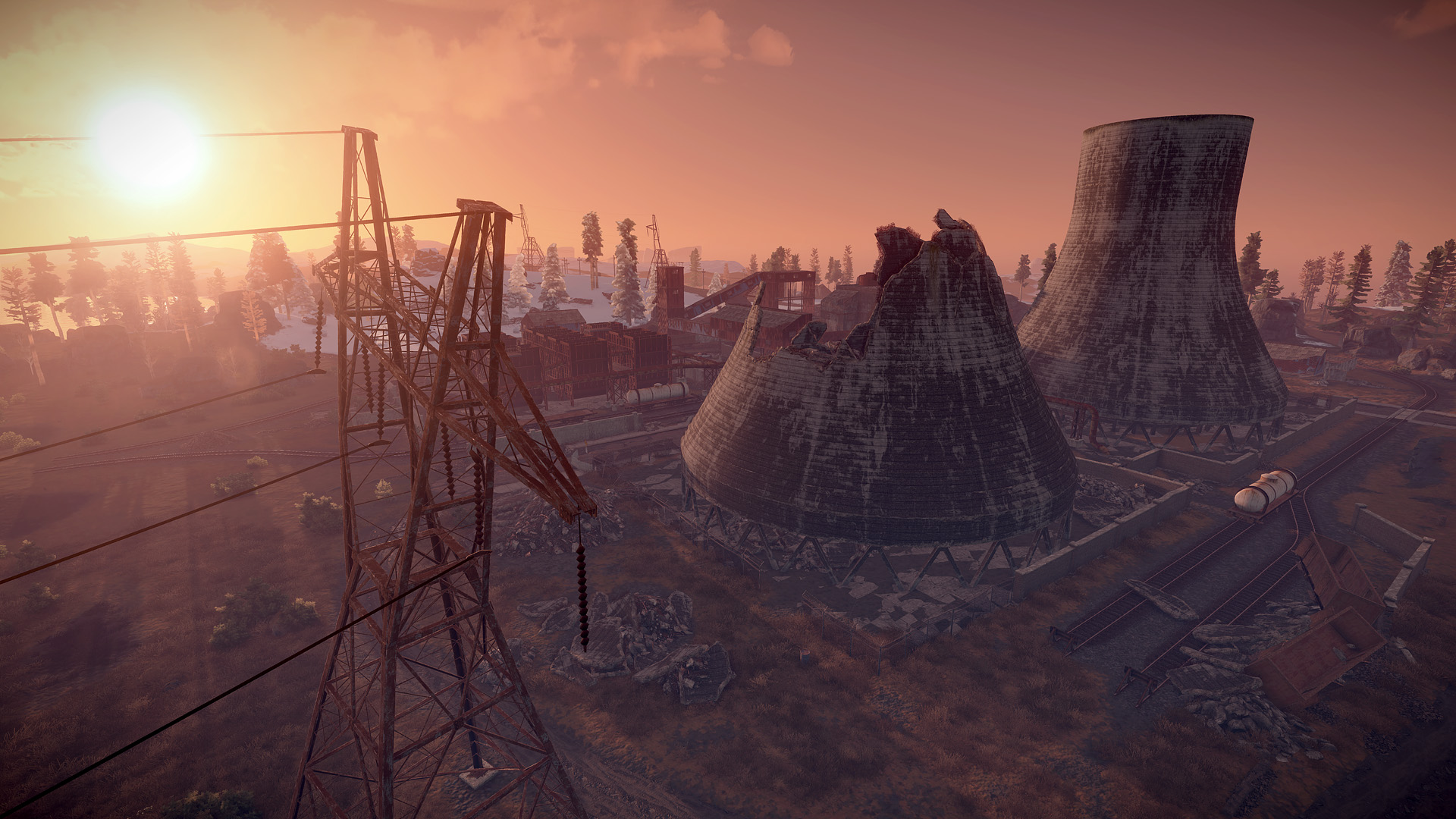
Devblog 109 landed on May 5th, 2016, bringing a forced wipe and some genuinely meaningful changes to how the island looked and how you survived on it. The headline additions were a snowier north with new mountain variety, updated power plant dungeon art, and Rust's very first form of fishing — plus a long-overdue nerf to cannibalism. It was one of those patches that touched map generation, survival mechanics, QoL and audio all at once.
A Snowier, More Varied Map
Snow made its return in this patch. There was more of it at high altitude, plus some fairly large patches scattered across the north of the island. It wasn't the vast, samey arctic biome from the old days — the team called it a good compromise, and a lot closer to what they wanted the north to eventually look like.
Mountains got attention too. Andre and Petur combined forces to add more mountain variety to procedural maps, with huge mountains now spaced farther apart. The biome-specific mountains they really wanted weren't ready yet — those needed more optimization and visual work — but maps immediately showed a lot more variety than the week before, with more promised for future wipes. World size also got clamped between 1000 and 6000.
Dungeon Art Updates
The accumulated dungeon art updates from April went in this week, covering quite a few of the buildings on the map — including the power plant. A bit of work remained, expected around the end of May or beginning of June, and performance in dungeons was likely to be slightly slower until a pass on LOD distances landed, hopefully by the next wipe.
Interestingly, the door barricades teased on the Twitter bot that week weren't (yet, and maybe never would be) player-placeable. The plan was for breakable entities placed around dungeon loot rooms to seal them, respawning with the loot after some time — a handy visual indication that a room hadn't been looted yet.
The Fish Trap: Rust's First Fishing
With the survival changes well received, there was still the risk of players simply not finding food. Helk's answer was the Survival Fish Trap — the game's first form of fishing. It shipped as a default blueprint: deploy it on the shoreline and add bait. Any food works as bait, but the more bait in the trap, the more likely it is to attract bigger fish. It effectively let you recycle low-value food like mushrooms into higher-quality meals, and the update added various fish meat and constituent products to go with it.
Salty Human Meat
Human Meat finally got the negative attribute it had long needed: eating it now reduced your hydration by 40. Surviving on cannibalism was still possible, but only with a good water supply. As Helk put it — please stop eating new spawns.
On the gathering side, resource spawning kept getting reworked. Since ores spawning around rock clusters had worked out well, mushrooms got similar treatment: they now only spawned on non-grassy ground inside forests, so you could identify likely mushroom territory from a distance instead of wandering aimlessly. Wild corn and pumpkins were also made easier to find and more common overall, paving the way for a broader resource balancing pass in a future devblog.
Peacekeeper Mode
An experiment in player-driven safe zones: sentry gun owners could now flip their turret into Peacekeeper Mode, where it only targeted players with a weapon drawn or who had recently dealt damage to another player nearby. The idea was to let players build outposts or trade hubs where non-aggressive strangers could interact without fear of a random KOS. Helk planned to build a couple of these on official servers after the wipe to see how it went.
Stack Sizes and Reactive Targets
Some welcome quality-of-life buffs to inventory management and an underused deployable:
- Most food items — Chocolate, Granola, Cans, even Empty Cans — now stacked to 10.
- Charcoal's stack size doubled to 1,000 units.
- 5.56 ammo now stacked to 100.
- The Reactive Target got its cost reduced by 100 Metal Fragments and now auto-reset six seconds after being knocked down. Helk had checked Rustafied's main server and found only nine reactive targets among 200,000 deployed entities, so it clearly needed the help.
Audio Polish
Alex R put the finishing touches on a big audio mix pass, benchmarking Rust against reference recordings from games with audio he loved. Each footstep type went from four to eight variations, bows and crossbows got multiple attack sound variations, and raising or lowering ironsights got more variety too. Gunshots and explosions now took over the soundstage much more aggressively, with background sounds dynamically ducked harder than before. Bear and wolf footsteps also became audible from farther away — useful survival information.
Performance and Everything Else
Bush and clutter rock spawn densities were trimmed, shaving around 1ms off frame time depending on hardware, mostly in spots where they weren't very noticeable. Testers also caught a loading time regression tied to non-uniform collider scaling on cliff meshes; the fix cut both client and server load times by multiple seconds.
Elsewhere, Taylor was texturing the female clothing set, with the skirt nearly done but needing a more frayed look before being called finished, and Alex Webster continued iterating on player preview states — animations that hint at how you're surviving (with dehydrated and fatigued states on the wish list) rather than random idle poses.
The changelist rounded things out with some notable fixes: diagonal walking was no longer faster than walking straight, metal facemasks now always protected against headshots, rivers stopped intersecting dungeon sewer systems, and helicopter gibs could no longer be destroyed by fire. All in all, a wipe week that made the island prettier up north and survival a little more interesting everywhere else.