
What's New in Rust's "Friends with Benefits" Update
July 2025's update was about playing with your friends: a main-menu party system that drops you on the same server and team, invites from chat and the team UI, plus deployable snapping, a new Outpost spawn mission and another pass at the Patrol Helicopter.
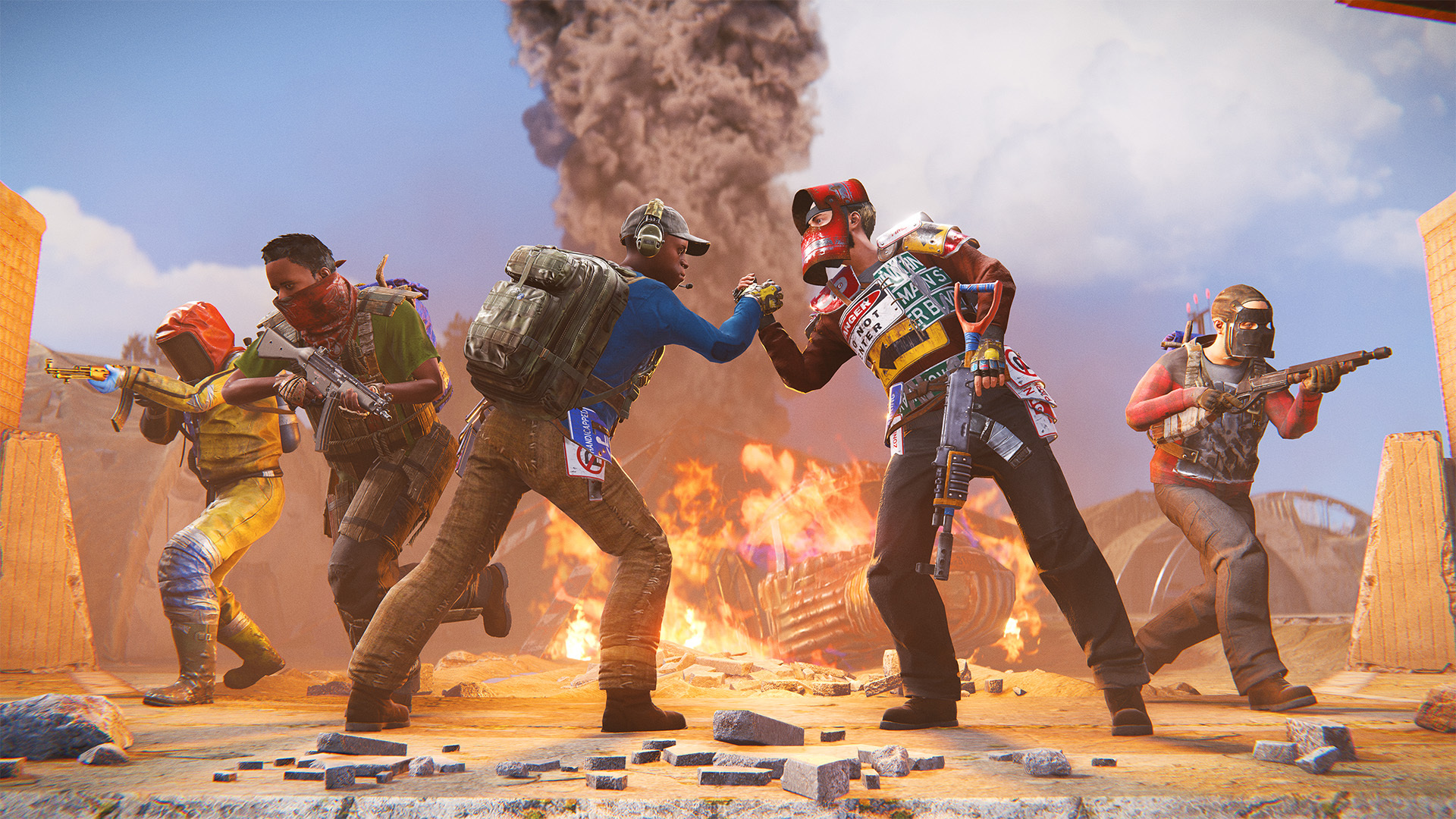
Friends with Benefits shipped in July 2025, and the name is a fair summary: most of the headline work went into getting you onto a server with the people you actually want to play with. A main-menu party system, reworked team invites and a new Outpost spawn point were the social half; deployable snapping, another pass at the Patrol Helicopter and improved world erosion made up the rest. It also came with an unusually long explanation of why a bunker got fixed.
The party system
Reducing friction for new players had been a long-term goal, and the party system was the direct answer. You open the friends menu at the bottom right of the main menu, right click a friend, hit "Invite To Party", and wait for them to accept. Once everyone's in, the party leader connects to a server and every party member connects to the same one.
There's an in-game payoff too. When you first spawn on that server, your party members spawn near each other and are automatically placed on the same team. That only applies to the initial spawn - future respawns go back to being randomly scattered along the beach.
Team invites, everywhere
Alongside the party system, the invite flow itself got easier. A new Invite button in the bottom-left Team UI lets you add friends to your team even if they aren't on the current server or aren't online at all. You can also send team invites straight from the chat panel by right clicking a player's name.
Outpost spawning and the mission system
After several years of doing nothing but waving a radiation detector around, CZ-721 at Outpost finally got a job. He now offers a mission to travel to a Fishing Village and back, and completing it unlocks a new permanent spawn point at Outpost. That spawn has a 30 minute cooldown and doesn't count towards your bag limit. It's available in Vanilla and Primitive modes but disabled in Softcore, which already has a permanent spawn point.
Underneath it sat months of tooling work. Creating a mission used to mean manually setting up conversation nodes, filling in translation fields and doing a lot of error-prone data entry; as much of that as possible has now been automated so missions can be made and iterated faster. Players got visible improvements too: the conversation screen no longer bounces around as text animates in, a Mission Complete panel now tells you when you've finished one, and the screen - previously quite heavy - got a batch of performance work.
Deployable snapping
Placing deployables in Rust had always been fiddly, particularly if you wanted something neatly in a corner or flush against a wall. Deployable snapping is the fix, and it's opt-in per placement: hold Left Shift while you're ready to place an object. There are two modes, switchable in the settings menu:
- Simple - tries to snap the object to a wall wherever possible without forcing anything else, effectively using the wall as a slider for custom placement
- Advanced (the default) - everything Simple does, plus snapping into corners and snapping onto similar nearby deployables, so a box snaps to a box and a shelf snaps to a shelf
Plenty of deployables are covered. The stated aim was something unintrusive and easy to use that opens the building system up through quick, accurate placement.
Patrol Helicopter, take two
Ian Henderson opened this section by admitting the previous round of Patrol Helicopter changes hadn't landed well in some respects. The underlying goal hadn't changed: encourage PVP across the whole map while stopping the same clans taking the heli every single time it spawns.
The old behaviour was that the heli aggroed on whoever last shot it, which made tagging it predictable and easy. That was replaced by tug of war danger zones - attacking the helicopter generates an invisible bubble, and players attacking from inside it raise the bubble's score based on factors like damage dealt, letting multiple groups contest aggro server-wide. The second half was multi-stage fights: when a bubble scored too much too fast, the heli would flee, ideally two or three times, dragging players into a running battle across the map.
The tug of war system was judged to be working and left virtually unchanged. The fleeing behaviour was where players felt frustrated and unrewarded, so that's what got reworked:
- The helicopter will always flee towards a monument
- Flees are capped at 1 grid maximum
- The flee location is now shown on the map
- It will no longer flee if you take it from nearby or inside a monument
The framing was refreshingly honest - these changes might not work either, but they were worth trying. A separate fix stopped the Patrol Heli failing to fly above jungle trees.
Improved erosion
The erosion simulation that runs during procedural map generation was upgraded. It now blends canyons and lakes into the surrounding environment far better and has a larger overall impact on how a world is generated. It costs a relatively small amount of extra generation time, and that's aggressively multi-threaded to keep the hit down.
Legacy walls, storage tanks and viewmodels
The Legacy External Wall and Gate skin pack arrived on the Rust Store, letting you swap your wooden external walls and gates for a rustic throwback look - applied with the Spray Can. If you want to see how the Legacy Wall looks before committing, it's worth a browse.
August 2023's Abyss Pack also got a free addition: Vertical and Horizontal Storage Tanks, each holding as much as a Large Wood Box. Existing owners had them appear automatically as crafting menu options.
On the animation side, Rust had been hand-animating viewmodel camera movement via a camera bone since April 2024, while older viewmodels stayed on the code-based system from 2017. That system worked but tracked on-screen movement poorly. Since any object can now be assigned as the viewmodel camera, the team hand-animated camera movement in Unity for the legacy assets instead - and as of this update all pre-2017 viewmodels are done, with admires getting camera animation too.
The roof stability explanation
A one-line commit about "roof stability being fixed" caused enough of an uproar that Facepunch wrote a whole section on it. Their position: some bugs are better left in the game once they become important gameplay mechanics. Bunkers and external TCs are known bugs deliberately left alone until an official mechanic can replace them, watched closely, with only the variations that cross from "cool mechanic" into "game breaking" getting patched.
So what happened? After the Jungle Update, players started building more pyramid bases and "Jungle Temples", and hit a problem - roofs would break after a server restart, or building would be impossible despite the game showing enough stability. The root cause was that the stability system used the lowest number of links to the ground rather than the highest stability for support. That same root cause was what made disconnect-able TCs possible, so fixing pyramid bases necessarily fixed those too. The team judged that acceptable: plenty of alternative bunkers still exist, and external TCs can still be broken manually before replacing the main TC. The summary was that they hadn't broken all bunkers and had no plans to - one type broke as a side effect of correcting the stability maths.
Notable changes and the changelist
The smaller stuff worth knowing:
- Peacekeeper-mode turrets now display a holster warning to offending players, like the old safe zones
- A dedicated UI sounds slider was added, which covers headshot sounds
- Weapons are now properly holstered when surrendering rather than just hidden
- Turret aiming calculations were optimized server-side
fps.startloggingoutputs a CSV of frametimes, withstoploggingto end it- Wire slack controls got dedicated keybinds, and mouse wheel movement can now be bound
- The Spray Can can reskin large objects like external gates and walls from further away
- An
killbeesadmin command was added, andlookingatnow returns more useful information
The full changelist runs to several thousand characters of fixes on top of that - among the more notable, reskinning large objects no longer restarts the demolish timer, long server uptimes no longer break calorie calculations or instantly spoil freshly harvested food, picking up a ladder on an external wall no longer destroys every other ladder on it, and a handful of exploits around floating shelves, stash placement and softcore looting of handcuffed players were closed.
Twelve years in
Alistair closed with a milestone round-up. Rust was approaching its 12th birthday, with over 380 content updates and 2,500+ hotfixes since launch, guaranteed monthly the whole way. The game passed 1 million positive reviews, making it the 6th most reviewed game on Steam, and crossed 20 million copies sold on PC alone. 2025 to that point had delivered the Primitive Update (four siege weapons, a new bow, shields and a new game mode, plus horse and ragdoll work), the Crafting Update (new cooking and crafting, pet chickens, bees, pies, armor inserts and optimizations) and the Jungle Update (a whole new biome with climbable trees, vine swinging, tigers, crocodiles, new monuments, boomerangs and blowpipes).
Looking forward: a Hardcore mode refresh the following month alongside long-requested quality-of-life work, then the Naval Update later in the year with modular player-built boats and cannons. AI and animal overhauls with new animals were in the pipeline, as was a Warhammer collaboration.
This update also landed during the Steam Summer Sale, with Rust and its store DLCs discounted 40%. If you're tracking what the month's skins - the Apocalypse Nomad LR and No Mercy Rocket Launcher among them - actually go for, they're all in our skin tracker.