
What's New in Rust's "Devblog 71" Update
July 2015's Devblog 71 fixed a server performance crisis that had some 200-player servers running at 4 FPS, opened the Workshop SDK so players could design skins, added stone and wooden compound walls, and disabled radiation for being broken.
Devblog 71 closed out July 2015 with a genuinely enormous fix. Server performance had been degrading for months to the point where players were teleporting around, and over one weekend Facepunch found the causes. Alongside that came the Workshop SDK that let players start designing their own skins, compound walls, a rethought spear nerf, and the temporary removal of radiation for being too broken to be worth having.
The Server Performance Breakthrough
Server performance had turned really terrible over the preceding couple of months, with many servers running at under 5 FPS - which is why gameplay felt like everyone was teleporting rather than moving.
The causes turned out to be a combination: performance problems in how Rust used rigidbodies, IsInvoking being slower than it needed to be, and moving the player on each received tick. Together those produced a snowball effect where once the framerate dipped, the server couldn't recover.
The results after the fixes are hard to overstate. Facepunch servers with 200 players connected that had been running at 4 FPS were now running at over 500 FPS. Garry's summary was that you wouldn't believe how much of a weight off their minds it was, which is a fair reaction to a two-order-of-magnitude improvement.
Compound Walls
Two new perimeter pieces went in. The Stone Compound Wall is heavy duty and hard to break through, but easily scaled with a ladder - so it isn't a hard barrier so much as a tool for funnelling attackers, making it more likely they'll come at the front of your base rather than from every direction at once. The pieces snap together so you can run a wall all the way around your house.
The Wooden Compound Wall works the same way but is made of wood, and comes with a nasty surprise for anyone trying to jump over it. Vince built both models this week.
The Workshop SDK
This is the update that opened skin creation to players. Garry built the Workshop SDK so people can design their own skins in the hope of getting them into the game, following the same model as CS:GO.
At launch it covered only t-shirts and pants, but people were already doing imaginative things with it. The curation stance was set out plainly: not everything gets in, what goes in is up to players via voting but ultimately up to Facepunch, and the bar is that it isn't a terrible meme, isn't someone else's IP, and fits Rust's style. The SDK shipped on Steam under the tools section, requires Unity, and came with a rough getting-started guide - comprehensive docs were deliberately held back until things settled down.
Analytics
Facepunch added analytics, and Garry explained why it isn't just a website thing. There were basic questions they simply had no answer to: which items are the most crafted, what's the most common cause of death, how many people play in DX9 versus DX11 mode. More to the point, there were assumptions being made that were probably wrong. The goal was making informed decisions rather than working from gut instinct or angry Reddit rants, with stats promised for the following week.
Spear Nerf, Take Two
Maurino admitted that cutting the spear's range as hard as he did the previous week was a stupid way to fix the problem. The revised approach restores the range but makes the attack radius very small, so you have to aim precisely at what you want to hit with very little grace area. Attack charge time and repeat delay were also increased. Gooseman supported this with reworked spear attack animations that have more of a windup, at Helk's request. The goal was a spear that's nerfed but not useless.
Wounding and Deploy Delay
The constant wound/revive train during raids was making battles run on effectively forever - an unintended consequence of the wounding system. Now, being wounded again within 60 seconds of getting up results in death.
Separately, weapons could previously be used the instant you pulled them out, which players exploited by stacking six spears in the belt and throwing them rapid-fire, or cycling through several loaded weapons instead of reloading. Weapons can now only be used once fully deployed.
Oil and HQ Metal Rebalance
One week after making High Quality Metal the backbone of firearms, the distribution got tightened:
- HQ Metal is less common in general.
- HQ Metal is more common in the tundra and arctic biomes.
- HQ Metal has a very small chance of spawning in the temperate biome.
- Oil is much less common in general, and much more common in the arid/desert biome.
- Small amounts of HQM can be found in radtowns and in barrels.
The consequence, acknowledged directly: some existing quarries and pumpjacks now produce nothing at all.
Radiation Disabled
Radiation was disabled by default. The reasoning was blunt - it was so horribly unbalanced and broken that the only thing it contributed to the player experience was annoyance. It was framed as temporary, with ideas in progress to make radiation behave like the hazard it's supposed to be.
Maurino used his closing notes to acknowledge the wider problem too. He introduced the HQM mechanic and accepted it hits smaller groups of players, though he considered most complaints wildly overstated, and was taking steps to mitigate it. More strikingly, he called the blueprint system absolute garbage along with radtowns - you shouldn't have to run naked into radiation zones 9000 times to finally find a remotely decent blueprint. Work on both had started but wasn't ready to ship.
Building Placement and the Rock Exploit
Getting inside rocks and building in them should now be fixed once and for all, with a request to report any surviving method. Exploit test rocks were added to CraggyIsland to make verifying this easier.
Andre also clarified the construction placement changes that had quietly shipped the previous week and left people unsure whether they'd stick. For months, building blocks used very strict placement rules that blocked placing partially inside terrain or rocks, which made building in caves or on slopes painful. Most of those checks were removed because the newer, much less preventative placement system now covers their original purpose. There's no plan to revert - if anything Andre wanted to push further, to the point where every placement that looks like it should work to a first-time player actually does.
He also found a bug causing building batching to refresh constantly rather than only when needed. It wasn't a huge cost per frame thanks to the load balancing system spreading work across frames - generally below 0.1ms - but it was wasted work, and it made the LOD grid refresh much slower when a lot of buildings were around.
Procgen10 Groundwork
Procgen10 wasn't live yet, but the week's preparation was: code allowing monuments to have interactive elements, icebergs restored to the arctic biome, improved icesheet spawn rules, and certain decor moved from the static system to the dynamic one to reduce load on Unity's terrain tree system. Physics optimisations on the road and river meshes should particularly help particle collisions like rain and snow.
Player Movement
More movement fixes landed: less of the annoying limbo state between falling and standing, and you can no longer bug to the side of certain colliders and have the movement system count that as grounded. Andre considered it pretty solid now and was ready to start on new step detection.
Art and Audio
Gooseman added the hacksaw melee weapon, replaced the placeholder building-construction animations with new ones where the player holds a blueprint, finished the recover-from-wounded animation, and fixed the player's back bending unnaturally when aiming straight up.
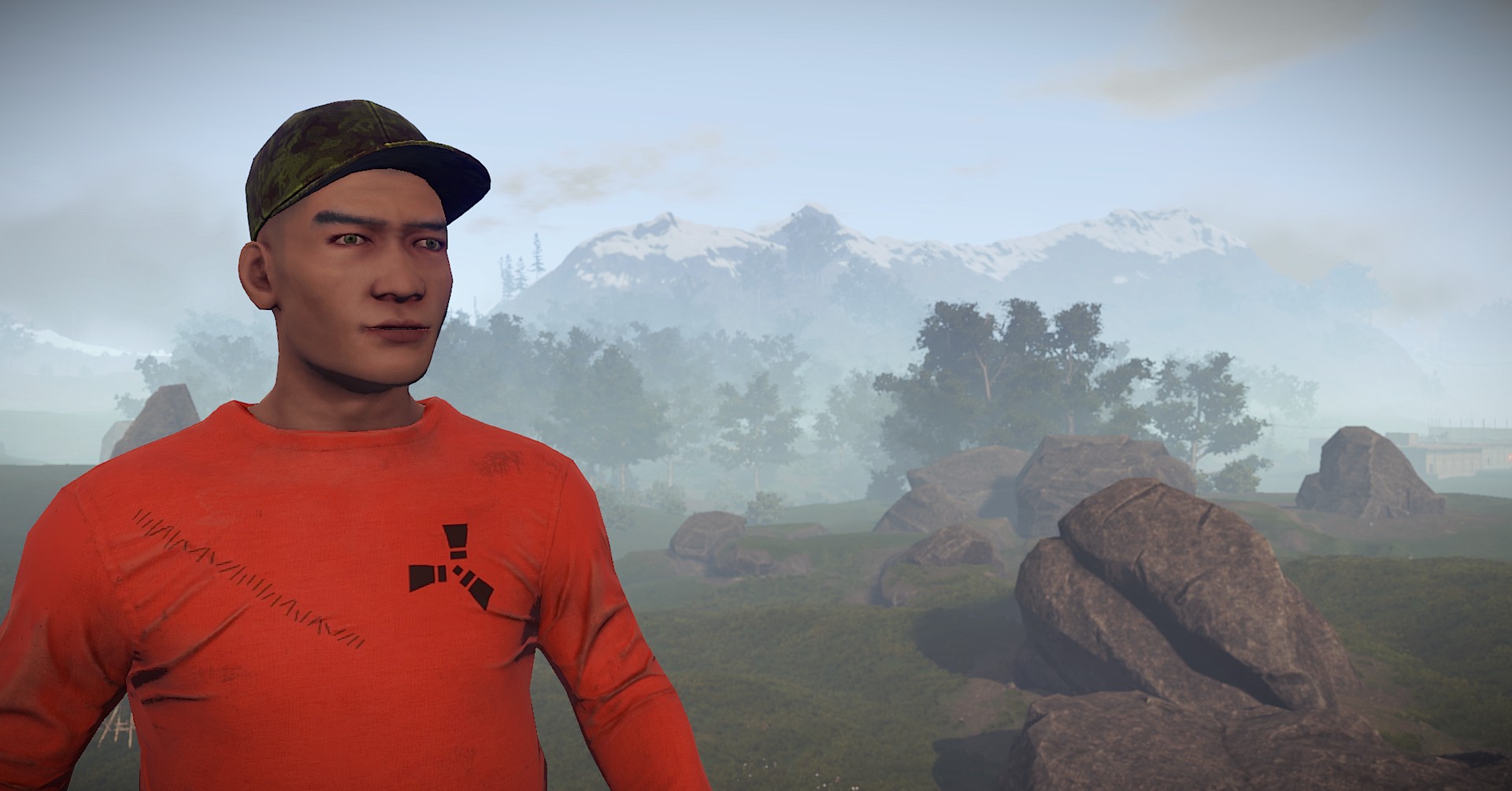
Xavier spent a couple of weeks on the unglamorous job of making female versions of every male clothing item that doesn't fit properly - copying, pasting, tweaking models and ticking off lists - with about another day and a half to go. Tom, meanwhile, revised the female model itself, making her a bit more top heavy with broader shoulders and a few other variations. He also made hat items for the Workshop plus a work-in-progress boonie hat shown with a military camo texture, and fixed an alternative normal map that made the character's eyes look funky.
Vince cleared a set of smaller tasks: replacing the ugly temporary pumpkin art, building the compound walls, finishing the sphere tank structure, and fixing collisions on large deployables like the quarry and pumpjack. Next up were a distinct survey crater for oil reserves and, finally, the large refinery.
Howie continued on vehicles, pushing them toward a more armoured, offensively useful look - or, as he put it, useful for humiliating your prisoners - and planned to start on horse saddles next, having noticed a lot of threads begging for rideable horses.
Megan showed flamethrower concepts, working toward a low tech solution; the favourite design is loosely based on a water pistol with a pump to build pressure and something simple like a candle or torch at the end. She also developed the bed idea further - not like the Legacy beds, more a tier up from a sleeping bag, harder to destroy, possibly with a recovery or health benefit and some extra storage that doesn't cost extra space in your base. On icons, the team decided players should discover the items themselves rather than have them previewed, so her absence from a devblog likely means she's deep in the icon mines.
Paul explored heavy armour with more scope for player painting - bigger and simpler plated areas that take custom designs - with military and SWAT gear, ammo belts and a quiver lined up next. Scott set aside what he calls Biome Prop Blending to make collision meshes and LODs, and agreed an approach with Andre for spawning plant life on props.
Alex Rehberg finished refactoring the ambience system and did work on the sound system, with little immediate in-game benefit but the groundwork laid for things he'd been planning. He also added metal surface footsteps, polished rock footsteps, and started on the new melee weapon sounds. The experiments he was itching to try are nice ones: varying sound frequency by time of day, weather or in-game events - more birds at dawn, birds going quiet when guns fire nearby, fewer birds in heavy rain.
Everything Else
- Lowered the small refinery and crossbow drop rates.
- Explosives now fall off their parent when it is destroyed instead of vanishing.
- Added a leather resource type.
- Fixed crate respawning stopping when it threw a server exception.
- Fixed the foundation step terrain check being off.
- Fixed weapon deploy corruption that could make the current viewmodel invisible.
- Fixed depth testing and sorting of the torch world model material.
- The interaction point now stays at the centre of the screen when looking around.
- Added sphere and capsule deploy volume checks, used by the furnace and campfire, plus support for multiple deploy volumes on a single object.
- Fixed the server not applying monument and radtown randomizations.
- Fixed the small bridge material - which now only exists on rivers.
- Added command history to the F1 console, navigable with the up and down arrows, and fixed possible text buffer overflows.
- Fixed the construction plan using the wrong body weights, plus a batch of code warnings and the CraggyIsland test cave.
The hats Tom made this week, including caps like the Grey Cap and Forest Camo Cap, arrived alongside the Workshop SDK that eventually turned Rust cosmetics into a player-driven economy. Our skin tracker covers what that catalogue looks like a decade on.