
What's New in Rust's "Devblog 149" Update
Devblog 149 let players cosplay as tin cans in Heavy Plate Armour at the cost of 30% movement speed, added guest codes and public beds for landlords, marked monuments and vending machines on the map, and outed armed nakeds with the Caveman Sash.
Devblog 149 arrived in late February 2017, and it read like a landlord's wishlist: guest codes for tenants, public beds for apartments, comfort furniture, and map markers pointing customers at your vending machines. Add the long-teased Heavy Plate Armour and a clever anti-bullshit measure called the Caveman Sash, and this was one of the most gameplay-dense patches of the era.
Heavy Plate Armour
Taylor's tin-can suit finally shipped in what Helk called "a really rough implementation." To support it, armor gained a whole new capability: dictating your maximum movement speed. Each piece of Heavy Plate slows you down, stacking to roughly a 30% speed loss when fully equipped. In exchange it protects extremely well - but it's very vulnerable to heat damage and leaves you cold in the arctic biome. "It's probably UP or OP, but I'll fix it all next week," Helk admitted, adding that the Metal Facemask and Chestplate needed a pass too since "our costs vs protection values are all out of wack." Proper walking animations were made to match the slower pace, replacing the old slowed-down jog. Longer-term, he wanted armor to carry more trade-offs - movement noise, helmets that partially occlude your view, and so on.
The Caveman Sash
A small feature with big social consequences: touch any hostile item, ever, and your character is marked - displaying a Caveman Sash instead of appearing completely naked, until you die. As Helk put it: "Now at least you know when someone is bullshitting you when they say they 'just spawned' and 'trust me, I really don't have a Waterpipe'." It was explicitly a first step toward showing actual items on player models, which he planned to investigate the following week.
Landlord Tools: Guest Codes and Public Beds
Guest codes came to the Code Lock: someone with the guest code can open and close the door, but can't unlock it, change the code, or remove the lock - perfect for renting out furnace-room access "for a fee." And beds gained a Public option: anyone can walk up to a public bed and take it over, becoming its owner - like assigning to a friend, but without you needing to be present. Helk suggested placing them near shops or building apartments; both settings can be toggled back at any time.
The Trading Economy Matures
The Metal Shopfront survived its first week "shockingly" well. The flamethrower exploit (flames passing through the glass) was fixed, health was set equal to a sheet metal wall, double-stacking was blocked, right-click deposits went in for both parties, and a short delay was added after both players confirm - "a chance to really, really be sure." The Peacekeeper Turret got sensible with a week of shop-running experience behind it: Water Bottles, Bota Bags, Buckets and Rocks no longer register as hostile items, but dealing any damage to anything gets you targeted immediately - and hostile status no longer persists through respawns. The Sentry Gun even picked up a laser sight. Vending Machines were hardened to Armored Wall strength, their screens now display the stack size being sold (10 wood for 1 stone shows exactly that), and the keypad got a neat light animation - all of which made workshop dress-up like the Army Vending Machine skin feel right at home.
Maps That Actually Help
Two map changes transformed navigation. Monuments are now labeled on the map - "It's better this way, trust me" was Helk's entire justification. And Vending Machines gained a Broadcast Position option, showing as a little green dot on everyone's map: existing machines needed it toggled on, new ones broadcast by default. Helk flagged it as possibly temporary while he worked out a more general map-marker system.
Make Yourself at Home
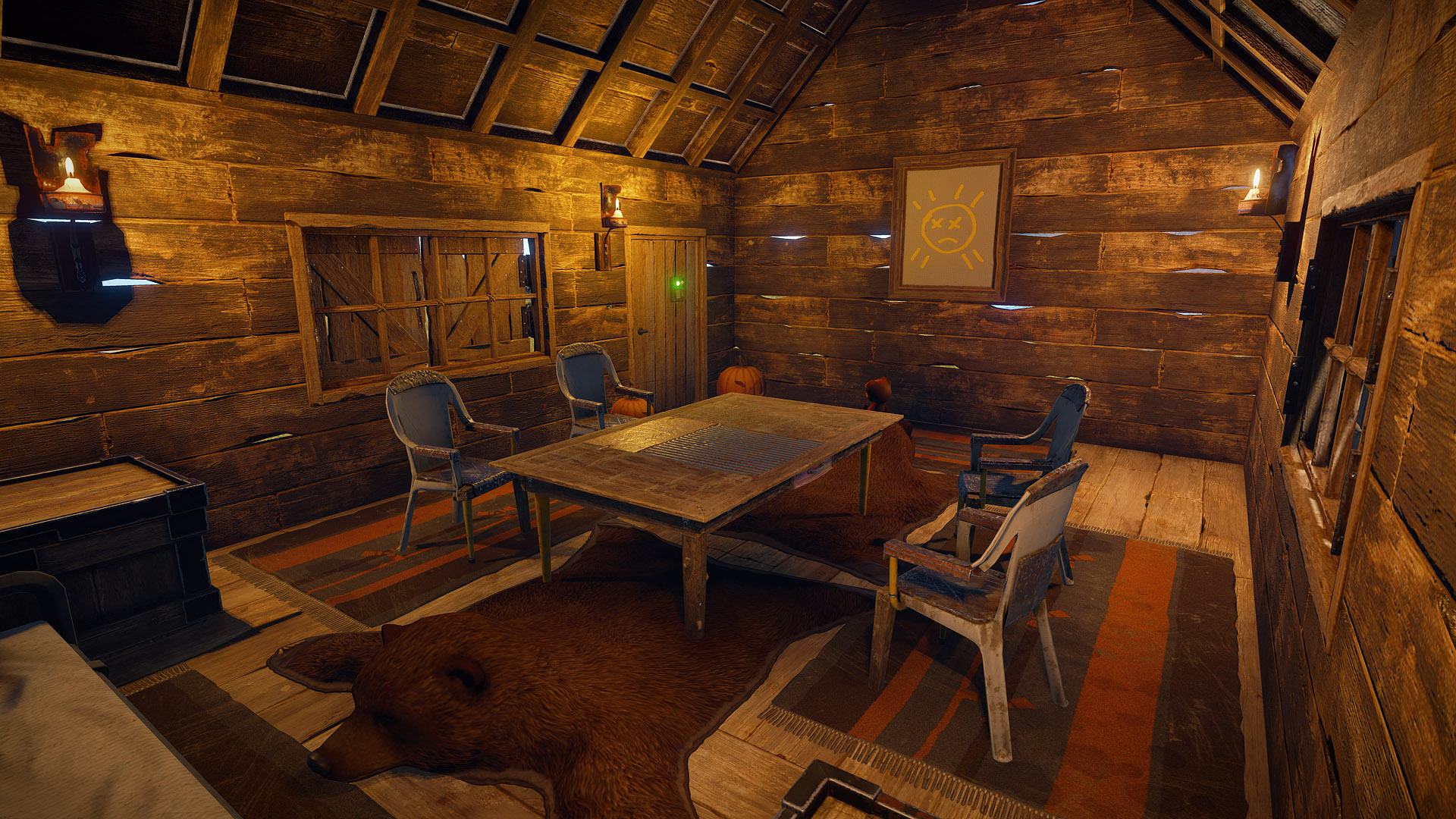
Damian's comfort deployables landed "for role-players, ahem": a bear skin rug, a common rug, a table and chairs. Rugs grant comfort while you stand on them; the table and chairs radiate a campfire-style "subtle radius of coziness." The Fridge from the previous week became easier to place - and with skins like the Biohazard Fridge appearing on the workshop, base decoration was properly becoming a hobby.
Performance and Polish
- Andre found that particle effects and decals from gunfire were spawning at extreme distances, wrecking performance on busy servers - decals were capped at 30 meters and particle effects at 100 meters.
- The multithreaded mesh batching system "pretty much eliminated" micro-stuttering around massive bases in testing, but wasn't stable enough to ship this week.
- Diogo closed a fairness gap: potato-mode terrain was so smooth that players used it to spot dropped items more easily, so a high-frequency texture overlay now breaks up the ground at no performance cost. He also added wind animation to the upcoming overgrowth foliage.
- Third-person animations arrived for the MP5, LR300 and Semi-Auto Rifle; twig and stone floors were flattened so deployables stop intersecting; and Alex Ramsey made physics sounds scale naturally with impact strength - no more thunderous clunks from a two-inch drop - alongside new sounds for the new world models. Alex Webster, meanwhile, acknowledged the "comedically large Sewing Kit" pickup pain and floated ghost outlines for pickups as a fix.
With Heavy Armour balancing, item-on-back rendering, and the foliage system all queued up, Devblog 149 left plenty cooking - and every skin from the era's fast-growing workshop catalogue is browsable on our skin tracker.