
What's New in Rust's "Devblog 132" Update
Devblog 132 unveiled the integrated workshop that let anyone make and publish Rust skins without touching Unity, added Rifle and SMG Bodies to the component system, defloooded the new caves, and killed two high-profile cheat exploits.
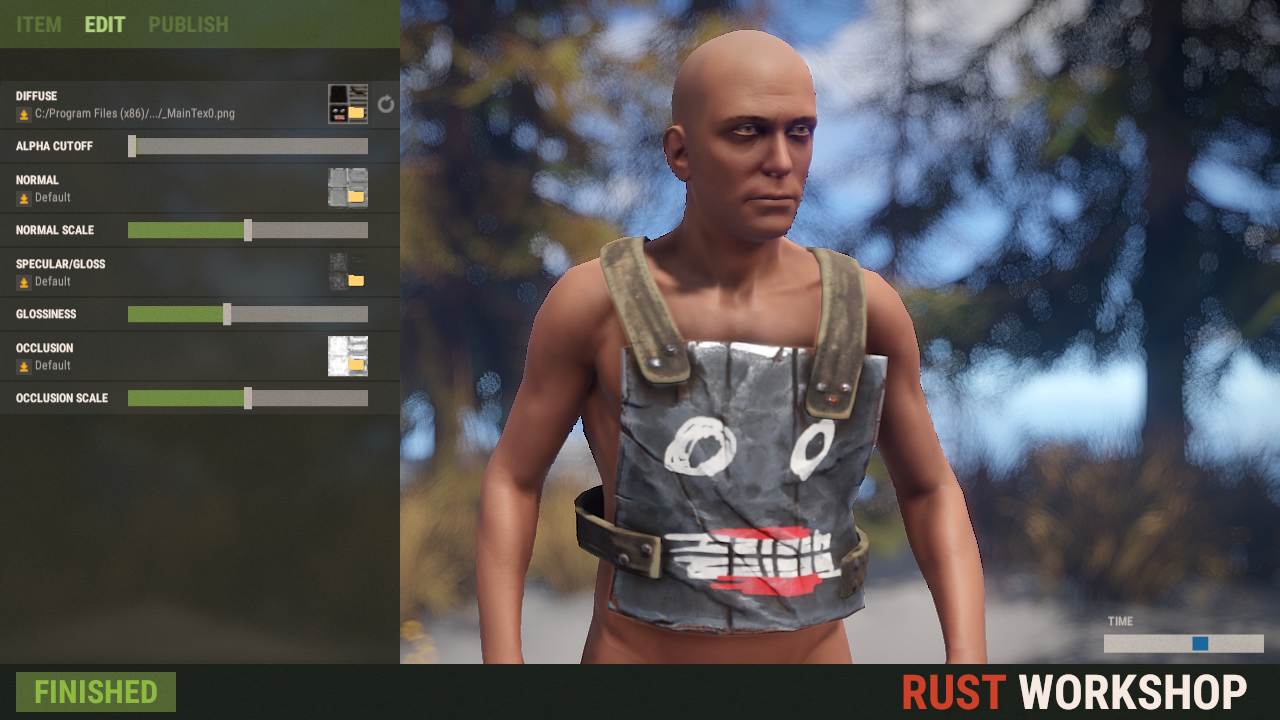
Devblog 132 landed on October 20th, 2016, headlined by something that would quietly reshape Rust's whole cosmetic economy: an integrated Steam Workshop editor that let anyone make and publish skins straight from the main menu. Behind it, the component system gained its recognizable core items on prerelease, the new caves were drained of water, and a pair of high-profile cheat exploits got shut down.
The Integrated Workshop
Garry's verdict on the old skin pipeline was blunt: the Rust SDK sucked, forcing creators to download Unity sucked, and Facepunch manually downloading, fixing, and adding skins sucked - which is why new skins had stopped being added at all. The replacement, live on prerelease as a heavy work in progress, made it "easy peasy lemon squeezy":
- Click Workshop in the main menu, then New, and pick an item type from a dropdown
- Download the default diffuse texture and draw all over it in Paint, Photoshop, "or whatever open source crap you have installed"
- Point the editor at your new texture - and as you keep editing, it updates automatically in game
- Click Publish to auto-generate an icon and upload straight to the Steam Workshop
A Rust Workshop project page with an almost-empty wiki went up alongside it, with Garry taking feedback and conversion questions via Twitter.
Component System Gets Real (Prerelease)
The prerelease component roster grew to include some now-iconic names: Metal Pipe, Sewing Kit, Spring, Metal Blade, Rifle Body, and SMG Body. Spawns were added to barrels and some loot crates, and early-game crafting recipes were adjusted to use them. Within a day or two, every item meant to have components as its limiting factor was due to have its recipe adjusted - after which Helk could "start seriously listening to feedback." The launch target was named for the first time: the 3rd, with the stated goal of making sure it "won't be a disaster."
Caves Defloooded, Hierarchies Flattened
Diogo's deflooding code - originally just a testing tool for cave assembly - was made to work properly across client and server and deployed to prerelease, draining Vince's caves and dungeons so they could finally be explored down to their deepest, most claustrophobic corners, with testing running until the next forced wipe.
Andre discovered that the deeply nested object hierarchies of caves and dungeons were slowing LOD calculations and adding CPU overhead to mesh rendering. Since artists need those hierarchies at design time but the game doesn't at runtime, he added automatic edit-time processing that flattens cave and dungeon prefabs and strips unused empty game objects - live with the next wipe.
Exploits and the Entity Leak
Working from Alistair's list of things private cheats were actively exploiting, Andre fixed the two highest-profile offenders: a gathering rate increase and an attack verification bypass (a server-side attack cooldown bypass fell in the same sweep, per the changelist). He also nailed the client-side entity leak from the previous week: nested parented entities were missing networking group changes from their parents, leaving children in different network groups server-side and leaking them on clients when the parent's group was destroyed. One rarer edge case - group change messages arriving after the group was already left - remained on the list.
Rendering: Rain, Underwater, and Load Times
Rain got a proper fix-up after an earlier optimization pass had cut particle counts so hard that rain fell in visible waves even at maximum intensity. The reworked effect looks more natural, the rain shader's GPU memory bandwidth under heavy rain was halved, and the result was more particles at lower cost - with rain indoors and in caves acknowledged as the next big target. Underwater bubbles and plankton, unintentionally disabled a while back, returned. And coarse height/slope map generation - recomputed on every map load and recently made more expensive by a resolution increase - became 6x faster, trimming loading times by 0.5 to 1.5 seconds depending on map size.
No More White Cubes and Burlap Sacks
The camera finally got a real world model - previously, anyone holding one was "running around holding a white cube like a total noob." A broader world-model push cut down on items dropping as burlap sacks, with the changelist crediting new dropped models and LODs for the LR300, double shotgun, bota bag, silencer, scope, holosight, muzzle boost, muzzle brake, and building plan. Muzzle flashes were also rebuilt after Helk and the art team studied real footage and found genuine flashes far more random in shape and size, and weapon LODs were further optimized for scenes full of guns.
Audio: A Third Fewer Voices
Alex chased down the long-standing pitch bug (a pain to reproduce because it took a while to kick in) and overhauled voice limiting: older gunshot sounds now stop faster but fade out smoothly during automatic sprays, out-of-range looping sounds pause automatically, and barely audible crossfade layers get skipped. The net result on a busy battlefield server - the most audio-stressful case found - was about a third fewer active voices, sometimes more. MP5 non-gunshot sounds were finished, deployable placement sounds got fresh source recordings, and sound occlusion stayed opt-in one more week (audio.occlusion 1 to help test) after a bug-fixing Saturday ate its playtest time.
The Recycler finished its LODs and was declared ready for implementation, the Hazmat Suit moved from bakes into texturing, and the shipping containers shipped in multiple colors - some open for interior exploration. With the workshop public and the component launch date set, Devblog 132 was the sound of late-2016 Rust clicking into place.