
What's New in Rust's "Devblog 116" Update
Devblog 116 kicked off a full graphical overhaul of Rust's outdoors, explained the XP system's ownership math in detail, closed the last known through-wall hack loophole via throwable verification, and took another shot at killing rock bases.
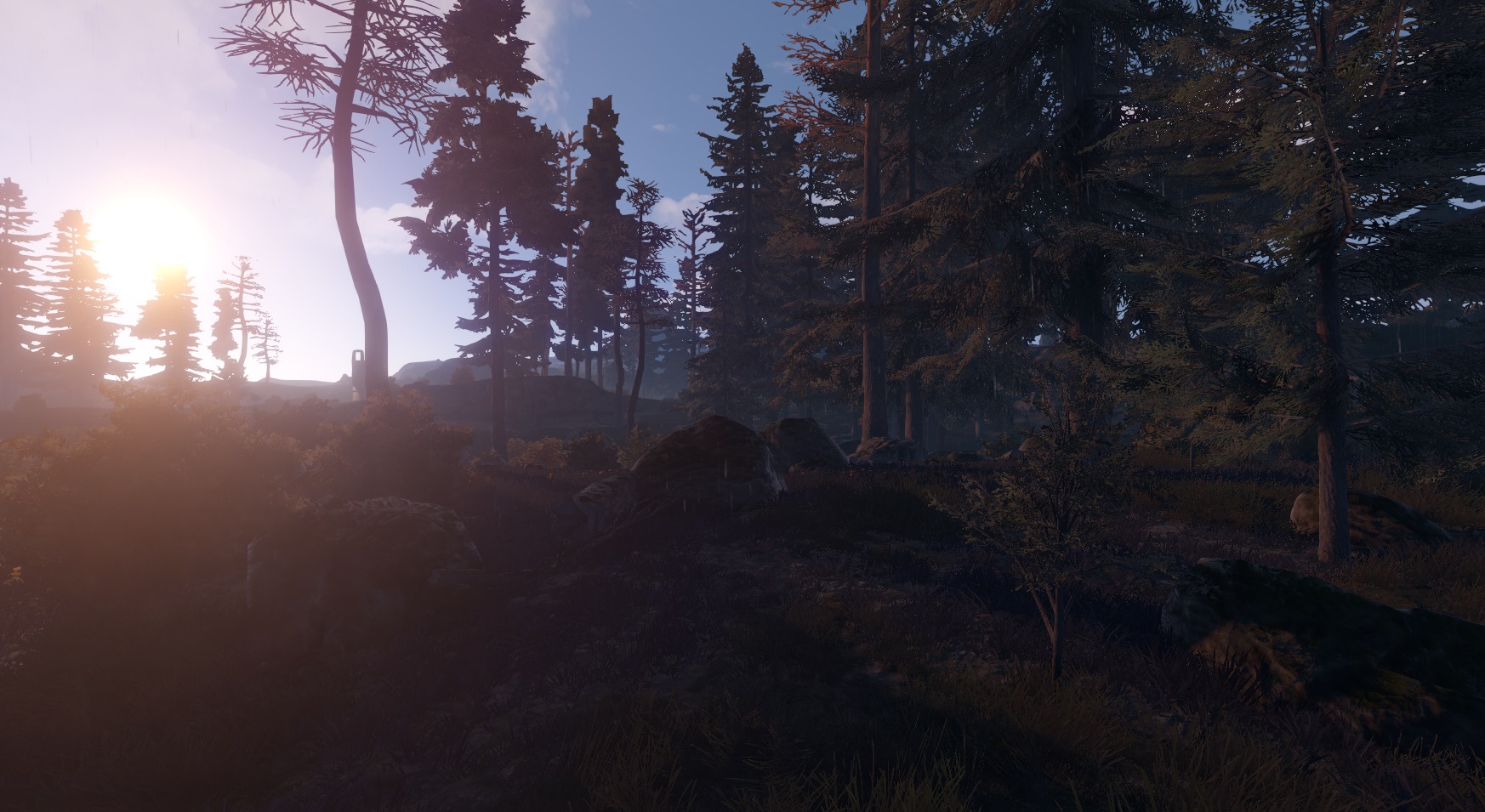
Devblog 116 arrived on June 23rd, 2016 as a deliberately small live patch with a huge amount happening behind the curtain. With the whole team pushing toward the July 7th XP launch, the update itself focused on anti-hack work and an EAC update — but the devblog delivered the first look at a from-scratch graphical overhaul of Rust's outdoor world, plus the full, gloriously convoluted math behind XP ownership. Servers were also being upgraded, meaning some extended downtime.
The Graphics Overhaul Begins
The most exciting news was a new branch that had been wiped nearly clean to rebuild Rust's rather ghastly outdoor environments. The stated goals: throw out the crappiest trees, improve the less-crappy ones, redesign lighting for all times of day from scratch, revisit terrain and biome tones, overhaul spawn tables (what bushes, rocks, trees and mushrooms spawn where, in what quantity and size), give individual biomes more distinct character, revisit weather — maybe making it harsher — and do all of it without diminishing performance. No timeline was given, but the header image served as a very early appetizer.
XP Ownership, Fully Explained
Helk cleared up confusion from the previous week: "ownership" was purely an internal XP-tracking concept — nobody would actually receive resources when someone used their tool. The short version: give people stuff, and you earn little trickles of XP when they use it, and when the people they help use things too — "pyramid scheme style".
The long version came with worked numbers. If Garry gave Andre the resources to craft a hatchet, ownership split 80% Andre, 20% Garry. If a barrel gave 1 XP per hit (not a real in-game number), Andre would earn 0.5 (action split) + 0.5 (tool split) × 0.8 (ownership) = 0.90 XP, and Garry 0.1 XP. Resources harvested with a shared tool carried ownership onward — so chains of helping created chains of XP, with everyone up the chain getting a small piece. Reddit's lone wolves worried about 10-player teams propping up one fast-leveling crafter; Helk didn't think it would be a big issue but promised to watch closely. Future ideas included cooked food granting ownership (split with the campfire deployer), XP for repair bench use, and more. His disclaimer was refreshingly honest: "this all might end up being a load of shit and we'll have to remove it, but, hey, nothing ventured nothing gained."
The Last Hack Loophole Closed
With projectile and melee verification live, Andre tackled the final weapon category: throwable weapons. Their exploits worked differently, but the new checks prevented all known hacks that used throwables to destroy cupboards and storage boxes inside bases. That closed the last known loophole for through-wall destruction hacks, and server owners still running community anti-hack mods were urged to switch back to the now significantly more secure official system.
Rock bases got another beating too: the known exploits for building inside rocks looked fully covered in testing, with the aim of a rock-base-free next wipe cycle — though Andre carefully avoided leaning too far out the window on that promise.
Menus, Nametags and Motion Blur
Garry's week was all quality-of-life, much of it on prerelease (and much of it, in his telling, for the benefit of "lone woolfes" — spelled differently every single time):
- Motion blur returned — love it or hate it, there was an option to turn it off.
- The main menu was tweaked and the options screen made "a bit less terrible".
- Nametags became slightly visible at night on prerelease instead of completely hidden — balanced by the fact you can't see them unless someone is practically standing next to you.
- The crafting menu on prerelease now showed locked and upcoming items per category: locked ones unlockable with XP, upcoming ones arriving at your next level.
Airfield Rework Planned
Rather than starting new dungeons and tunnels, monument work pivoted to the areas that looked worst — and by this point that shortlist was basically the airfield's hangars and the lighthouse. The Airfield rework would go military: a perimeter of big concrete slabs planted into the ground, watch towers, a small office building and proper concrete runways, with the goal of making it one of the best places on the map again and more fun to traverse and explore.
Music, Armour and Animation
Alex R neared the end of chopping existing songs into intensity layers — a base ambience layer at any intensity, a calm melodic layer for low intensity, small drums and staccato strings in the middle, and strong drums and big synths at the top — while writing extra mid- and high-tension parts so songs wouldn't collapse into a single drum loop during long fights. Menu-screen music support was added, and the system was headed to prerelease within days.
Elsewhere, the last two-handed throwables got the new aiming system with spear throwing being simplified to match (targeting a prerelease merge the following week), the heavy armour moved into texturing with duct tape, bolts and rivets breaking up the big metal plates for a hand-crafted feel, and female clothing deformation around the chest was smoothed out — previously it looked like players were hiding sharp objects in there.
The live changelist stayed lean and focused: rock-base and throwable-hack protections, the EAC update, and a string of anti-hack false-positive fixes — including one for jumping on floating ice caps — plus fixes for chain link fence exploits against turrets and the patrol helicopter. The calm before July 7th's storm.