
What's New in Rust's "Devblog 114" Update
Devblog 114 brought server-side melee verification to stop through-wall damage exploits, extended decay to boxes and more deployables, nerfed the pipe shotgun quick-swap tactic, and explained the XP system's fascinating fractional ownership idea.
Devblog 114 shipped on June 9th, 2016, and while its changelist looked short, the ideas in it ran deep. Anti-hack coverage expanded from bullets to melee swings, decay reached even more deployables in the war on entity counts, and Helk laid out one of the most interesting designs of the XP era: fractional item ownership, a system built to make cooperation actually pay in a game where everyone wants to kill each other.
Melee Verification
With projectile line-of-sight and distance verification now quite solid, Andre extended the same treatment to melee weapons. The system used the same lag compensation as projectiles, making it equally reliable and resistant to false positives. The line-of-sight part mattered most: it shut down exploits that let players deal damage to sleepers, storage containers and cupboards through walls.
A long-standing server annoyance also finally died: the endless log spam about missing projectile IDs. The last remaining cause turned out to be the server-side firing rate not compensating for client-to-server delay or attachment effects — which had been producing wonky firing rates, especially for players with unreliable connections and inconsistent pings. Lag compensation was added to the server-side projectile firing rate to fix it.
Decay Spreads Further
Continuing the push for better long-term performance deep into the wipe cycle, decay was added to many more deployables — including wooden boxes — to fight escalating entity counts. As a counterweight, opening a storage container now reset its decay timer, smoothing the transition. Doors still reset decay on building blocks and deployables, but with a smart refinement: using the building ID system added the week before, a door now only reset decay on blocks belonging to the same building. The decay.scale convar was also changed to affect both delay and duration.
On the anti-hack side, the advanced fly and jump hack protection tested on high-population servers during the week graduated to prime time: flyhack_protection now defaulted to 2, with mode 1 available as a fallback if server owners noticed performance issues (tests showed none).
The XP System's Big Idea: Fractional Ownership
After a rough week of merge trouble (with apologies for prerelease outages), main and prerelease could now stay in parity much more seamlessly. That freed up time to nail down new XP earners, and the team settled on something genuinely novel: fractional ownership of items.
The way it worked: item ownership dictated who earned XP when an item was used. Craft a hatchet entirely from your own resources and you owned 100% of it. Craft it from resources someone else provided, and you and the provider each owned 50%. Hand that hatchet to a third player who harvests with it, and the harvested resources' ownership split 33% each between crafter, harvester and provider. The goal was a big, structural incentive to help other players — being a provider for new spawns could give you many XP streams and let you advance faster than a recluse. As Helk put it, it's very hard to make people cooperate in Rust and very easy to make everyone want to kill each other; this was a first step at fixing that. The follow-up plan: phase out XP from simply hitting rocks and trees, and award it instead when those resources actually got crafted into something.
One sour note: D3D11 crashes were now the team's highest priority, seemingly rooted in Unity's multithreaded D3D11 implementation. The -force-gfx-direct launch parameter avoided them at a real performance cost, so D3D9 was recommended in the meantime.
Pipe Shotgun Quick-Swap Nerf
A dubious tactic got addressed: players filling their quickbar with several Pipe Shotguns, firing one, swapping to the next loaded pipe, and firing again — effectively bypassing the reload. The deploy animation was lengthened so the delay between switching shotguns and firing made the trick far less effective.
Dungeon Doors and the Trainyard Crane
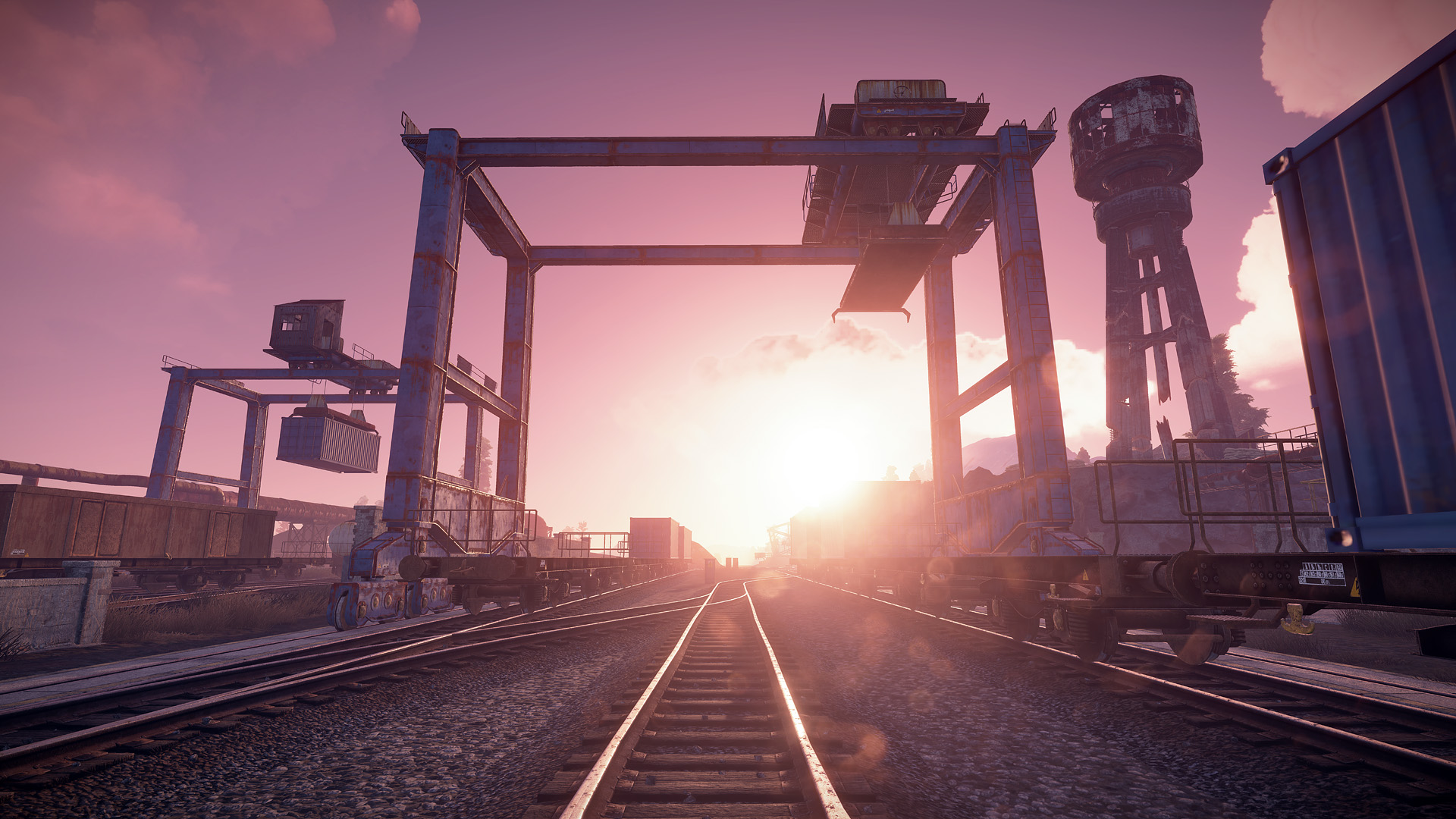
The trainyard crane — the last of the big structures for the industrial dungeon set — was finished, complete with a small room at the top offering a bit of shelter for anyone finding the cranes too exposed. Work then moved to garage doors and a proper door set for dungeons. These would work exactly like player doors with an open/close action, but couldn't be picked up, and most would be unbreakable to keep the experience balanced. And yes — the question on everybody's lips — players would probably get to place those door types in their own bases eventually, but later.
Art, Animation and Optimization
A busy art week beyond the dungeons:
- The heavy armour set progressed to a spinnable untextured work-in-progress.
- The double-barreled shotgun moved toward final design in 3D, built first-person-first with a chunky, brutal close-quarters shape and exposed bolts, screws and springs — a style its artist dubbed "DIY Punk".
- The mortar art model, from an old Paul concept, was nearly finished.
- Player clothing skinning was fixed to stop the unnatural, Gumby-like bending at joints.
- A Maya LOD plugin quirk had left animal and third-person weapon LODs with wildly excessive vertex counts (from non-unified normals); all offending LODs were fixed for a slight performance and memory boost.
- The throwable weapon aiming system continued rolling out across more weapons.
Music Nears Launch
Alex R's dynamic music system took a big step toward shipping. Intensity changes were being wired to in-game events: a slight bump for having a weapon equipped or a helicopter flying around, a bigger one for a bullet whizzing past your head, bigger still for taking damage — and a natural decay back to zero when nothing happened. A proper visual arrangement UI replaced the old nightmare of nested dropdowns. The plan was to include it in the next update, disabled by default behind a convar for a week or two of live tuning before launching "for realsies".
A lean changelist week on paper — melee verification, decay expansion, flyhack default changes, Hapis and Savas maintenance — but one whose ideas about cooperation would define the XP system debate all summer.