
What's New in Rust's "Devblog 113" Update
Devblog 113 was a wipe week that shipped the Muzzle Booster and Muzzle Brake, halved attachment costs, fixed a long-standing bug where disabled attachment modifiers were always active, and detailed big XP system progress on prerelease.
Devblog 113 arrived on June 2nd, 2016 with a server wipe and a distinctly weapons-flavored patch: two brand-new muzzle attachments, halved attachment costs, and the confession of a genuinely funny long-standing attachment bug. Behind the scenes, the XP system was taking real shape on the prerelease branch, and the procedural map quietly picked up more caves, more monuments and fewer holes of death.
Muzzle Mods Launch
With a batch of attachment bugs fixed, the two new muzzle modifications went live. The Muzzle Brake let you stay on target far more easily at the expense of some errant shots — think more CoD-style spread — while the Muzzle Booster increased your weapon's fire rate. Helk openly expected a rebalance the following week and promised to listen.
To get more attachments into more hands, costs for weapon attachments were lowered by about half (the Scope excepted). They simply weren't being used enough, and mostly by players with so much high quality metal to spare they might as well waste it. The cheaper prices aimed to lower the bar for poorer players and boost usage across the board.
The Attachment Bug Confession
Helk's own words: "Wow this is embarrassing." For the longest time, attachment modifier effects had been active even when not set to enabled — meaning the Scope had been quietly lowering bullet velocity by 30%, and the Silencer had been increasing fire rate. With everything finally working properly, the game's true balance was about to reveal itself. Rage on.
Relatedly, the Muzzle Booster's flaky behavior led Andre to a deeper find: a bug in the server-side weapon firing rate calculation caused inconsistencies for high rate-of-fire weapons, especially with attachments involved. Fixing it made automatic fire feel smoother and damage output consistent — and made fire-rate balancing actually possible. Other fixes in the same vein: only the first weapon attachment had been receiving the weapon's aiming state, the hip-aim cone parameter was being ignored entirely, and attachments were invisible when attached to the held weapon.
XP System Progress
The XP system wasn't live in this patch, but it was fully playable on the prerelease branch on Steam. Helk rebalanced the tech tree and wrote code that priced items based on their unlock level and how many other items unlock alongside them — tuned so that when a level opens up, you can afford about 66% of its items. That forced an interesting choice: unlock something useful now, or bank XP for something better later.
Next on his list: proper game-feel for leveling up, new ways to earn XP (when players use tools you crafted, when players use resources you gathered, when crafting items), and toning down or eliminating XP from simply hitting trees and rocks. The tech tree was being patched several times a day based on feedback, with the pitch: the sooner it's balanced, the sooner it hits main.
Map Generation: More Caves, No More Death Holes
A minor-but-meaningful world generation pass: mountains no longer had random holes of death in them, and the distribution of mountains, land and water was tweaked to allow higher monument and road density. There were now a lot more caves on the map with a reduced minimum distance between them, and road materials finally interacted with shore wetness so flooded roads blended in naturally.
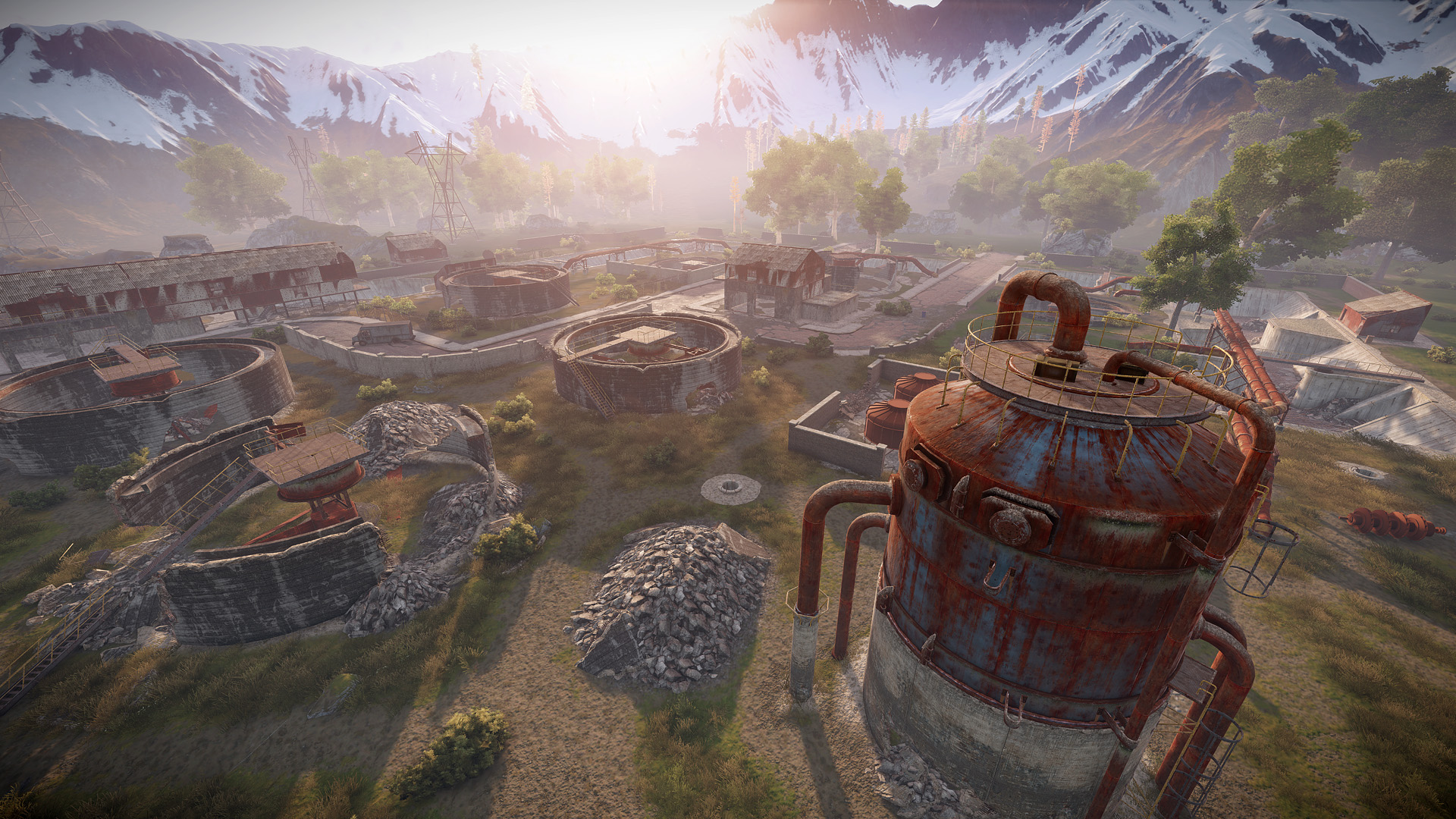
Dungeon art kept rolling too — the pigeon nest tower in the canyon and water treatment plant got a climbable path marked by bird poop (with jumps tweaked to be more predictable), and the water treatment plant's traversable sewage tanks got cosmetic updates. Being a wipe week, all of the previous month's dungeon artwork also came into play at once.
Server Admin Improvements
A meaty week for server owners:
- New
layer.toggle,layer.show,layer.hideandlayer.cullingconsole commands, bindable to keys, for showing or hiding parts of the world without the F1 menu. - A new fly and jump hack protection enabled via
flyhack_protectionmode 2, stricter projectile line-of-sight verification for player-to-player damage, and fixes for a no-clip exploit and an exploit that accessed the client-side layer rendering tools. - The
statscommand now displayed suicides in a separate column from deaths, making suspicious behaviour easier to spot. - The
restartcommand took a seconds argument, the default restart timer grew from 60 seconds to 5 minutes, andrestart -1cancelled a countdown in progress. - Admins no longer got violations for toggling fly mode while moving very fast.
Server performance also improved by batching per-client-tick processing into chunks of ticks, and entity linking was optimized to speed up server startup and network group streaming. Box stacking via walls was fixed too — back to shelves, everyone.
Building ID Groundwork
Building blocks now stored a building identifier shared by every block in the same building, used to enforce a two-world-unit distance between blocks belonging to different buildings. Andre was upfront that this wouldn't kill wall-stacking base designs yet — triangle foundation tricks could achieve the same within a single building — but it laid the baseline for future improvements.
Art, Audio and Experiments
Diogo shipped the first working version of experimental large scale occlusion — a barely documented technique the team was rolling themselves — off by default and enabled via graphics.lso 1, with a warning about performance on mid-to-low-end hardware. Taylor finished the decayed body sculpt for the corpse-rot work and tentatively began the heavy armour set, aiming for a deliberate niche: a slow, flank-vulnerable tank role for raid parties rather than an objectively best choice. The throwable weapon aiming system expanded to the rock, bone club and bone knife (still not on main until every throwable was converted), third-person deploy and reload animations were redone to match viewmodel timing so you could tell when an enemy actually finished reloading, and the floating ration box art wrapped up — beans, chicken dinner, mashed potato, water and fuel, all as individual items.
Alex R spent the week getting his music into the game rather than writing more of it, rebuilding the arrangement system around intensity-driven layers: a bullet flying past could now kick the drums in on the very next downbeat, with section-based structure and planned randomization to keep songs fresh. No timeline yet — he wanted to nail it first. A dense wipe week all around, and with the attachment stack finally honest, the meta was about to get interesting.