
What's New in Rust's "Devblog 104" Update
Late March 2016 brought atmospheric ceiling lights, a proper armor condition system with breakable gear, rebooted melee hit detection, the great syringe nerf, a rebuilt building weak-side system, and honest news that the XP update wouldn't be rushed out.
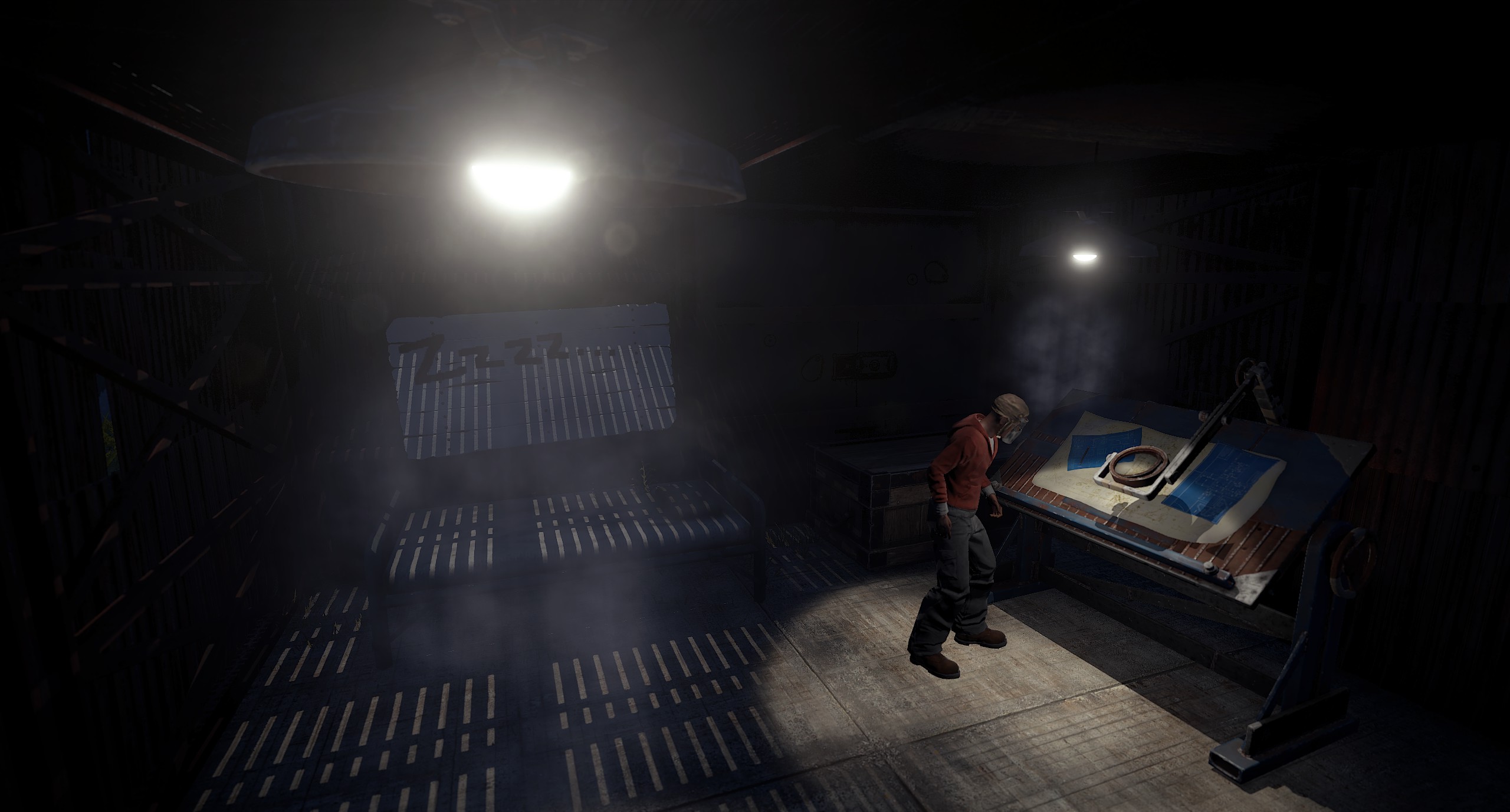
Devblog 104 closed out March 2016 with a patch that touched a bit of everything: new base lighting, a second pass at armor condition, rebooted melee combat, and a stack of exploit fixes. It was also a transitional moment for the studio — with Garry's baby due near the start of May, Helk officially took charge of the majority of Rust's development. As Garry put it: when you write a complaint post on Reddit, please replace "garry" with "helk".
Ceiling Lights and Better Lanterns
The Ceiling Light (a swinging ceiling light, per the changelist) was implemented from old concept art — more involved than expected, but the results were worth it. With no electricity system in the game yet, it works like the lantern: Low Grade Fuel and an on/off toggle, ready to give bases some genuine atmosphere.
Speaking of lanterns — the disgusting wall-penetrating yellow light they used to cast was partially fixed. Lantern light now looks far more natural and actually casts shadows (though with more lights than your max light settings allows, some bleed-through remains). The mesh became more transparent so you can see the flame, lanterns can now be placed on top of deployables, and they burn Low Grade Fuel instead of wood. Under the hood, the ancient LightLOD script that toggles shadow casting was fixed and gained spot light support, load-balanced independently from the pricier point lights of campfires and lanterns.
Armor Condition 2.0
Last week's rough armor condition system got a proper overhaul. Armor worn over clothing — helmets, vests — now has a condition value that works like hitpoints: damage the armor absorbs reduces its condition, and at zero it breaks, providing only 25% of its original protection. Texture overlays showing armor health are planned but didn't make it in. The rebalance that came with it:
- Roadsign armor — more effective against melee, less against bullets.
- Wood armor — buffed substantially, but breaks after 1-2 hits and can't be repaired.
- Helmets — more effective against melee overall.
- Metal facemask and chestplate — slightly cheaper, but break after 5-8 shots.
- Bone armor — nerfed ("looks stupid anyway, don't use it").
The design goal: crafted armor shouldn't sit around forever — protection should cost ongoing resources. Alongside this, the syringe was nerfed to 5 instant health with the other 30 healing over time, on the grounds that spamming medkits mid-combat "was played out in 2004".
Melee and Building Protection Reboots
Melee combat never felt right, largely because flailing hands and arms kept eating hits meant for the torso. The old fix — giving limbs the same damage multiplier as the torso — backfired once armor entered the picture, turning unprotected limbs into a weak spot. The new melee hit detection lowers the limb multipliers again and analyzes every body part in your line of sight, dealing damage to the most significant one instead of the first thing the swing intersects. The result feels a lot more natural.
The building weak-side system also got completely redone after a long history of hotfixed exploits and fresh workarounds. Weak-spot checks are now much more robust: foundations and wall sides that used to be exploitable are protected by the outer building shell, and only hits clearly on the weak side count as such.
Exploits and Networking
Two notable fixes: a network group hopping exploit — where players could briefly see entities inside buildings (loot rooms, even players to shoot at) while walls were despawning — was closed. And destroying a huge base no longer floods clients with building stability updates until they time out; stability now only sends final results to clients, which also speeds up the server-side refresh. The small powerlines beside roads, accidentally missing from procedural worlds for a while, returned via hotfix — no wipe required.
XP System: No Crunch, No Rush
On the prerelease branch, the HUD was being reconfigured to make XP gains more apparent, and clearer indication of upcoming item unlocks was identified as the next need. A Unity 5.4 animation-system crash was still blocking proper playtests. The team briefly discussed crunching to ship the XP update with the April 7th wipe — and quickly decided that would be stupid: with players already rallying against the XP system, releasing it untested would only make things worse. The official status: don't expect to be forced onto it any time soon, but the prerelease branch on Steam is open if you want a look.
Art, Maps and Arrowheads
The arrowhead line-up grew: standard, stone/flint, bone, metal, and metal-and-cloth (fire arrows!) heads were completed, with a poisoned/irradiated tip in progress — all aimed at making the bow a more useful low-tier weapon and combat more tactical. Dungeon art advanced too: the train carriages were finished for the following week's update, industrial dungeons neared completion, and production began on dungeon buildings.
Hapis Island had most of its bug-tracker issues cleared — ladders climbable, sewer tunnels enterable, no more hiding inside concrete rubble — plus biome tints synchronized with procedural maps (darker rocks in tundra and snow). Billboard shadows returned with tweaks after being disabled for looking rough, river-to-ocean transitions were smoothed for water volume colour, and the next iteration of procedural generation made progress on mountains, cliffs, roads and rivers, including experiments with a new terrain texture generation approach. One more racial variation was sculpted — likely the last before the new player model went in, toward the goal of every player being recognisable by face and skin alone. Plenty in motion, with the XP update looming as the next big moment.