
What's New in Rust's "Boat Vendor Update" Update
September 2020 changed how you get to sea: three fishing village safe zones selling Rowboats and RHIBs replaced random beach spawns, the paddle-powered Kayak arrived, and the Storage Monitor hooked your Tool Cupboard up to the Rust+ app.
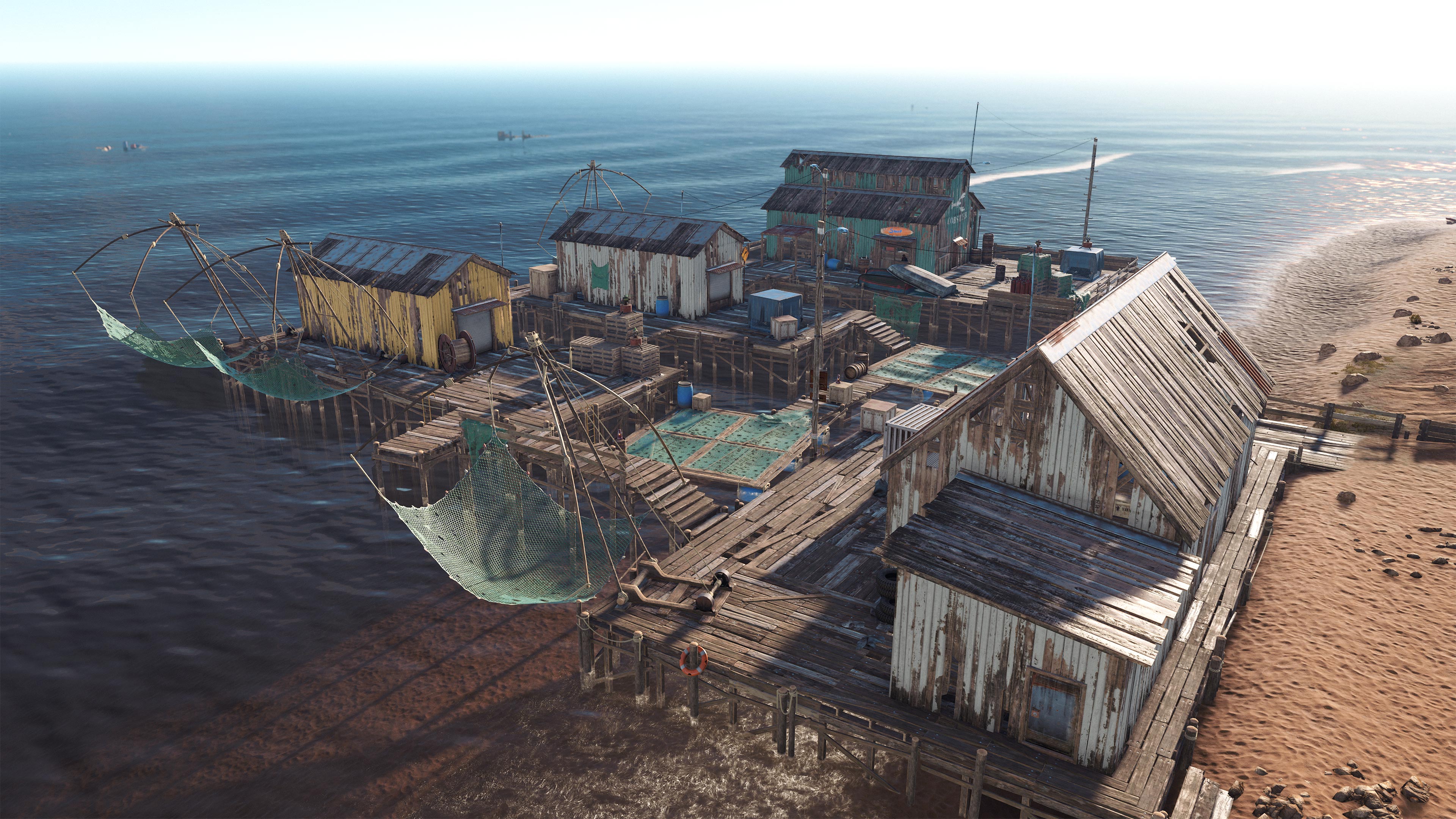
The Boat Vendor Update arrived in September 2020 and quietly rewired one of Rust's oldest routines: finding a boat. Instead of roaming the shoreline hoping to stumble on a seaworthy vessel, you could now simply buy one - and if you were broke, a new paddle-powered option let you take to the seas the primitive way. Add the Rust+ Storage Monitor, a round of electricity upgrades and a hefty performance pass, and this was a patch with something for everyone.
Fishing Villages
Three new Fishing Villages of varying sizes were scattered around the map, and boats stopped spawning procedurally along beaches entirely. Instead, the Boat Vendor at these villages sells a Rowboat for 200 or a RHIB for 400. Fishing villages are safe zones - hostile action results in a swift death - and they also sell each piece of scuba gear, plus a budget option: the blueprint for the new Kayak and Paddle, letting you craft your own transport any time.
Facepunch flagged this as the start of a bigger direction: more NPC villages were planned ("stables anyone?"), and a mission system was in the works to let players acquire items and blueprints through means other than pure scrap farming - with mission providers likely appearing at these micro-monuments first.
Kayak and Paddle
The Kayak is a craftable vessel placed in the water like the Sunburn DLC boogie boards. Sit on it and propel yourself with the Paddle: LMB paddles left, RMB paddles right, so forward travel means alternating strokes, and holding S while paddling slows you down or reverses. The Paddle is technically a weapon, and a wonderfully Rust one - off the kayak it doubles as a melee weapon and can even be thrown.
Storage Monitor and Electrical Upgrades
The Storage Monitor is a new electric deployable that integrates with the Rust+ companion app. Deploy it onto a Tool Cupboard or Large Wooden Box and the app shows your remaining upkeep and the container's contents. It also outputs a pulse of electricity whenever items are added or removed, so you can wire it into traps and alarms - just make sure your Rust+ app is up to date.
Other electrical changes rounded out the theme:
- The Door Controller gained a passthrough electric output, making multi-controller circuits far less of a headache
- The Searchlight now runs on electricity (10 power) instead of low grade fuel - a long-planned conversion
- Reactive Targets got four optional electrical connections, working like a pressure pad: Lower and Reset inputs, a Power In, and a Power Out that passes (Power In - 1) while the target is lowered - and lowering the target sends a brief 1-power pulse even with no input
Vehicles and Workbenches
Modular Car cockpits now have window glass providing additional protection, particularly in the armoured module, and RHIB physics were improved for smoother water traversal. Meanwhile Work Benches became portable - they can now be picked up and moved, a change Facepunch acknowledged would ripple through gameplay in ways they'd be monitoring. To balance it, Tier 2 and 3 Work Bench health was reduced.
Farming Improvements
Farmers got a full pass: server performance for large farms was greatly improved, Electric Heaters now warm nearby planter boxes (making cold-biome farms viable), and holding RMB over a valid plant gives quick access to the clone option for mass-cloning without menu-diving. Water flow now splits evenly between multiple outputs - a Water Barrel feeding a splitter into three barrels distributes evenly - the maximum flow range between entities was extended so long chains work, and the Powered Water Purifier stops converting when its output is full and resumes automatically when space appears. Even tea got a buff via the changelist: drinking tea now hydrates.
Performance: Unity 2019 LTS, Pooling and Gibs
Under the hood, Rust upgraded to Unity 2019 LTS - the long-term support release you're actually supposed to ship games on - with hopes of staying on LTS versions going forward. The newer farming, electricity and fluid entities all gained pooling support, significantly reducing framerate drops when moving around high-population servers.
The gib system - the little chunks spawned when objects are destroyed (a twig wall spawns 20 of them) - was reworked to pool and reuse gibs rather than creating and destroying them constantly, and most building-block gibs switched to simple collider shapes instead of complex meshes. In testing, the new system spawned objects twice as fast while using less memory, which should mean fewer frame hitches during raids. Flares (the bright light effects) moved largely to the GPU with LOD support, animator counts in the benchmark demo dropped from 150-350 active to 30-150, and wasted UI text processing was trimmed. A nice bonus from the flare work: all light sources now illuminate the ore hotspot minigame marker at night, not just the miner helmet.
The full changelist adds a healthy fix list - garage doors no longer get stuck closed with a vehicle nearby, AFK players can't block vending machines anymore, and conditional roof exploits were closed. Fittingly for such a nautical patch, the kayak instantly inspired matching cosmetics - the Kayak Helmet, Kayak Vest and Lifejacket Sleeping Bag among them - all of which you can track on our skin tracker. And with fishing villages established and missions teased, this update planted seeds that would grow for years.